
- Apply
- Visit
- Request Info
- Give


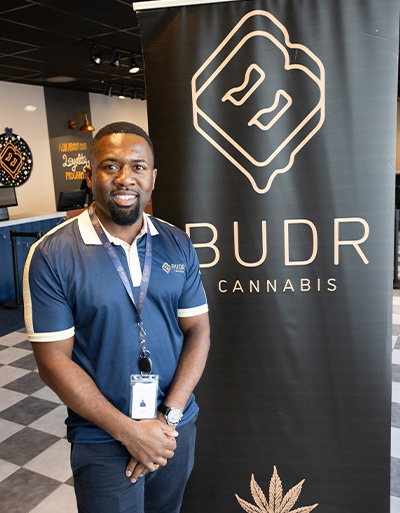
After founding the Middletown-based home healthcare agency Change Inc., entrepreneur Derrick Gibbs ’08 is setting roots in Connecticut’s newest industry: recreational cannabis.
One year since the state’s January 2023 legalization of recreational cannabis, Gibbs and co-founder Carl Tirella Jr. have opened a chain of adult-use retail stores under the name Budr Cannabis, focusing on destigmatizing cannabis use and providing education to customers.
Budr currently operates two retail-only stores in Danbury and West Hartford, with a third on its way in Tolland and three more in the pipeline for Bridgeport, Stamford and Stratford.
The two business partners exercise caution when approaching municipalities with their business plan. “There’s a lot of fear and pushback over who the customer base might be,” said Gibbs, “... over the (supposed) characters who would come to the store.”
Nonetheless, Gibbs has found their customer base to be the most diverse clientele he’s worked with, catering to a wide range of ages and ethnic backgrounds.
Addressing concerns from the community, Gibbs highlights the professional and respectable appearance of Budr's stores, designed to counter skepticism and convey a serious business image, steering away from stereotypical pot leaves and neon signs.
As a social-equity venture — one of the state’s classifications for cannabis businesses — Budr has a company-wide goal to employ 50% people of color. Additionally, each store under the Budr umbrella supports different social causes, such as homelessness in greater Tolland and sponsoring summer camps in West Hartford.
Educating customers is a core focus for Gibbs and Tirella. Although their stores are for recreational cannabis, their goal is to share medical information with the broader market, providing valuable insights into the effects of different cannabinoids and terpene profiles. The duo noted that customers come into their stores seeking relief for a range of issues, including anxiety, sleep problems, depression and nausea.
While they cannot make medical or health claims, Budr staff members, known as “bud-tenders,” do make recommendations. “Our job is to educate and recommend products based on customers’ desired effects,” said Tirella.
However, the cannabis industry comes with its fair share of challenges. Despite legalization at the state level, cannabis remains a Schedule 1 controlled substance federally, posing hurdles in banking, lending and insurance. As the state rolls out its recreational market, thousands of business applicants are competing for a limited number of licenses. Zoning issues, moratoriums in towns and restrictions on marketing further complicate the business landscape.
“I know of no other business with so many barriers to entry,” said Gibbs, adding that state and municipal taxes total up to 30%, and substantial upfront costs for security and infrastructure create additional hurdles.
Gibbs’ entrepreneurial spirit was fostered during his time at Eastern as a business administration major and as the founder of Change Inc. He sees coping as the common thread between his two ventures, whether he is helping home health clients develop strategies or Budr customers find stress relief through cannabis.