
Skip to Main Site Navigation Skip to Content Skip to Footer
Back To Top

Honorary Degrees

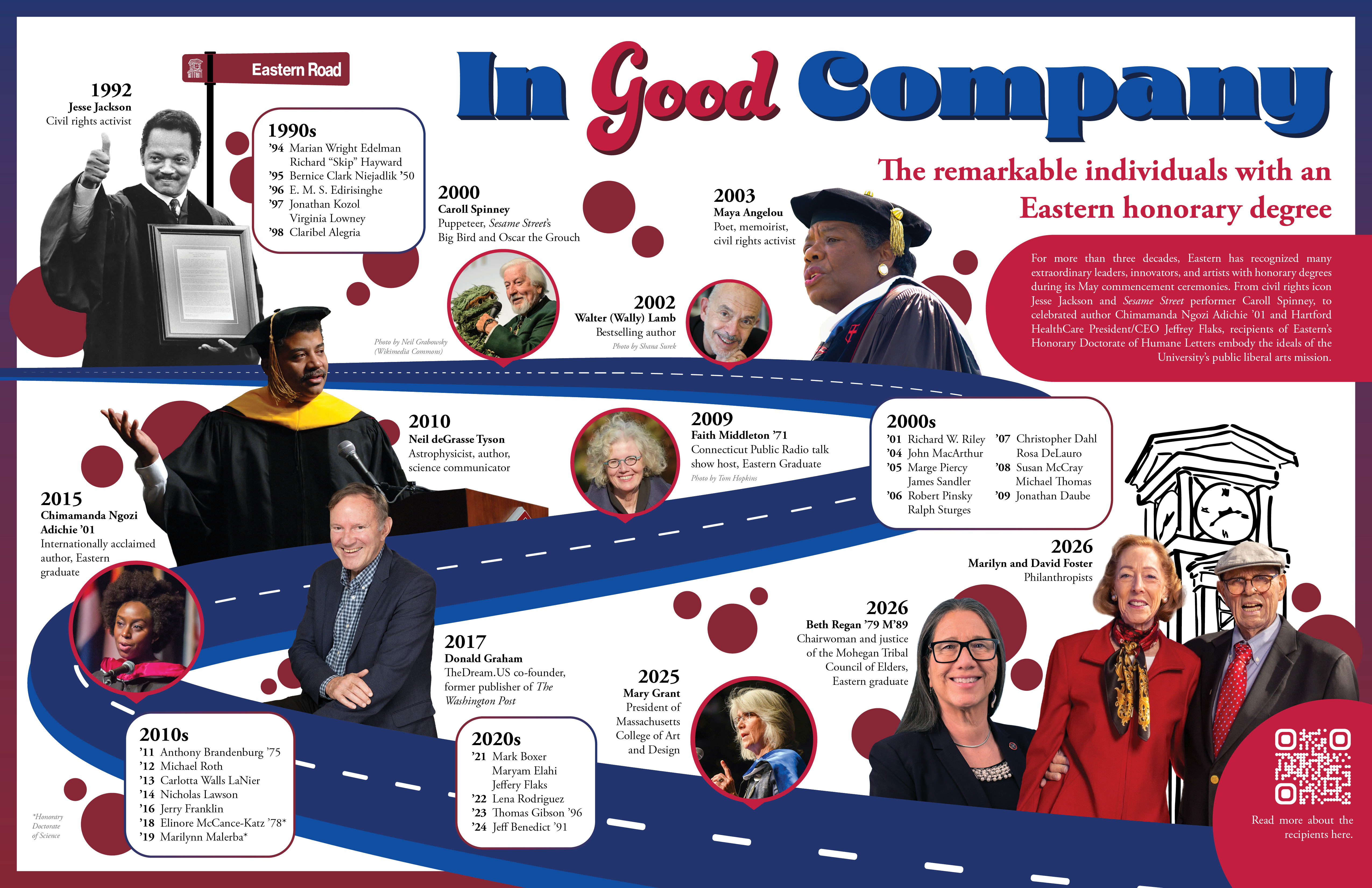
For more than three decades, Eastern has recognized many extraordinary leaders, innovators, and artists with honorary degrees during its May commencement ceremonies. From civil rights icon Jesse Jackson and Sesame Street performer Caroll Spinney, to celebrated author Chimamanda Ngozi Adichie ’01 and Hartford HealthCare President/CEO Jeffrey Flaks, recipients of Eastern’s Honorary Doctorate of Humane Letters embody the ideals of the University’s public liberal arts mission.

Honorary Degree Recipients

2026

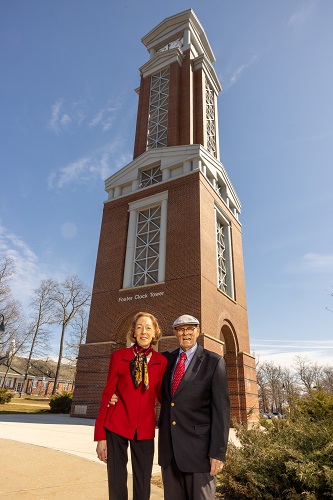
  • David and Marilyn FosterDavid and Marilyn Foster have demonstrated a lifelong commitment to community, philanthropy, and expanding educational opportunity across eastern Connecticut. Their leadership and generosity have had a lasting impact on the Town of Windham and the surrounding region, supporting organizations such as Windham Hospital, Windham Public Schools, the Salvation Army of Willimantic, Covenant Soup Kitchen, Project HOPE,

    Windham Area Interfaith Ministry, Horizons, the Lions Club, Veteran’s Memorial Park, and Eastern Connecticut State University.

    Through the Lester E. Foster and Phyllis M. Foster Foundation, the Fosters have made significant and sustained contributions to Eastern. Their support includes a $250,000 gift to the David G. Carter Jr. Endowment Fund, building on more than $125,000 in prior investments in scholarships, academic programs, and student initiatives. Since 2008, Marilyn Foster has served as a director of the foundation, helping guide its philanthropic mission and stewardship.

    David Foster’s impact on the region also extends through a distinguished career in music. As co-owner of the Shaboo Inn, he brought more than 3,000 concerts to northeastern Connecticut, hosting artists such as B.B. King, The Police, Muddy Waters, and Tom Petty. He later formed the Shaboo All-Stars and continues to support charitable causes through benefit performances and community events.

    Among his honors, David Foster was named Willimantic’s Citizen of the Year in 2019, inducted into the Mohegan Sun Hall of Fame in 2015, and received the Connecticut Blues Society Lifetime Achievement Award in 2012. In 2015, the Connecticut Association of Schools recognized him with the Distinguished Friend of Education Award, an honor that also reflects Marilyn Foster’s longstanding dedication to education. In recognition of their enduring contributions to community and education, David and Marilyn Foster received Honorary Doctorates of Humane Letters from Eastern Connecticut State University in 2026.
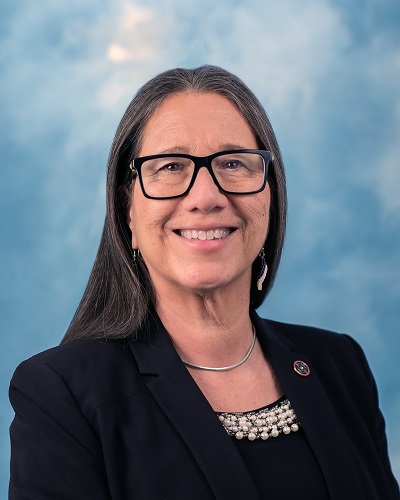
  • Beth ReganBeth Regan ’79, M’89 is an Eastern Connecticut State University alumna, educator, coach, and dedicated community leader whose career reflects a lifelong commitment to service, cultural education, and student development. A proud member of the Mohegan Tribe, she has served on the Tribe’s Council of Elders for more than a decade and, since 2024, as chairwoman, helping to guide and preserve Mohegan traditions and values.
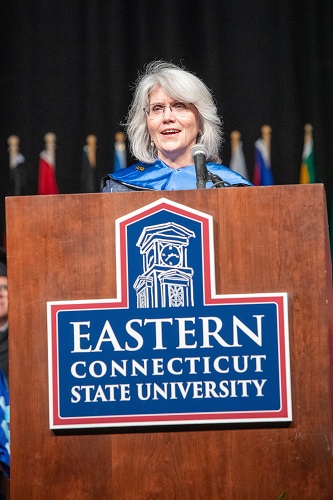
    Regan spent more than 35 years as a teacher at Tolland High School, where she specialized in Native American studies and Russian history. Across her work in the classroom, in Tribal leadership, and in athletics, she has been guided by the belief that understanding fosters empathy. Inspired by the words of Mohegan Chief Harold Tantaquidgeon — “It’s harder to hate someone whom you know a lot about” — she has worked to expand cultural awareness and respect for diverse perspectives.

    In that spirit, Regan has developed and shared curriculum on Mohegan history and culture for educators across Connecticut, offering free resources, leading workshops, and building partnerships between the Mohegan Tribe and the broader community. She also served as a consultant in the development of Eastern’s inaugural Land Acknowledgement in 2025.

    Athletics have been a central part of Regan’s life and legacy. She founded Eastern’s women’s soccer program and has coached soccer and basketball at the high school and collegiate levels. A passionate advocate for inclusive athletics, she has devoted 40 years to Special Olympics as a coach and volunteer, including decades of involvement with Unified Special Olympics Soccer and the creation of a Unified Basketball Program at Tolland High School.

    Regan’s many honors include multiple recognitions as Teacher of the Year and Coach of the Year. She has been inducted into the athletic halls of fame at Eastern Connecticut State University, the Connecticut Soccer Hall of Fame, New Britain High School, and the Connecticut Girls Soccer Association. She earned both her bachelor’s degree in history and education and her master’s degree in human relations from Eastern.

    She has also served on the Mohegan Tribe’s Board of Education and the Tribe’s Language Committee, supporting efforts to reclaim and preserve the Mohegan language for future generations.

2025

  • Mary K. GrantMary Grant is a nationally recognized leader in public higher education with more than 30 years of experience. Known for her commitment to access, equity, and the power of creative education, she has spent her career expanding opportunities for students and strengthening the role of higher education in building stronger communities.
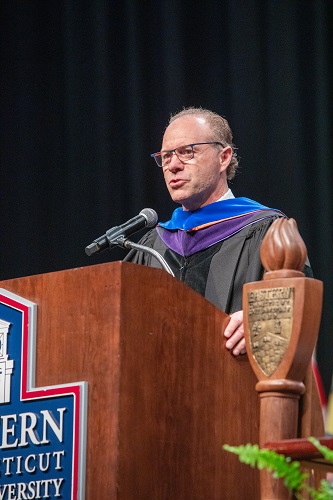
    She currently serves as President of Massachusetts College of Art and Design — the nation’s only independent public college of art and design — where she brings a clear vision, deep care and a lifelong belief in the value of creativity. A dedicated advocate for public colleges and universities, she has also led the University of North Carolina Asheville as Chancellor and served more than a decade as President of her alma mater, the Massachusetts College of Liberal Arts (MCLA), advancing civic learning, student success and institutional growth.

    President Grant also served as chair of the board of the Council of Public Liberal Arts Colleges (COPLAC) Throughout her career, she has emphasized that education is not only about earning a degree — it’s about discovering purpose and preparing for a meaningful life. She is a strong voice for public service, civic dialogue and the role of education in shaping the next generation of citizens and leaders.

    Beyond campus, Grant contributes her leadership to several regional and national organizations. She is vice chair of the board of the Norman Rockwell Museum, chair of the National Campus Compact Board, secretary of the Association of Independent Colleges of Art and Design, and serves on advisory and nominating panels for EdVestors, Boston Public Schools and the Greater Boston Chamber of Commerce. She’s also a regular guest on GBH’s The Culture Show with Jared Bowen.
    President Grant’s previous roles include president and CEO of the Edward M. Kennedy Institute for the United States Senate and senior administrative fellow for civics and social justice at the Martin Richard Institute at Bridgewater State University. In every role, she’s worked alongside students, faculty and community members to lead with creativity, care and purpose.
    A first-generation college graduate, Grant understands firsthand the impact of higher education — and continues to champion its promise every day.

2024

  • Jeffrey R. BenedictJeff Benedict ’91 is an American author, a special features writer for Sports Illustrated, and a television and film producer. He has written for the New York Times and the Los Angeles Times, and his stories have been the basis for segments on 60 Minutes, 20/20, CBS Sunday Morning, CBS Evening News, the NFL Network, HBO Real Sports, Good Morning America, 48 Hours and the Discovery Channel.
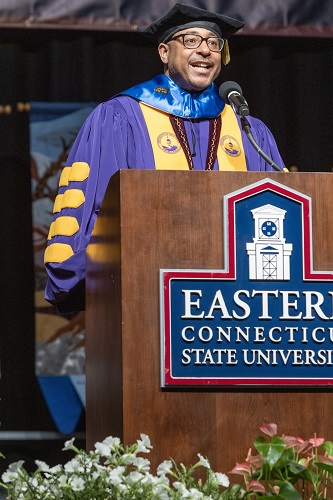
    Benedict is a #1 New York Times best-selling author of 17 nonfiction books and more than 100 published stories and essays. He has written books and stories on Indian casinos, violence against women, ancient skeletons, retired Duke basketball coach Mike Krzyzewski, eminent sexual assault, David Crosby, Kobe Bryant and a company purchased by Warren Buffett. Benedict’s 2023 book, “Poisoned,” was the basis of a Netflix documentary that Benedict wrote and co-produced.

    “The Dynasty” — Benedict’s detailed story of the New England Patriots published in 2020, has been turned into a 10-part docuseries for Apple+. Executive produced by Benedict, Brian Grazer and Ron Howard, the series premiered on Feb. 16, 2024. Benedict spent five years inside the Patriots organization, where he was given broad access. In the story, which tells the 20-year saga of Robert Kraft, Bill Belichick and Tom Brady, Benedict documents the Patriot’s historic journey of success, and examines such controversies as Deflategate along the way.

    His most recent book is a biography of LeBron James, published in April 2023. In 2018, Benedict co-wrote the #1 New York Times bestselling biography of Tiger Woods. In 2021, the book was the basis of a 2-part documentary on HBO, with Benedict serving as an executive producer. The book is currently being developed into a scripted television series, which Benedict is also executive producing.

    In 2016, Benedict wrote the national bestseller “QB: My Life Behind the Spiral,” the autobiography of Hall of Fame quarterback Steve Young. He was also a writer and creative consultant for “Steve Young: A Football Life” which was based on the book and aired on the NFL Network in 2016.

    Before becoming a journalist, Benedict was the director of research at the Center for Study of Sports and Society at Northeastern University, where he conducted groundbreaking research on athletes and violence against women. In graduate school he published a series of studies on violence against women. While in law school, he worked as an assistant to the chief prosecutor in the child victims unit at the District Attorney’s office in Boston.

    In 2003, Benedict partnered with Connecticut Attorney General Richard Blumenthal and founded the Connecticut Alliance Against Casino Expansion, a non-profit corporation that led the effort to repeal Connecticut’s Las Vegas Nights law. Benedict also led the effort to prevent Donald Trump and other casino moguls from constructing casinos in Connecticut.

    Benedict’s book “My Name Used to be Muhammad” is the biography of a fundamentalist Muslim from Nigeria who was persecuted and imprisoned for converting to Christianity. It was a Book of the Year finalist in 2013. Also in 2013, he published “The System: The Glory and Scandal of Big-Time College Football,” co-written with Armen Keteyian. He is also an executive producer for the motion picture “Little Pink House,” based on his book of the same name that was published in 2009.

2023

  • Thomas GibsonThomas Gibson became the 15th chancellor of the University of Wisconsin-Stevens Point on Jan. 11, 2021. Dr. Gibson is a 1996 graduate of Eastern Connecticut State University, majoring in Communication. In his role as chancellor, Dr. Gibson is focused on three key goals to achieve student success: ensuring academic excellence, expanding inclusive excellence, and increasing enrollment and growth.
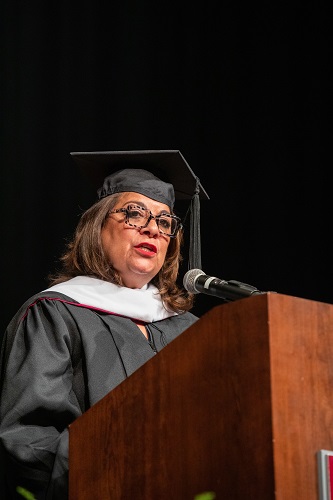
    In his first year, highlights included the launch of an online and graduate program enrollment growth initiative; the opening of the Center for Inclusive Excellence at the University of Wisconsin-Stevens Point campus in Marshfield, WI; and a process to provide first-year students with applied learning experiences. Within his first month at UW-Stevens Point, Dr. Gibson created the Chancellor’s Commission on the Ancestors Buried Below Us to expand educational opportunities for Native students, families and communities.

    Early in his tenure, Chancellor Gibson’s leadership resulted in UW-Stevens Point receiving state approval and $96 million to replace Albertson Hall, which housed student support services and the library collection. The university also received several major gifts that give students greater hands-on opportunities, including a land donation to support College of Natural Resources programs; a cello and music advocacy faculty fellowship; and the Skyward Internship Center located on campus. New programs include a community sustainability major, a doctorate in physical therapy, and certificates in Inclusive Excellence and Native American and Indigenous Studies.

    Prior to joining UW-Stevens Point, Dr. Gibson served as vice president for student affairs and vice provost at Bowling Green State University in Bowling Green, OH, from 2016–2020. In that role, he advocated for the academic and social development of students, devised institutional policies, engaged in strategic planning, led student success efforts and oversaw diversity, equity and inclusion. He also supported an increase in record student retention and helped raise $8 million in collaboration with the University Advancement team.

    Dr. Gibson has held numerous positions to enhance student success and diversity in higher education. He was associate vice president of Student Affairs at Ball State University in Muncie, IN. He held several roles at York College, City University of New York in New York City, including associate dean for student development. He also led academic support services at Queens College/CUNY and the University of Connecticut at Stamford.

    Dr. Gibson has taught graduate courses in higher education and English and undergraduate interdisciplinary programs. He completed his master’s degree in education from University of New Haven, CT, and his doctorate in educational leadership in higher education at Johnson and Wales University in Providence, RI.

    Dr. Gibson grew up in New Haven, CT, and enjoys reading, theatre, live music and traveling. He and his wife Brigette are the proud parents of their daughter Kennedy.

2022

  • Lena RodriguezLena Rodriguez has dedicated her professional career to helping people build better lives for themselves. With a heartfelt passion for CRT’s mission of “Preparing Our Community to Meet Life’s Challenges,” she provides outstanding leadership to CRT in meeting unmet needs in the community.
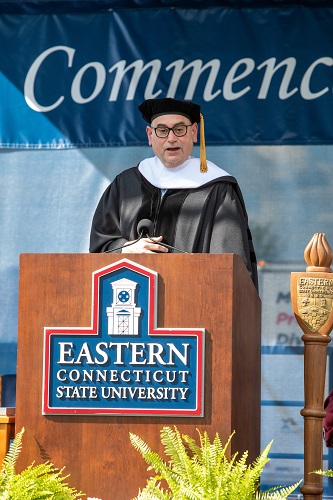
    Rodriguez is consistently focused on maximizing services that will benefit the people of central Connecticut. As CRT’s Chief Executive Officer, she has taken the lead on several large-scale, innovative projects dedicated to helping people in need, including CRT Generations, a housing development in Hartford for grandparents with legal custody of their grandchildren; Veterans Crossing, a transitional residence for homeless veterans located in East Hartford; and The Retreat, a unique affordable assisted living facility in the heart of Hartford for 100 low-income seniors. She also worked tirelessly to preserve vital mental health and addiction services in Hartford, creating a licensed and accredited Behavioral Health Services unit at CRT that is accessible to people from all income levels, regardless of whether or not they have health insurance.

    In 2019, Rodriguez realized a lifelong dream when she led the official opening of CRT’s Women’s Empowerment Center on Market Street in Hartford. For more than 10 years, the majority of CRT clients have been women and girls. Today, with a range of hands-on services and personal mentoring for its members, the Women’s Empowerment Center is helping women succeed and realize their potential.

    Prior to joining CRT, Rodriguez worked for a decade at the New York City Board of Education as director of finance for the Division of Special Education, serving a population of more than 20,000 students and managing a $450 million annual budget.

    Rodriguez works closely with funding sources, elected officials and key stakeholders at CRT to foster long-lasting relationships that help to increase the resources and services available to individuals and families throughout central Connecticut.

    As a result of her dedication and talents, CRT has received numerous awards for excellence from local, state and national groups. In setting high standards for herself and her team Rodriguez has successfully led the organization through accreditation by third-party national organizations such as the Joint Commission and the National Association for the Education of Young Children.

    Rodriguez received her Master of Science from Rensselaer Institute in Hartford, Connecticut, and her undergraduate degree in International Business from Bernard Baruch College.

    She also serves on the boards of several area nonprofit organizations. Rodriguez is also an

    avid golfer and helped establish the Connecticut Latinas Golf Team.

2021

  • Mark BoxerDr. Mark Boxer served as Cigna's Global Chief Information Officer (CIO) from April 2011 until June 2020. On June 2, 2020, he began a new position as executive vice president chief operating officer at the University of Hartford.
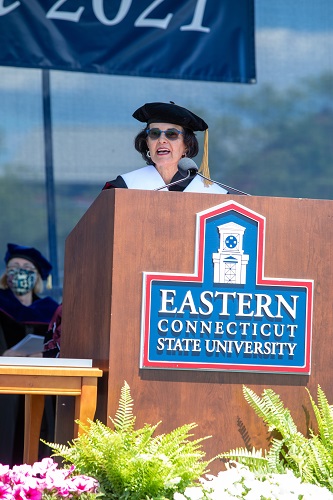
    As the chief operating officer at the University of Hartford, Boxer oversees finance, facilities, information technology, and human resources. Boxer helps manage and direct the strategic plan of the University, while further developing critical partnerships with the community, industry, government officials, and other nonprofit organizations. He also is on the teaching faculty in addition to his administrative responsibilities.

    At Cigna he was responsible for driving Cigna’s worldwide technology strategy and overseeing the health company's technology operations, digital capabilities, analytics and ventures. 

    Prior to joining Cigna, Dr. Boxer was Group President, Government Healthcare at Xerox and served as Deputy Global CIO for the Xerox Corporation. Prior to joining Xerox, he was a member of WellPoint’s executive leadership team and served in various leadership roles at that company, including Chief Operations Officer, Chief Information Officer, President of Consumer Health Plans, and Chief Strategy Officer. Before WellPoint, Dr. Boxer was senior vice president of Information Technology and eCommerce at Cigna Healthcare and served as Chief Information Officer at Healthsource, a Cigna acquisition.  

    A champion for advancing the employment of people with different abilities, Boxer is a recipient of the American Association of People with Disabilities “Justice for All” Award along with two United States congressmen.

    Dr. Boxer is a University of Connecticut Board Trustee and sits on the Board of the Connecticut Children's Law Center. Dr. Boxer earned a Bachelor of Science degree in Engineering and a Bachelor of Arts degree in Physics from the University of Hartford. He also holds a Master of Business Administration degree in Finance from the University of Connecticut and a Master of Science degree in Information Systems from Drexel University, as well as doctorate degrees in Health Administration from the Medical University of South Carolina and in Global Public Health from Arizona's School of Health Sciences.

  • Maryam ElahiMaryam Elahi is President and CEO of the Community Foundation of Eastern Connecticut.
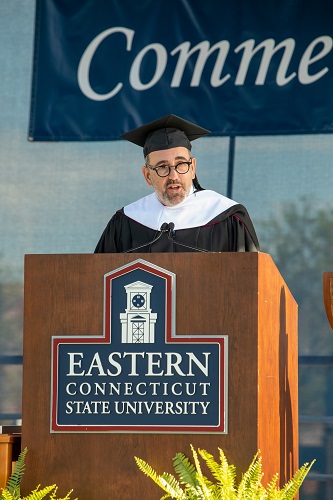
    Prior to joining the foundation in 2013 and for more than 25 years, she served in positions of leadership in the international human rights community as an advocate, teacher and grant-maker.

    Elahi was the director of the International Women’s Program at the Open Society Foundations in New York City from 2007 until 2013. She had previously been the founding director of the Human Rights Program at Trinity College in Hartford, Connecticut, establishing the first undergraduate college Human Rights Program in the United States. She taught courses on international human rights law at Trinity College, as well as at the Oxford University Summer International Human Rights Program. She served as the Advocacy Director on the Middle East, North Africa and Europe for Amnesty International in Washington, DC. from 1990 to 1997.

    Over the years, Elahi has led human rights missions to dozens of countries around the world. She is a graduate of the Fletcher School of Law and Diplomacy at Tufts University, Boston College Law School and Williams College.

    She currently serves on the boards of Connecticut Public and Connecticut Council on Philanthropy. She is also on the advisory boards of a number of international human rights organizations.

    Elahi was a former chair of the International Human Rights Committee of the American Bar Association and previously served on the boards of the Women’s Commission for Refugee Women and Children, the Center for Justice and Accountability and American Civil Liberties Union of Connecticut.

    She was honored in 2018 by the Connecticut Women’s Education and Legal Fund for her service to the communities in eastern Connecticut and for her years of service as a human rights advocate. Elahi is the recipient of the 2014 Boston College David S. Nelson Public Interest Law Award which recognizes an alumnus who has made significant contributions to the public sector or in public interest law. She was also recognized as a Global Impact Honoree by the Connecticut Women’s Hall of Fame in 2015. Ms. Elahi is a member of the Massachusetts Bar.

  • Jeffrey A. FlaksJeffrey A. Flaks has been an innovator and leader in the health care field, enhancing health care delivery and access throughout Connecticut and beyond. At Hartford HealthCare he oversees a $4.3 billion enterprise serving more than 1.7 million patients and customers.
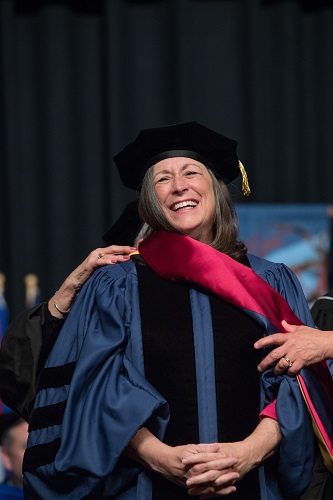
    A Connecticut native, Flaks began his tenure at Hartford HealthCare in 2004 and has served in a variety of executive and operational roles prior to his current position. Before joining Hartford HealthCare, he held leadership roles in health systems in New York and Detroit. In addition to serving on the American Hospital Association’s Health System’s Council, Flaks serves as co-chair of the Connecticut Governor’s COVID-19 Health System Response Team and was appointed to the Governor’s Workforce Council.

    Flaks’ career has been marked by significant service to the community outside of his professional role, having served on the Board of Trustees of George Washington University and now as a director of the Connecticut Science Center, Connecticut Public Broadcasting Inc., Hartford Promise and the Connecticut Hospital Association.

    He earned a master’s degree in health services administration at The George Washington University, where he is a member of The George Washington University School of Public Health Dean’s Council and the University’s President’s Advisory Council. He received a Bachelor of Science degree at Ithaca College.

2019

  • Marilynn “Lynn” MalerbaMarilynn “Lynn” Malerba, chief of the Mohegan Tribe, has achieved an exemplary career in the health care and tribal governance fields. Not only has she served her community with distinction, she has brought national recognition to the State of Connecticut.
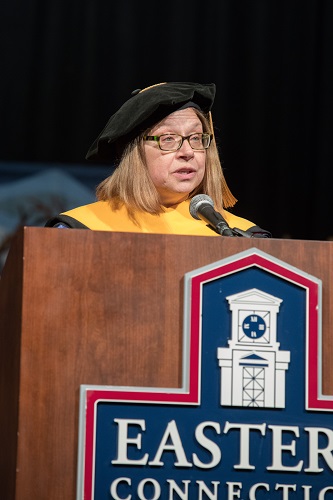
    Chief Mutáwi Mutáhash (Many Hearts) Malerba became the 18th Chief of the Mohegan Tribe on August 15, 2010, and is the first female chief in the tribe’s modern history. The position is a lifetime appointment made by the tribe’s council of elders. She previously served as chairwoman of the tribal council and was also executive director of health and human services for the tribal government.

    Prior to her work for the Mohegan Tribe, Chief Malerba had a distinguished career as a registered nurse and served as director of cardiology and pulmonary services at Lawrence and Memorial Hospital. She earned her Doctor of Nursing Practice degree at Yale University and was named a Jonas Scholar. She holds a master’s degree in Public Administration from the University of Connecticut, and has an honorary doctorate from the University of St. Joseph in West Hartford.

    Chief Malerba has achieved a national reputation as an advocate and supporter of health issues and the welfare of Native Peoples. She is chairwoman of the Tribal Self-Governance Advisory Committee of the Federal Indian Health Services; is a member of the U.S. Justice Department’s Tribal Nations Leadership Council; serves on the Tribal Advisory Committee for the National Institute of Health; is a member of the U.S. Treasury Department’s Tribal Advisory Committee; and serves as a technical expert on the Commission for Environmental Cooperation. She also serves as the United South and Eastern Tribes board of directors secretary, and is a member of the board of directors for the Ms. Foundation for Women.

    In Connecticut, Chief Malerba serves as a trustee for Chelsea Groton Bank, as a board member for the Community Foundation of Eastern Connecticut, as an advisory committee member for the Harvard University Native American Program.

    She served on the board of directors for Lawrence Memorial Hospital for 11 years.

2018

  • Elinore McCance-KatzDr. Elinore McCance-Katz graduated Magna Cum Laude from Eastern Connecticut State College in 1978 with a degree in Biology. Her sterling career in medicine, psychiatry, academic achievement and public administration culminated in August 2017 with her appointment as Assistant Secretary for Mental Health and Substance Use in the U. S. Department of Health and Human Services.
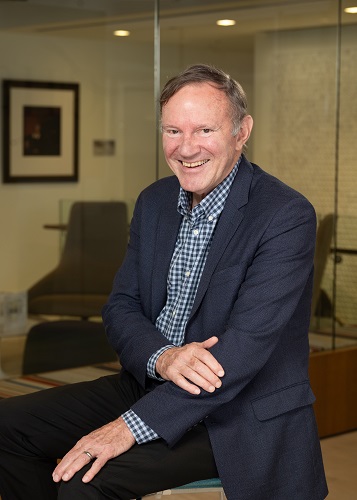
    Her appointment makes her the first Assistant Secretary-level director of the Substance Abuse and Mental Health Services Administration in the U.S. Department of Health and Human Services (HHS).

    After earning her degree from Eastern, Dr. McCance-Katz went on to earn a Ph.D. at Yale University in Infectious Disease Epidemiology in 1984, and then received her M.D. from the University of Connecticut in 1987. After completing a residency in psychiatry, Dr. McCance-Katz held teaching positions at the Yale School of Medicine, Brown University, Virginia Commonwealth University, the University of California in San Francisco, the University of Texas and the Albert Einstein College of Medicine.

    She is board certified in general psychiatry and addiction psychiatry, and is a Distinguished Fellow of the American Academy of Addiction Psychiatry, with more than 25 years of experience as a clinician, teacher and clinical researcher.

    Prior to her HHS appointment, Dr. McCance-Katz was Chief Medical Officer of the Rhode Island Department of Behavioral Health, Developmental Disabilities and Hospitals from 2015 to 2017, and also served as Professor of Psychiatry and Human Behavior and Professor of Behavioral and Social Sciences at the Alpert Medical School at Brown University.

    She also was the Chief Medical Officer of the Substance Abuse and Mental Health Services Administration for two years, State Medical Director of the California Department of Alcohol and Drug Programs from 2007-13 and Medical Director and Chief Operating Officer of the Virginia Health Practitioners’ Intervention Program from 2003-07.

    Dr. McCance-Katz has published numerous articles on clinical pharmacology and, along with her husband Michael, holds a patent for a method used to prevent specimen substitution in substance use screening.

2017

  • Donald E. GrahamDonald E. Graham is chairman of Graham Holdings Co., formerly the Washington Post Co. A graduate of Harvard College, Graham is a veteran of the Vietnam War, serving as an information specialist with the First Cavalry Division from 1967 to 1968.
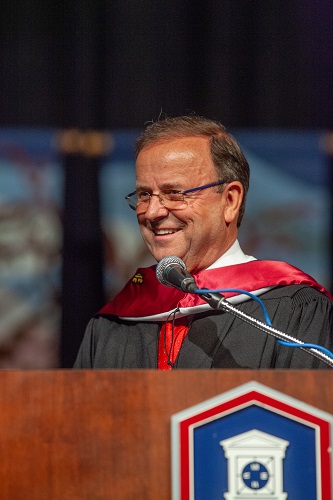
    He later served as a patrolman on the Washington, D.C., police force before joining the staff at the Washington Post in 1971 as a reporter. This was the first of several positions Graham held at the Post and at Newsweek magazine; in 1974, he joined the board of directors of the Washington Post Co., and became publisher of the newspaper in 1979, following in the footsteps of his father, Philip Graham, and his mother, Katherine Graham. He served in that capacity until 2000. In 1991, Graham took over leadership as chief executive officer of the Washington Post Co.

    In addition to his duties with Graham Holdings, Mr. Graham is a trustee of the Federal City Council. He also has served as a director of the College Success Foundation, KIPP-DC, The Summit Fund of Washington, Facebook, and was a member of the Pulitzer Prize Board.

    Graham co-founded and served as chairman of the District of Columbia College Access Program; he remains a member of the board. The program has helped double the number of District of Columbia public high school students going on to college and has helped triple the number graduating from college.

    In 2013, Graham and his wife, Pulitzer Prize-winning journalist Amanda Bennett, joined Carlos Gutierrez, former U.S. Secretary of Commerce, and Henry R. Munoz III, chairman of Munoz & Company, to co-found TheDream.US, a national scholarship fund that helps undocumented immigrant youth get access to a college education. Since its founding and as of 2017, TheDream.US had raised $91 million in scholarship funds, providing financial support to more than 1,700 college students nationwide.

2016

  • Jerry FranklinFor more than 30 years, Mr. Jerry Franklin has been the Chief Executive Officer and President of the Connecticut Public Broadcasting Network (CPBN). Franklin’s personal commitment to education and CPBN’s longstanding focus on educational programming are noteworthy, and are compatible with Eastern’s historical role as a teachers college and its current role as Connecticut’s public liberal arts university.
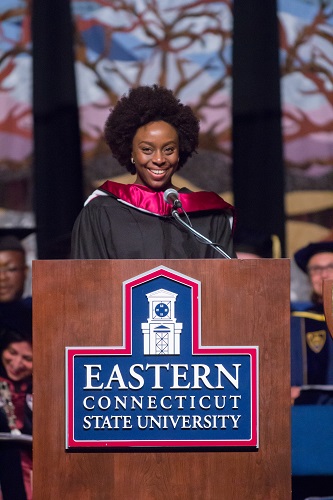
    Through CPTV, the state’s only public television broadcasting network, and WNPR, Connecticut’s leading National Public Radio affiliate, CPBN serves Connecticut as well as areas of Massachusetts, Rhode Island and New York — reaching an estimated 450,000 television viewers and 276,000 radio listeners each week.

    During his tenure at CPBN, Franklin has led a growth in programming ranging from the Infinity Hall music concert series to playing a leadership role in bringing “Barney and Friends,” “Bob the Builder” and “Thomas and Friends” to public television. Attesting to Franklin’s commitment to education, in fall 2013 CPBN opened its Learning Lab, which houses the Journalism & Media Academy Magnet School satellite campus.

    Under his leadership, CPTV has won two National Daytime Emmy Awards, 98 Regional Emmy Awards, seven CINE Golden Eagle Awards and one Gracie Allen Award. WNPR has earned two George Foster Peabody Awards, five Ohio State Awards, two Gracie Allen Awards, and more than 60 Associated Press Awards, including eight Mark Twain Awards for Overall Station Excellence.

    Franklin is also active in the community, serving as a member of the Connecticut Children’s Medical Center Foundation; a director of Southside Institutions Neighborhood Alliance; a member of the Governor’s Industry Advisory Council; a member of the Board of Trustees at Bay Path College; and a trustee of Long Wharf Theatre.

    A recipient of the National Academy of Television Arts & Sciences Silver Circle Award, Franklin earned a Bachelor of Science in Political Science and Journalism from Georgia Southern University and a Master of Arts in Telecommunications Management from Indiana University.

2015

  • Chimamanda Ngozi AdichieInternationally acclaimed author Chimamanda Ngozi Adichie ’01 grew up in Nsukka in southeastern Nigeria. Her work has been translated into 30 languages and has appeared in publications around the world. In addition, her books have been made into feature-length Hollywood movies. Her TED talks are equally notable.
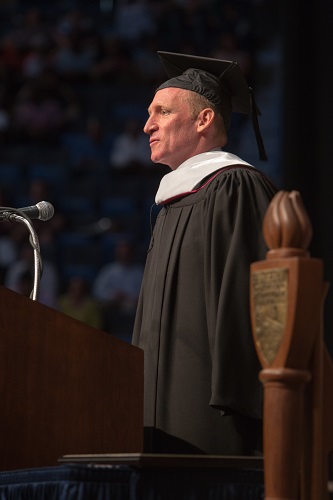
    She entered the University of Nigeria, Nsukka, to study medicine and pharmacy, leaving at the age of 19 to continue her education in the United States, but on a different path. She has been writing since the age of four; her first publication appeared when she was in secondary school in Nsukka.

    Adichie first entered Drexel University, transferring to Eastern Connecticut State University to live with her sister, a doctor based in Connecticut. She graduated summa cum laude from Eastern in 2001 with a degree in communication. In 2004, Eastern honored Adichie with its Distinguished Alumnus Award.

    Adichie subsequently earned her master’s degree in Creative Writing from Johns Hopkins University in 2003. She later studied at Yale University and graduated with a Master of Arts degree in African History in 2008. In 2008, she also was awarded a Macarthur Fellowship, popularly known around the world as the Macarthur Genius Award.

    Adichie is the author of a collection of short stories, “The Thing Around Your Neck,” and three novels. Her first novel, “Purple Hibiscus,” won the Commonwealth Writers’ Prize and the Hurston/Wright Legacy Award.

    Her second novel, “Half of a Yellow Sun, won the Orange Prize — the world’s top prize for female writers — and was also a National Book Critics Circle Award Finalist, a New York Times Notable Book, and a People and Black Issues Book Review Best Book of the Year. “Half of A Yellow Sun” was also made into a feature film, starring Thandie Newton and Chiwetel Ejiofor.

    Her novel, “Americanah,” was published around the world in 2013. It has received many accolades, including the National Book Critics Circle Award for Fiction and recognition as one of The New York Times Ten Best Books of the Year in 2013. “Americanah” is set to be adapted into a movie starring Lupita Nyong’o and David Oyelowo.

    In 2015, Adichie was named one of Time Magazine’s 100 Most Influential People in the World.

    In addition to her writing, Adichie has been invited to speak on many occasions around the world. Two of the most notable are TED Talks. The first, “The Danger of a Single Story,” was delivered in 2009 and is now one of the Top Ten most-viewed TED Talks of all time. The second, “We Should All Be Feminists,” has started a worldwide conversation about feminism, picking up even greater inertia after it inspired the song “Flawless” by Beyoncé.

    Adichie is committed to assisting young aspiring writers. As one of her commitments, she started an Annual Writers Workshop in Nigeria that draws applications come from around the world. Her deep love for her country is evident in her work, and in 2011 the Nigerian Government awarded her the Global Ambassador Achievement Award.

2014

  • Nicholas LawsonNicholas Lawson began working for Doctors Without Borders in 1997 as a logistical and administrative expert during Sudan’s civil war. Since then he has held 11 other positions within the organization, which have taken him on humanitarian missions across the globe.
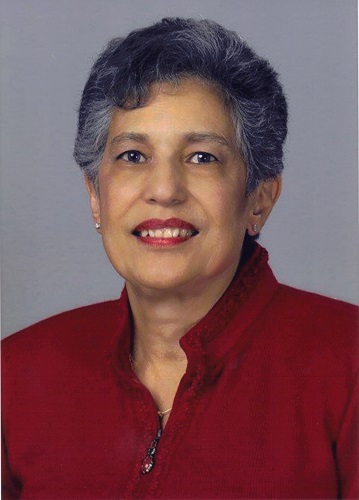
    As Director of Field Human Resources for MSF since 2007, Lawson is responsible for the oversight of 35,000 staff across the globe, and leads the development and implementation of MSF’s vision as a member of the Executive Management team.

    In 2013 in Uganda, Lawson coordinated MSF’s medical, logistical, administrative and security response to the Kamango/Bundibugyo refugee crisis on the Uganda/Congo border. In 2011, he coordinated a similar mission at an MSF surgical hospital in Hangu on the Pakistan/Afghanistan border.

    In 2006, Lawson was Head of Mission for a project to provide HIV-related hospital care to the population of the Chiradzulu district in Malawi. Also in 2006, he was Emergency Coordinator for MSF’s efforts following the earthquake in Pakistan. Over the years, he has traveled to and coordinated humanitarian and medical relief efforts in Burundi, East Timor, South Sudan, and Afghanistan.

    During his years with MSF, Lawson has risen through the organizational ranks from logistician to field coordinator, logistical coordinator and finally head of mission. Lawson’s extensive field experience prepared him for the headquarter role of Recruitment Officer for Field Human Resources at MSF-Australia in Sydney. Today, he continues to use these skills to lead the New York-based human resources team that recruits and places U.S. medical and non-medical staff in MSF projects.

    Lawson continues to play an essential role in promoting the Nobel Prize-winning organization’s mission to provide assistance to populations in distress, to victims of natural or man-made disasters, and to victims of armed conflict, irrespective of race, religion, creed or political convictions.

    Prior to joining MSF, Lawson worked in the finance, construction, education, and hospitality industries in Australia and other locales. He studied anthropology at the University of Western Australia.


    Médecins sans Frontières/Doctors without Borders was founded in 1971 to provide emergency medical care to people in areas of the world impacted by natural or manmade disasters, war, epidemics and other health emergencies. The organization’s beginnings were in Biafra in 1968, when a group of two doctors, two clinicians and two nurses volunteered to provide assistance during the civil war there. Other emergency missions followed to Nicaragua, Honduras, and Cambodia. Since its inception, the organization has provided care to more than 100 million people. In 2012, 8.3 million people around the world were treated by MSF. In 2014, MSF had offices in 28 countries and employed 30,000 people; the MSF-USA offices opened in 1990. MSF’s guiding principle: “Go where the patients are.”

2013

  • Carlotta Walls LaNierCarlotta Walls LaNier made history as the youngest of nine African-American students who desegregated Central High School in Little Rock, Arkansas, in 1957. The students, who faced harassment, intimidation and threats, became known around the world as the Little Rock Nine. With great courage and determination, they changed the face of American education forever. After Arkansas Governor Orval Faubus closed Little Rock’s high schools in 1958 to avoid further integration, LaNier was forced to sit out her junior year and take correspondence courses. However, she was one of the two members of the original nine students who returned to Central in 1959. On May 20, 1960, she became the first African American female student to participate in a graduation ceremony at Central.
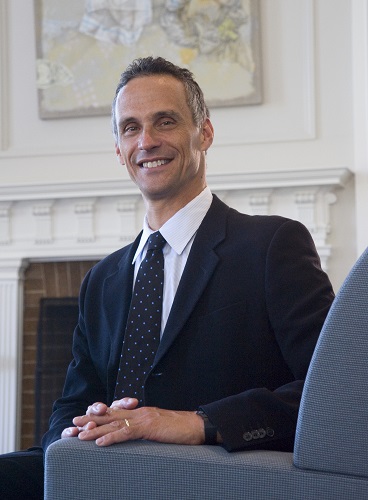
    After graduating from Central High School in 1960, LaNier studied at Michigan State University for two years. In 1968, she earned a BS from Colorado State College (now the University of Northern Colorado) and began working at the Young Women’s Christian Association (YWCA) as a program administrator for teenagers. In the 1970s, she founded her own real estate brokerage company and has worked in that industry for 38 years. Her real estate experience ranges from construction and remodeling to marketing and selling.

    LaNier was awarded the prestigious Spingarn Medal by the National Association for the Advancement of Colored People (NAACP), along with the other Little Rock Nine and Daisy Bates.. She has also served as president of the Little Rock Nine Foundation, a scholarship organization dedicated to ensuring equal access to education for African Americans, and is a trustee for the Iliff School of Theology and the University of Northern Colorado. LaNier, along with the other members of the Little Rock Nine, received the nation’s highest civilian award, the Congressional Gold Medal, from President Bill Clinton in 1999. She also has received honorary degrees from the University of Northern Colorado and Iliff School of Theology. In 2004, LaNier was inducted into the Colorado Women’s Hall of Fame. LaNier has been active in the Colorado Aids Project, Jack and Jill of America, the Urban League, the NAACP and the National Diversity Council for Youth Committee.

    LaNier is the author of “A Mighty Long Way, My Journey to Justice at Little Rock Central High School,” a memoir has been adopted by a number of universities for their first-year reading list. The Associated Press has said, “LaNier tells her story with eloquence, dignity, and a riveting sense of urgency,” and Congressman John Lewis calls the book “a marvelous personal account that describes a moving period in the transformative struggle for civil rights and social justice in America.” In the book’s foreword, President Bill Clinton writes, “’A Mighty Long Way’ will make you ashamed and proud, angry and hopeful, heartsick and happy…[it is] a story we all need to know.”

2012

  • Michael S. RothMichael S. Roth, President of Wesleyan University, is a 1978 graduate of Wesleyan, and took office as president on July 1, 2007. Prior to his appointment at Wesleyan, Roth was the president of California College of the Arts; he is also known as a historian, curator and author.
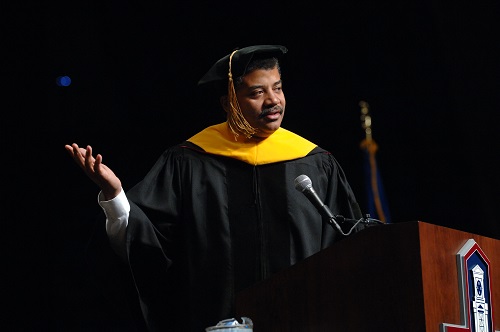
    A professor in history and the humanities since 1983, Roth was the founding director of the Scripps College Humanities Institute in Claremont, CA, a center for intellectual exchange across disciplines. He developed a reputation as a leader in the arts community through his accomplishments as associate director of the Getty Research Institute in Los Angeles and his success as President of the California College of the Arts in enhancing that institution’s academic quality, national reputation and financial strength.

    Roth has authored five books: “Psycho-Analysis as History: Negation and Freedom in Freud” (Cornell University Press, 1987, 1995); “Knowing and History: Appropriations of Hegel in Twentieth Century France” (Cornell, 1988); “The Ironist’s Cage: Trauma, Memory and the Construction of History” (Columbia University Press, 1995); “Irresistible Decay: Ruins Reclaimed,” with Clare Lyons and Charles Merewether (Getty Research Institute, 1997); and “Memory, Trauma, and History: Essays on Living with the Past” (Columbia University Press, 2011).

    “Irresistible Decay” stemmed from the exhibition of the same name that he co-curated for the opening of the Getty Museum. He also curated the exhibition “Sigmund Freud: Conflict and Culture,” which opened at the Library of Congress in 1998. Roth has edited and co-edited numerous journal issues and books, and in recent years, has published essays and book reviews in such publications as the San Francisco Chronicle, the Los Angeles Times, Book Forum, Rethinking History, and Wesleyan's History and Theory.

    A native of Brooklyn, New York and a member of the first generation of his family to attend college, Roth designed his own major in “history of psychological theory” at Wesleyan and wrote a thesis titled “Freud and Revolution,” which served as the foundation for his first book and the basis of the Library of Congress exhibition. He completed his undergraduate studies in three years, graduating with University Honors, summa cum laude and Phi Beta Kappa, and went on to earn his doctorate in history at Princeton University in 1984.

    Since becoming the President of Wesleyan, Roth has increased grant support for its students who receive financial aid and undertaken a number of initiatives that have energized the curriculum. In 2009, the energy-efficient Allbritton Center opened as the home to two new programs: The Allbritton Center for the Study of Public Life, which links intellectual work on campus to policy issues nationally and internationally, and the Shapiro Creative Writing Center, which brings together students and faculty seriously engaged in writing. Roth has also overseen the launch of a multidisciplinary College of the Environment and efforts to anchor civic engagement in the University’s culture.

2011

  • Anthony J. Brandenburg currently serves as Chief Judge of the Intertribal Court of Southern California. He has more than 16 years of service on the bench in both municipal and superior courts.

    As has been the case with many Eastern students, Judge Brandenburg was the first of his family to attend college, and was a non-traditional student balancing the challenges of work and family.

    He served in the United States Marine Corps and received an Associate’s Degree from Palomar College in 1965. Judge Brandenburg earned his Bachelor of Science Degree in Education from Eastern Connecticut State University in 1975, and went on to earn his Master of Arts Degree in Education from the University of Connecticut and his law degree from Thomas Jefferson University.

    Judge Brandenburg has worked as an attorney in private practice, specializing in criminal law, business contract law, and labor, family and juvenile law. He was appointed to the California Municipal Court in San Diego where he conducted numerous settlement conferences and established a mediation hotline program for settling civil disputes. He was later elevated to the Superior Court as a commissioner. In 2004, having retired from the Superior Court, he was appointed as Chief Judge of the Intertribal Court of Southern California where he currently presides. In this capacity, he brings more than 25 years of experience in the field of Native American law to resolve disputes involving contracts, employment, environment, evictions/exclusions, gaming, intertribal, land use, personal injury and various other tribal issues. He is also an educator and faculty member at the National Judicial College in Indian Law. He created and taught a program in which he has trained over 700 Pro Tem judges, and has testified before the U.S. Senate Subcommittee on Indian Affairs.

    Judge Brandenburg has been the recipient of such awards as the Spirit of Luiseno Award by the Rincon Band of Mission Indians in 2008 and the Restorative Justice Mediation Award by the Amicus Project in 2007. He is a member of the National American Indian Court Judges Association, the California Judges Association, and the California Bar Association. He is a past president of the San Diego County Judges Association and of the California Court Commissioners Association.

2010

  • Neil deGrasse TysonNeil deGrasse Tyson was born and raised in New York City. Educated in the New York Public School System, Dr. Tyson graduated from the Bronx High School of Science and went on to earn his B.A. in physics from Harvard University and his Ph.D. in astrophysics from Columbia University.
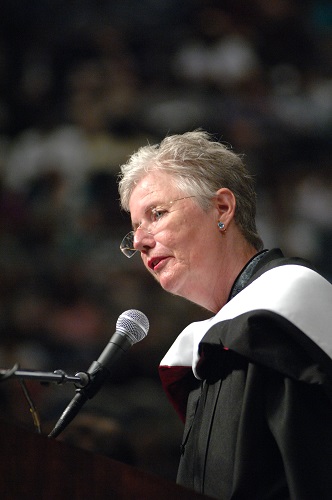
    Tyson's professional research interests include star formation, exploding stars, dwarf galaxies and the structure of the Milky Way. He obtains his research data from the Hubble Space Telescope, as well as from telescopes in California, New Mexico, Arizona and in the Andes Mountains of Chile.

    In 2001, Tyson was appointed by President George W. Bush to serve on a 12-member commission that studied the Future of the U.S. Aerospace Industry. The final report was published in 2002 and contained recommendations to promote a thriving future of transportation, space exploration and national security. In 2006, the head of NASA appointed Tyson to serve on its prestigious Advisory Council, which helps guide NASA through its perennial need to fit its ambitious vision into its restricted budget. Among Tyson’s nine books is his memoir The Sky is Not the Limit: Adventures of an Urban Astrophysicist; and Origins: Fourteen Billion Years of Cosmic Evolution, co-written with Donald Goldsmith. Origins is the companion book to the 2004 PBS-NOVA 4-part mini-series Origins, in which Tyson served as on-camera host. His latest two books are the playful and informative Death By Black Hole and Other Cosmic Quandaries, which was a New York Times bestseller, and The Pluto Files: The Rise and Fall of America's Favorite Planet, chronicling his experience at the center of the controversy over Pluto’s planetary status. Based on the book, the PBS/NOVA documentary “The Pluto Files” premiered in March 2010.

    Tyson is the recipient of nine honorary doctorates and the NASA Distinguished Public Service Medal. His contributions to the public appreciation of the cosmos have been recognized by the International Astronomical Union in their official naming of asteroid 13123 Tyson. He is the first occupant of the Frederick P. Rose Directorship of the Hayden Planetarium. He lives in New York City with his wife and two children.

2009

  • Faith MiddletonIn recognition of her skills as an interviewer and host, Faith Middleton has twice received the “Pulitzer” of broadcast journalism, The Peabody Award. In May 2008, she received the Mark Twain Award from the Connecticut Press Association and a Humanitarian Award from The Children’s Community Programs of Connecticut.
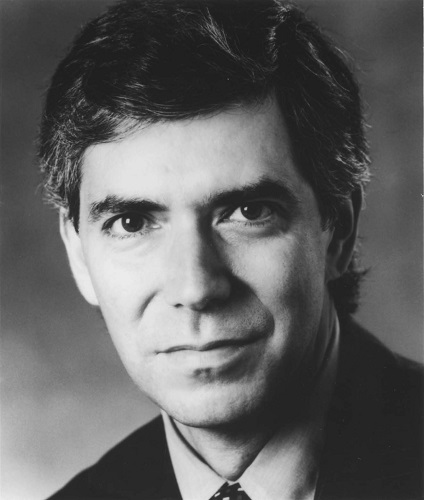
    Joining the ranks of Helen Keller, Richard Rodgers, Arthur Miller and Dr. Henry Lee, Faith Middleton recently received a Distinguished Public Service Award from the Connecticut Bar Association. Now in her 29th year as the host and executive producer of “The Faith Middleton Show,” Middleton is heard in prime-time six days a week in Connecticut, Rhode Island and New York on WNPR, as well as on the Internet at wnpr.org.

    With her unique style and thought-provoking questions, Faith Middleton has been described as “an institution” in her broadcast region. For 11 consecutive years, the readers and editors of Connecticut Magazine have voted her “Best Radio Talk Show Host” in Connecticut. In 2008, Middleton was named a Hall of Fame recipient by Connecticut Magazine.

    In addition to her radio work, Faith Middleton has hosted and produced several popular television series for Connecticut Public Television; one aired nationally. She has been a regular contributor to NPR’s “All Things Considered,” “Morning Edition,” and “Weekend Edition,” and has guest-hosted NPR’s “Fresh Air with Terri Gross.”

    Faith Middleton is the author of “The Goodness of Ordinary People,” a book of true stories from her WNPR callers, demonstrating what she describes as “the uncelebrated breadth of humanity frequently present in secular life.”

    Middleton describes her work as “a never-ending exploration of the richness of life,” conducting interviews she hopes will enlighten as well as entertain. The wide-ranging subjects she brings to her listeners include culture, food, sustainability, news, politics, entertainment, poverty, community issues, architecture, work, leisure, design, science, sports, education, religion, history, medicine, humanity and art. (She just completed a six-part series of interviews in New York at The Museum of Modern Art.)

    For many years, she has chaired the Celebration of Connecticut Farms along with co-chairs Meryl Streep, the late Paul Newman, Jacques Pepin and Sam Waterston. She co-chaired the Connecticut Audubon Society Eagle Festival in 2007 and 2008 with Phil Donahue.

    Starting as a print journalist in 1968, Middleton continues to have an extensive career as a columnist and freelance writer. Her articles have appeared in The New York Times, Hartford Courant, San Jose Mercury News, St. Louis Post Dispatch, Ms. Magazine, and Connecticut Magazine, where she was editor-in-chief for three years.

    In recognition of her skills as an interviewer interested in community and hope, Faith Middleton was awarded an honorary doctorate by Charter Oak University. She is also an Associate Fellow at Yale University, where she taught “The Art of the Interview.”

  • Jonathan Daube served as president of Manchester Community College from 1987 until his retirement in June 2008. As president, he provided the vision, leadership and guidance to develop an innovative academic curriculum and to shepherd a comprehensive building program, which brought MCC (Connecticut’s largest community college) into the state and national limelight. Today, MCC holds the distinction as the only community college in the country recognized for academic excellence by the Harry S. Truman Scholarship Foundation.

    During his term as president, Daube also pushed for faculty hiring to focus on different cultures, religions and ethnicities, creating a climate that welcomes and embraces the differences among faculty and staff. He is a strong advocate of an inclusive college environment where students can achieve and grow by enlarging their understanding of the world and themselves.

    Believing in the importance of education as a continuum, Daube played a key leadership role in the establishment of Great Path Academy, a magnet high school on the MCC campus where students can take college courses. He brought the concept of a middle college high school to the Manchester campus and then guided its ongoing development as a state-of-the-art facility that serves the needs of high school students from throughout the region. Great Path Academy, the first public high school constructed on a college campus in Connecticut, serves more than 300 students in grades 10, 11 and 12. Governor M. Jodi Rell has praised the project as “an innovative and exciting opportunity” for high school students who might not otherwise attempt to attend college.

    Over the years, Daube has been a member of the board of directors of the Association of American Colleges and Universities, has served as a visiting member of the editorial board of the Hartford Courant, and was recently elected president of the board of directors of the University of Aberdeen (Scotland) Development Trust. He currently teaches a course on community colleges as a visiting lecturer at the University of Massachusetts in Amherst.

    Throughout his long and distinguished career, Daube has been the recipient of numerous awards including the Certificate of Special Congressional Recognition, A Michael Bennett Lifetime Achievement Award and induction into the Manchester Arts Commission Hall of Fame. In 2008, he received the Connecticut State Merit Award from the New England Board of Higher Education for his leadership on behalf of higher education and the advancement of educational opportunity.

    Originally from Great Britain, Daube moved to the United States in 1963 and earned his doctorate from Harvard University. Before becoming president of MCC, he was president of Berkshire Community College in Pittsfield, MA; professor and director of Union Graduate School in Yellow Springs, OH; superintendent of schools in Martha’s Vineyard, MA; and an English teacher in Newton, MA.

2008

  • Before his election as chair of the Mashantucket Pequot Tribal Council in November 2002, Michael Thomas served three terms on the council, having being elected in the early 1990s as the youngest Tribal member ever to the elected to the Council. During his time as treasurer, he initiated major advances in the Tribe’s financial controls and long-range planning.

    Thomas has served as a board member of Connecticut Public Television and as a member of the Board of the University of Connecticut Foundation, and presently serves on the Board of Russell Simmons RUSH Philanthropic Arts Foundation. He received an honorary degree from Mitchell College in New London and was a member of the New England States Exposition (Big E).

    Chairman Thomas’ priorities as chairman have been to continue the success of the tribe, build upon and improve relationships with surrounding communities, and ensure continued financial independence for future generations of Tribe members.

    During his tenure, the tribe’s Foxwoods Resort Casino has helped counter the loss of defense industry jobs in southeastern Connecticut by providing gainful employment to thousands of local residents. At the same time, a revenue sharing program has resulted in $2.7 billion annually being transferred by Foxwoods to the State of Connecticut’s treasury. A new $700 million expansion project at Foxwoods is also helping to bring new jobs and new revenue to the region.

    During his time as Tribal Chair, Thomas also has encouraged the Mashantucket Pequots to support Eastern Connecticut State University. A tribal gift totaling $500,000 is providing essential support for the University’s academic programs.

    In 2004, through Thomas’s leadership, the Mashantucket Pequot Tribal Nation sponsored “TUNZA, the International Children’s Conference on the Environment.” Eastern faculty provided programming support, and 450 children from Ghana to Ireland came to New London for a week of activities and enrichment programming.

    As Tribal Council chair, Thomas has been an impassioned advocate for the Mashantucket Pequot Museum and Research Center, which helps to preserve tribal traditions while offering educational programs on tribal history and the tribe’s contemporary activities.

    In his leadership role as the Tribal Council Chair of the Mashantucket Pequot Tribal Nation, Thomas has benefited his tribe, the southeastern Connecticut region, the state of Connecticut, and others. Raised in South Kingston, RI, Thomas moved to Mashantucket as a teenager. He lives on the Pequot reservation with his wife, Mechele, and their six children.

  • Susan McCray began her career in film and television casting as a receptionist for Paramount Pictures, later working in the casting departments of Warner Brothers and Twentieth Century Fox. During her career as a casting director, McCray has cast talent for such shows as “Happy Days,” “Laverne and Shirley,” “Hawaii 5-0,” “Little House on the Prairie,” “Father Murphy,” and “Highway to Heaven,” among others.

    Among her many philanthropic activities, Susan McCray and her husband, Hollywood producer Kent McCray, have raised and/or donated funds to the Michael Landon Children’s Cancer Research Fund at the University of Arizona Medical Center in Tucson, Arizona; the ALS (Lou Gehrig’s Disease) Association’s augmentative communication devices program; and the Arizona Council On Aging.

    Over the years, McCray has been very involved in supporting the University of Hartford. In 2002 she and her husband raised more than $50,000 on behalf of the University of Hartford Magnet School. In 2005, as a gift to the University’s Hartt School of Music, McCray renovated and dedicated the Harry Sukman Foyer in honor of her father. The foyer has the Academy Award-winning composer’s memorabilia exhibit “A Life In Music” on permanent display. In spring 2005, McCray was elected to the Board of Regents at the University of Hartford and serves on the education committee.

    For the better part of the past decade, McCray and her husband have been strong supporters of Eastern Connecticut State University’s performing arts programs. The McCrays have been frequent visitors as guest lecturers to Eastern’s campus, offering expert advice to students on show business and entertainment careers, and introducing several of their Hollywood friends to campus, including playwright Maggie Brown and actors Henry Darrow and Pamela Roylance. In May 1999, McCray established the Susan McCray Endowment Fund for the Theater Arts at Eastern to support special initiatives and programs for Eastern Theatre students.

    In May 2004, Ms. McCray donated her father’s sheet music — the Harry Sukman Master’s of Music Collection — to Eastern’s J. Eugene Smith Library. Sukman, who wrote the music for dozens of Hollywood films and hundreds of television series episodes such as “Bonanza” and “High Chaparral,” won an Academy Award in 1962 for his score of the movie, “Song Without End.”

    In March 2005, the McCrays graciously made their Malibu, CA, home available and hosted a west coast reception for the Eastern’s Alumni Association.

2007

  • Christopher C. Dahl became the twelfth president of the State University of New York at Geneseo on Feb. 28, 1996, after serving as the University’s provost and interim president. Geneseo is the most selective of all public colleges and universities in New York and is consistently ranked among the top 10 regional colleges and universities in the North.

    Among President Dahl’s major accomplishments at SUNY Geneseo was a major review and enhancement of the University’s general education curriculum; the “Principles and Goals of a Geneseo Education” was a major outcome of this collaborative effort. In addition, Dahl established a University-wide Commission on Diversity and Community in 1998 to foster a more welcoming community on campus.

    A major link to the surrounding community has been Geneseo’s active involvement in the Knight Collaborative Engagement on Strategic Partnerships, a project supported by the Pew Charitable Trusts. The Geneseo team joined teams from Michigan State, Franklin and Marshall College, and Washington and Jefferson College on this project, which led to renewed community service and service learning opportunities for Geneseo students while supporting community initiatives in the City of Rochester.

    In addition to his contributions on his own campus, Dahl has advocated tirelessly on behalf of public liberal arts colleges in America, both during and since his term as president of the Council of Public Liberal Arts Colleges (COPLAC).

    Dahl is a scholar of nineteenth-century British literature and continues to serve as a member of the faculty at Geneseo, teaching a course on British Romantics each fall semester.

    The son and grandson of teachers, President Dahl has a longstanding interest in teacher education issues. He has served as president of several national scholarly and educational organizations, including the national Project 30 Alliance, which brings together faculty from arts and sciences and education to set an agenda for the reform of teacher education. In 1997-98, he served as co-chair of the Panel of Presidents advising the New York State Regents Task Force on Teaching in the development of new standards for teacher preparation and certification.

    Dahl graduated magna cum laude in English from Harvard College and received his master’s and doctoral degrees in English from Yale University. In addition to writing a book on the New York lawyer-novelist, Louis Auchincloss, as well as numerous articles on literature and higher education, he was associate editor and co-founder of the publication, Philosophy and Literature.

    Prior to joining the administration at SUNY Geneseo in 1994, Dahl served as Dean of the School of Humanities and Social Sciences at Millersville University of Pennsylvania from 1989–1994. From 1973–1989, he held positions as Assistant Professor of English, Associate Professor of English, and Chair of the Department of Humanities at The University of Michigan–Dearborn.

    Dahl is a member of the board of directors of the Association of American Colleges and Universities and serves on the American Council on Education’s Commission for the Advancement of Racial and Ethnic Equity.

  • Congresswoman Rosa DeLauro was first elected to Congress from Connecticut's Third District in 1990, and is currently in her ninth term. Congresswoman DeLauro sits on the influential House Appropriations and Budget Committees and is chairwoman of the Agriculture-FDA Appropriations Subcommittee. She also serves as a member of the Labor-Health and Human Services-Education and Commerce-Justice-Science Appropriations subcommittees.

    In 1999, Congresswoman DeLauro was elected assistant to the Democratic Leader by her colleagues, making her the second highest ranking Democratic woman in the House of Representatives. She was re-elected to this position in 2000 and has served as co-chair of the House Steering and Policy Committee since 2002.

    Congresswoman DeLauro was born and raised in New Haven and both her parents were active in New Haven politics. Her father, Ted DeLauro, was a New Haven Alderman who was known as the “Mayor of Wooster Square.” The Congresswoman’s mother, Luisa, served on the New Haven Board of Aldermen from 1965 to 1998. Echoing this tradition of public service, Congresswoman DeLauro was recognized in 1998, 2000 and 2002, as one of the House of Representative’s top “Workhorses” by Washingtonian magazine.

    DeLauro is a champion of the working family. The first bill she introduced as a member of Congress was a middle-class tax cut. More recently, she has fought for tax cuts such as a $500 per child tax credit, a tax cut for children’s health care, and education tax cuts for Connecticut families. DeLauro also is a strong supporter of women’s rights and has authored legislation that would guarantee men and women equal pay for equal work. Connecticut’s defense industry and Social Security benefits for today’s seniors are also concerns she has championed.

    During her tenure in Congress, DeLauro has taken a special interest in health care issues, leading the fight for affordable, quality health care. Lowering the costs of prescription drugs, increasing cancer research (she is an ovarian cancer survivor), addressing underaged drinking, increasing funding for breast and cervical cancer screenings and research, and ensuring longer hospital stays for women undergoing breast cancer surgery are all issues for which the Congresswoman has advanced legislation.

    In February 2005, DeLauro was appointed ranking member of the House Appropriations Agriculture Subcommittee. She has worked to provide funding for a safe food supply, a healthy agricultural economy, and to ensure that the Food and Drug Administration (FDA) properly regulates food and pharmaceuticals.

    The Ted DeLauro Scholarship, which Congresswoman DeLauro founded in memory of her late father, has provided $397,000 to 397 students to further their education. In 2004, DeLauro also established the Maria Baez Perez Scholarship in the name of a former staff person. Since that time, 22 area students have received $1,000 scholarships. From 1981-1987, DeLauro served as Chief of Staff to U.S. Senator Christopher Dodd.

    She is a graduate of Marymount College, and earned her master’s degree in International Politics from Columbia University. DeLauro is married to Stanley Greenberg, president of Greenberg-Quinlan Research, Inc., a public issues research and polling firm. They have three grown children and one granddaughter.

2006

  • Chief Ralph Sturges of the Mohegan Tribe truly is deserving of the Native American name G’tinemong (“He who helps thee”), bestowed on him by the late Mohegan medicine woman Gladys Tantaquidgeon. He has spent most of his life in service to people, working in a variety of positions in the public and private sectors for the benefit of humankind. As the Chief says so eloquently, “We are put here on this Earth not to collect material goods but to serve and help one another.”

    As a young man in the 1930s, the New London native worked in the Civilian Conservation Corps in Pachaug State Forest, and later helped people on the Connecticut shore following the great hurricane of 1938. He spent more than five years in the U.S. Army during World War II as an intelligence specialist and gunner.

    Chief Sturges continued his record of service in the 1950s as a public relations officer for the Salvation Army in southern New England. During disasters such as the Hartford flood of 1955, Chief Sturges raised funds to help feed the homeless, sometimes providing three meals a day to more than 600 people at a time.

    In the 1980s, Chief Sturges became interested in tribal affairs at a time when the Mohegan Tribal Council was meeting in a church — it had no office or phone. He was elected to the council and then was elected lifetime chief in 1992, the first Mohegan chief to be elected since 1769.

    Gaining federal recognition was a major goal of the tribe, and through his patience and ability to partner with others, Chief Sturges was able to persuade the Bureau of Indian Affairs to grant federal recognition after a three-year process. He also was able to find Wall Street bankers who were willing to finance the $175 million needed to build the Mohegan Sun.

    The Chief and the tribe have turned the Mohegan Sun into a multimillion-dollar business. Today it is virtually a small city, employing more than 15,000 people and having a major impact on Connecticut’s economy

    Reflecting his many interests, in addition to his business acumen, Chief Sturges is a world-class sculptor in marble. The whale in the Connecticut State Capitol Building commissioned by Governor Ella Grasso and unique works of art for Uncas Elementary School in Norwich and Montville High School are examples of his talent.

    Even at 87 years of age, the chief stays busy. He works with many local charities, including Hospice of Southeastern Connecticut and Big Brothers Big Sisters of Southeastern Connecticut. Nonetheless, he makes sure to take time to enjoy morning coffee and other quiet moments times with Ida, his wife of more than 50 years.

    Among Chief Sturges’ many honors are his naming by the Eastern Connecticut Chamber of Commerce as its Citizen of the Year, and his being designated by Big Brothers Big Sisters of Southeastern Connecticut as the recipient of its Distinguished Citizen Award — both in 2005.

    What do others have to say about the Chief? One tribal employee perhaps summed it best for many whose paths have crossed that of Ralph Sturges: “The Chief is the wind at my back.”

  • Robert Pinsky, poet, essayist, educator and U.S. Poet Laureate from 1997-2000, is a public ambassador for poetry. He founded the Favorite Poem Project, which provided thousands of Americans with an outlet for their poetry; the anthologies, American’s Favorite Poems and Poems to Read, were the best-selling outcomes of the project. Pinsky served three terms as U.S. Poet Laureate, the third term appointment by the Library of Congress being unprecedented.

    He is the author of six collections of his own poetry, including Jersey Rain and The Figured Wheel, which was nominated for a Pulitzer Prize and received the Lenore Marshall Award and the Ambassador Book Award of the English Speaking Union. A renowned translator, Pinsky received the Los Angeles Times Book Award for his translation of Dante’s Inferno.

    In addition to being poetry editor for Slate, the online magazine, Pinsky has appeared regularly on The NewsHour with Jim Lehrer and has a weekly column in the Washington Post.

    Pinsky has spoken at length about the social and cultural value of poetry, writing three books on the subject: Poetry and the World, The Sounds of Poetry, and Democracy, Culture and the Voice of Poetry. His poems have appeared in The New Yorker, The Atlantic Monthly, Threepenny, American Poetry Review, and in the Best American Poetry anthologies.

    Pinsky earned his doctorate at Stanford University, and is the recipient of numerous honorary degrees and recognitions.

2005

  • Attorney James P. Sandler is partner and principal in the Hartford, Connecticut law firm, Sandler & Mara, P.C. Prior to joining the firm in 1973, he was with the Murtha, Cullina, Richter and Pinney firm of Hartford from 1962–1973, becoming partner in 1967. Throughout his career, he has found time to provide community leadership and support to numerous Connecticut charitable organizations and public service projects.

    Eastern Connecticut State University is fortunate to be one of the organizations with which Sandler has chosen to share his time, expertise, and enthusiastic support. Over the years, he has demonstrated an unwavering commitment to the University, its students, and the people of the world that today’s graduates are setting out to serve.

    Through Sandler’s extraordinary leadership, Eastern has been able to raise more than $1 million in support of student scholarships, new educational programs and other important work of the University. Since 1996, he has provided leadership in ensuring the success of Fun*Ding, the University’s biggest annual fund-raising event. Through his efforts, Eastern’s generous donors have been entertained by such international recording artists as Paul McCartney, Bruce Springsteen, Fleetwood Mac and others. In addition to working closely with concert producers on behalf of the University, Sandler has been instrumental in securing the corporate and private sponsorships that constitute the majority of funds raised each year at Fun*Ding. The pre-event auction has also benefited from the high-value auction items he has solicited.

    Sandler also was a prime force behind President David Carter’s 15th anniversary celebration in 2003, facilitating the establishment of the David G. Carter–ECSU Endowment for Scholarships.

    In addition to his continued support of Eastern Connecticut State University, Sandler has worked tirelessly to lead community efforts in support of such public service projects as the Connecticut Commission on the Arts, the Connecticut Energy Advisory Board, the Connecticut Junior Republic, the Connecticut Law Revision Commission, the Connecticut Task Force on Restructuring the Electric Industry, the Governor’s Commission on Quality and Integrated Education and Hartford’s Riverfront Recapture project.

    Numerous charitable organizations also have benefited from Mr. Sandler’s civic-mindedness. Chief among these are The Michael Bolton Charities, the UConn Children’s Cancer Fund, and several organizations addressing multiple sclerosis and diabetes.

    Sandler graduated cum laude from Princeton University in 1957 and received his Juris Doctor degree from Harvard University in 1962. He served in the U.S. Army’s third Armored Division in Butzbach, Germany from 1957-59, and was discharged at the rank of Captain.

  • For nearly five decades, Marge Piercy has educated and enlightened people throughout the world with her writings, speeches, and teaching. She also has actively supported many of the progressive social movements of the past 40-50 years, including women’s rights, civil rights, global peace and public health.

    Piercy is the author of 17 novels, including the New York Times best seller, “Gone to Soldiers,” and the national best seller, “The Longings of Women.” Her memoir —“Sleeping with Cats” — was published to great critical acclaim. Attesting her range as a writer, Piercy is also the author of 17 books of poetry. She is equally gifted at writing historical novels, science fiction, and social commentary. In December 2005, Morrow/HarperCollins published her novel, “Sex Wars,” an historical novel set in New York City in the 19th Century.

    Included in her many literary awards are the Arthur C. Clarke Award for best science fiction novel in the United Kingdom; the Patterson Poetry Prize for the best book of poetry in 1999; the Sheaffer-PEN/New England Award for Literary Excellence; the Literary Award from the Massachusetts Governor’s Commission on the Status of Women; and the New England Poetry Club’s Golden Rose Award.

    In addition to the Honorary Doctor of Humane Letters that Piercy received from Eastern Connecticut State University, she also has been conferred honorary degrees from Hebrew Union College in Cincinnati, Ohio; Lesley College in Cambridge, Massachusetts; and Bridgewater State College in Massachusetts.

    Piercy has lectured or performed at more than 350 colleges and universities around the world. She has taught or been artist-in-residence at such institutions as Indiana University, Holy Cross University, Vanderbilt University, the University of Kansas, the Ohio State University, and the University of Michigan, to name a few. Piercy also has been featured on Bill Moyer’s PBS Specials, Garrison Keillor’s Prairie Home Companion, The Today Show, and other television and radio programs.

    Actively supporting the causes that she cares about, Marge Piercy has performed numerous benefits to raise money for such worthy organizations as the Women’s Bail Fund, the Massachusetts Tenants’ Organization, Cape Code Women’s Liberation, the State Coalition to Ratify the ERA, Feminist Writers Guild, the Detroit Women’s Community Health Project, the Fine Arts Work Center, and the Boston and San Francisco Rape Crisis Centers.

    Piercy is a member of the Authors Guild, PEN, the Poetry Society of America, the National Writers Union, the New England Poetry Club, and other professional organizations.

    Marge Piercy was born in 1936 in Detroit, MI. She received her bachelor’s degree in 1957 from the University of Michigan and her master’s degree from Northwestern University in 1958. She and her husband live on Cape Cod.

2004

  • John R. MacArthur John R. MacArthur is president and publisher of Harper’s Magazine and an award-winning journalist and author. In 1980, he initiated the foundation-sponsored rescue of Harper’s, the nation's oldest continuously published monthly magazine, and became president and publisher in 1983.
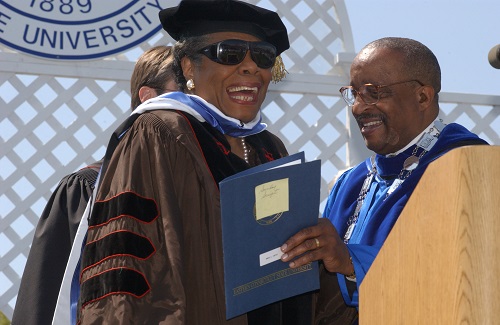
    His campaign to revitalize the publication began with his reinstatement of Lewis H. Lapham as editor. Together they launched the “new” magazine, with a radically different format that caused a sensation in the publishing world. Since the first redesigned issue in March 1984, Harper’s has received numerous awards and the support of advertisers and readers alike. In 1993, Harper’s won an unprecedented three National Magazine Awards, the industry’s highest recognition, in the categories of fiction, feature writing, and essays and criticism. In 1997, Harper’s won another National Magazine Award for feature writing, and one in 1998 for fiction.

    MacArthur's book “Second Front: Censorship and Propaganda in the Gulf War” was critically acclaimed in the United States, was a finalist for a 1993 H. L. Mencken Award for books, and became a best-seller in Germany. His newest book, “The Selling of ‘Free Trade’: NAFTA, Washington, and the Subversion of American Democracy,” was published by Hill and Wang in April 2000.

    Before joining Harper’s, MacArthur was an assistant foreign editor at UPI (1982) and reporter on the Chicago Sun-Times (1979-82), Bergen Record (1978-79), Washington Star (1978), and the Wall Street Journal (1977). He continues to write for newspapers and magazines, including the New York Times, Newsday, Wall Street Journal, Boston Globe, Toronto Globe and Mail, Los Angeles Times, Philadelphia Inquirer, The Progressive, and the Columbia Journalism Review. He received the 1993 H. L. Mencken Award for best editorial/op-ed column and the Illinois ACLU’s 1992 Harry Kalven Freedom of Expression Award.

    A tireless advocate for international human rights, Mr. MacArthur founded and serves on the board of directors of the Death Penalty Information Center and the MacArthur Justice Center. Along with members of his family, he founded Article 19, the International Center on Censorship based in London, and in 1989 helped organize the PEN/Article 19/Author's Guild reading and rally for Salman Rushdie. He is also on the board of directors of the Committee to Protect Journalists.

    Born on June 4, 1956, in New York City, MacArthur grew up in Winnetka, IL, and graduated in 1978 from Columbia University with a B.A. in history. He is a fellow at the New York Institute for the Humanities and is on the board of directors of the Author’s Guild. He lives with his wife and daughter in New York City.

2003

  • Maya AngelouWhile she was a renowned author famous for her autographical style, Maya Angelou was also a poet, dancer, singer, activist, and scholar.
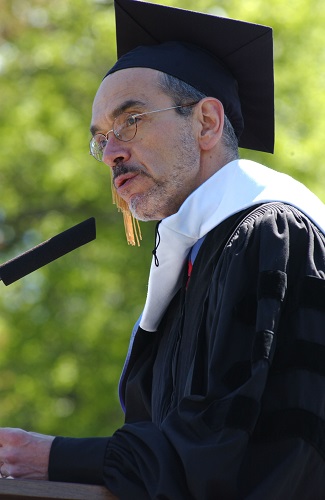
    Born Marguerite Ann Johnson in 1928, Angelou was given the nickname “Maya” by her older brother. She was raped as a child by her mother’s boyfriend, with the resulting trauma rendering her mute for six years.

    Angelou’s interest in writing began early in life. During her childhood, she wrote essays, poetry, and even kept a journal. While living with her grandmother in Arkansas, she became interested in poetry and memorized works by Shakespeare and Poe.

    Before the start of World War II, Angelou moved back in with her mother, who was living in Oakland, CA. She attended George Washington High School and took dance and drama courses at the California Labor School.

    When war broke out, Angelou applied to join the Women’s Army Corps. Her application was rejected because of her involvement in the California Labor School, which was said to have Communist ties. Despite being only 15 years old, she decided to apply for the position of a streetcar conductor, and became the first African American woman to work as a streetcar conductor in San Francisco.

    In 1949, she married Tosh Angelos, an electrician in the US Navy. She adopted a form of his surname and kept it throughout her life, though the marriage ended in divorce in 1952.

    Angelou was also noted for her talents as a singer and dancer, particularly in the calypso and cabaret styles. In the 1950s, she performed professionally in the United States, Europe, and northern Africa, and sold albums of her recordings.

    Angelou joined the Harlem Writers Guild in 1959. She also became active in the Civil Rights Movement and served as the northern coordinator of the Southern Christian Leadership Conference, a prominent African American advocacy organization.

    In 1969, Angelou published “I Know Why the Caged Bird Sings,” an autobiography of her early life. “I Know Why the Caged Bird Sings” has been translated into numerous languages and has sold over a million copies worldwide. Angelou eventually published six more autobiographies, culminating in 2013’s “Mom & Me & Mom.”  

    She wrote numerous poetry volumes, such as the Pulitzer Prize-nominated “Just Give me a Drink of Water ’fore I Diiie” (1971), as well as several essay collections. She also recorded spoken albums of her poetry, including “On the Pulse of the Morning,” for which she won a Grammy for Best Spoken Word Album. The poem was originally written for and delivered at President Bill Clinton’s inauguration in 1993. She also won a Grammy in 1995, and again in 2002, for her spoken albums of poetry.

    In 1972, she became the first African American woman to have her screen play turned into a film with the production of “Georgia, Georgia.” Angelou earned a Tony nomination in 1973 for her supporting role in Jerome Kitty’s play “Look Away,” and portrayed Kunta Kinte’s grandmother in the television miniseries “Roots” in 1977.

    President Clinton awarded Angelou the National Medal of Arts in 2000. In 2012, she was a member of the inaugural class inducted into the Wake Forest University Writers Hall of Fame. The following year, she received the National Book Foundation’s Literarian Award for outstanding service to the American literary community. In 2010, President Barack Obama awarded Angelou the Presidential Medal of Freedom, the country’s highest civilian honor. It was a fitting recognition for Angelou’s remarkable and inspiring career in the arts.

2002

  • Wally LambWally Lamb is a Connecticut native and the critically acclaimed author of such novels as “She’s Come Undone,” “I Know This Much Is True,” and “The River Is Waiting,” all of which were selected for Oprah’s Book Club or Oprah's Book Club 2.0. He was the director of the Writing Center at Norwich Free Academy in Norwich from 1989 to 1998. Lamb has also taught Creative Writing in the English Department at the University of Connecticut.
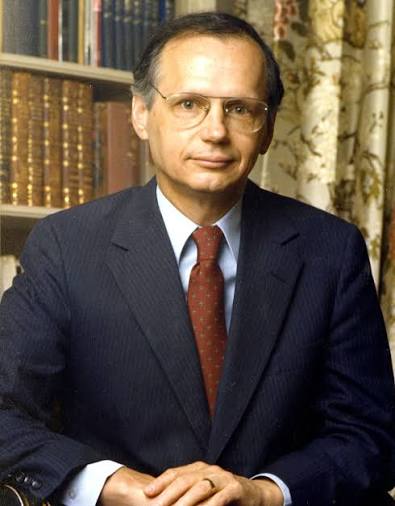
    Other books written by Lamb include the New York Times-bestsellers “I’ll Take You There,” “We Are Water,” “Wishin’ and Hopin’,” and “The Hour I First Believed.”

    Lamb also edited “Couldn’t Keep It to Myself” and “I’ll Fly Away,” two volumes of essays from students in his writing workshop at York Correctional Institution, a women’s prison in Connecticut, where he was a volunteer facilitator for 20 years.

    As a child, Lamb loved to draw and create his own comic books — activities which, he says, gave him “a leg up” on the imagery and colloquial dialogue that characterize his stories. He credits his ability to write in female voices, as well as male, with having grown up with older sisters in a neighborhood largely populated by girls.

    After graduating from high school, Lamb studied at the University of Connecticut during the turbulent early 1970s era of anti-war and civil rights protests and student strikes. He holds a B.A. and an M.A. in Education from the University of Connecticut and a Master of Fine Arts in Writing from Vermont College.

    For 25 years, Lamb taught English and writing at the Norwich Free Academy, a regional high school that was his alma mater. In his last years at the school, Lamb designed and implemented the school's Writing Center, where he instructed students in writing across the disciplines. As a result of his work for this program, he was chosen the Norwich Free Academy's first Teacher of the Year and later was named a finalist for the honor of Connecticut Teacher of the Year (1989).

    From 1997 to 1999, Lamb was an Associate Professor in the English Department at the University of Connecticut. As the school's Director of Creative Writing, he originated a student-staffed literary and arts magazine, The Long River Review.

    Lamb lives in Connecticut with his wife, Christine, and they have three sons.

2001

  • Richard W. RileyDavid Broder, former columnist for The Washington Post, once called Richard Riiley one of the "most decent and honorable people in public life." When the former U.S. Secretary of Education was governor of South Carolina, he was so popular that the state’s constitution was amended to allow him to serve for a second term.
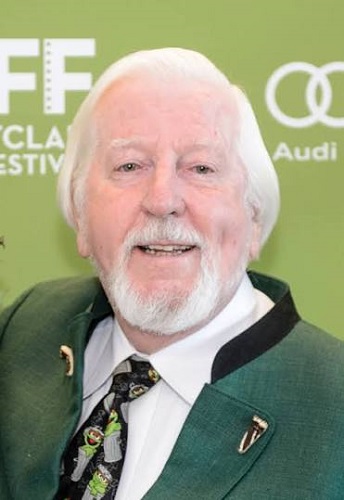
    A father of four and grandfather of 10, Riley was universally respected for his integrity, principled leadership, commitment to children, and passion for education.

    President Clinton chose Riley to be Secretary of Education in December 1992 after Riley won national recognition for his successful efforts to improve education in South Carolina. During Clinton’s first term, Riley helped launch initiatives to raise academic standards; improve instruction for the poor and disadvantaged; expand grants and loan programs to help more Americans go to college; prepare young people for the world of work; and improve teaching. He also helped to create the Partnership for Family Involvement in Education, which today includes more than 4,000 groups.

    Riley’s gets things done by reaching out to all citizens. He prefers partnership to partisanship. His quiet, humble style “can drive impatient, assertive young Washington movers and shakers crazy,” the National Journal has written. “He doesn't grab headlines or clamor for credit ... But, inevitably, Riley reaches his goal.”

    Riley's efforts were so successful that President Clinton asked him to stay on in his second term to lead the President's national crusade for excellence in education. In Clinton’s second term, Riley helped win an historic ruling by the F.C.C. to give schools and libraries deep discounts for Internet access and telecommunications services and helped win major improvements in the Individuals with Disabilities Education Act.

    Riley’s goals as Secretary of Education included helping all children master the basics of reading and math; making schools safer; reducing class sizes in grades 1-3 by helping states and schools to hire 100,000 more good teachers; modernizing and building new schools to meet record-breaking student enrollments; helping students learn to use computers; and expanding after-school programs.

    Riley was born in Greenville County, S. C., on Jan. 2, 1933. He passed away in 2011. He graduated cum laude from Furman University in 1954 and served as an officer on a U. S. Navy minesweeper. In 1959, Riley received a law degree from the University of South Carolina. He was a state representative and state senator from 1963-1977, elected governor in 1978 and reelected in 1982.

2000

  • Caroll SpinneyCaroll Spinney was an American puppeteer, cartoonist, author, artist and speaker, most famous for playing Big Bird and Oscar the Grouch on Sesame Street from its inception in 1969 until 2018.
    Spinney’s British-born mother named her son Caroll because he was born the day after Christmas. At age five, he witnessed a puppet performance of “Three Little Kittens,” and was smitten with what became a lifelong passion. At age 8, he began his puppeteering career, using a monkey puppet that he had found at a garage sale. A year later, his mother bought him a Punch and Judy theatre set for Christmas. Throughout his teen years, he performed with his puppets, raising what he hoped would be his college tuition.

    In the early 1950s, Spinney enlisted in the Air Force, and showed his artistry with the creation of his “Harvey” comic strip as well as a set of animated cartoons titled “Crazy Crayon.”

    Returning to his home state of Massachusetts, Spinney was a puppeteer and performer throughout the 1960s, appearing in Boston’s Bozo’s Big Top program in various costumed character roles. He was also an animator and commercial artist during this time.

    In 1969, Spinney met Jim Henson in Utah at a Puppeteers of America festival and Henson convinced Spinney to join the cast of Sesame Street. In addition to the television show, as Big Bird and Oscar the Grouch, Spinney performed in Europe, Canada, Japan, China and Australia.

    He wrote several books around his famous characters, which were also the focus of numerous video games. Spinney’s film credits include “The Muppet Movie,” “The Great Muppet Caper,” and “The Adventures of Elmo in Grouchland.”

    Among Spinney’s many awards were two Grammys; four Daytime Emmys, as well as a Lifetime Achievement Award at the 2006 Emmys; two golden records; and his star on the Hollywood Walk of Fame in 1994.

    A longtime resident of Woodstock, CT, Spinney passed away in 2019.

    photo credit: (c) Neil Grabowsky

1998

  • Claribel Isabel Alegría Vides was Nicaraguan-Salvadoran poet, essayist, novelist and journalist who was a major voice in the literature of contemporary Central America. She received the 2006 Neustadt International Prize for Literature. She is also a writer of novels and children’s stories.

    Alegría was born to Nicaraguan and Salvadoran parents in Estelí, Nicaragua, in 1924. Her cousin was activist Leonel Gómez Vides. When Claribel was nine months old, her father was sent into exile for protesting human rights violations occurring during the United States occupation of Nicaragua.

    She grew up in western El Salvador. Although she was too young to read or write, she began composing poems at the age of six and dictated them to her mother, who would write them down. Alegría consistently cited Rainer Maria Rilke's “Letters to a Young Poet” as the impetus for becoming a poet. At the age of seventeen, she published her first poems in Repertorio Americano, a Central American cultural supplement.

    In 1943 Alegría moved to the United States. In 1948 Alegría received a B.A. in philosophy and letters from George Washington University.

    Throughout her life, Alegría emphasized her commitment to nonviolent resistance, even during her close association with the Sandinista National Liberation Front (FSLN), the people’s movement that took control of the Nicaraguan government in 1979 and overthrew dictator Anastasio Somoza Debayle. In 1985, she returned to Nicaragua to aid in the country’s reconstruction.

    Alegría's literary work reflects the style of the popular literary current in Central America during the 1950s and 1960s, "la generacion comprometida" (the committed generation). Like many other poets of her generation who are critical of their societies, she made claims for rights using a language which is often counter-literary.

    Alegría published numerous books of poetry, including “Casting Off” (Curbstone Press, 2003); “Sorrow” (Curbstone Press, 1999), which focuses on the death of her companion and translator, Darwin Flakoll; “Umbrales/Thresholds”; (Curbstone Press, 1996); “Fugues” (Northwestern University Press, 1993); and “La mujer del río/Woman of the River” (University of Pittsburgh Press, 1989), a bilingual edition.

    In addition to her poetry, Alegría also published novels and children’s stories, as well as testimonies (often in collaboration with her husband, D.J. “Bud” Flakoll), such as “They Won't Take Me Alive.”

    Alegría won the Cuban-sponsored Casa de las Américas Prize in 1978 for “Sobrevivo/I Survive; (Casa de las Américas, 1978). She resided in Managua, Nicaragua, until her death in 2018.

1997

  • Jonathan Kozol is an American writer, progressive activist, and educator, best known for his books on U.S. public education. “Death at an Early Age,” his first non-fiction book, described his first year as a teacher in Boston Public Schools. Published in 1967 and recipient of the National Book Award in Science, Philosophy and Religion, the book has sold more than two million copies.

    After graduating from Harvard University summa cum laude in 1958 with an A.B. in English literature, he was awarded a Rhodes Scholarship to Magdalen College, Oxford. He did not, however, complete his scholarship, deciding instead to go to Paris to learn to write fiction and nonfiction from experienced authors such as William Styron, Richard Wright and others who were living in Paris at the time.

    Upon his return to the United States from Paris, Kozol began to tutor children in Roxbury, MA, and soon became a teacher in the Boston Public Schools. He was fired for teaching a Langston Hughes poem and then became deeply involved in the civil rights movement. He subsequently taught in Newton Public Schools, which he attended as a child, remaining there for several years before becoming more deeply involved in social justice work and dedicating more time to writing.

    Kozol has held two Guggenheim Fellowships, has twice been a fellow of the Rockefeller Foundation, and has also received fellowships from the Field and Ford Foundations.

    Kozol also has worked in the field of social psychology. He has been working with children in inner-city schools for more than 40 years. Kozol is currently on the editorial board of Greater Good Magazine, published by the Greater Good Science Center at the University of California, Berkeley. His contributions include the interpretation of scientific research into the roots of compassion, altruism, and peaceful human relationships.

    Among the other books by Kozol are “Rachel and Her Children: Homeless Families in America,” which received the Robert F. Kennedy Book award for 1989 and the Conscience-in-Media Award of the American Society of Journalists and Authors, and “Savage Inequalities: Children in America’s Schools,” which won the New England Book Award and was a finalist for the National Book Critics Circle Award in 1992.

    His 1995 book, “Amazing Grace: The Lives of Children and the Conscience of a Nation,” described his visits to the South Bronx of New York City, the poorest congressional district in the United States. It received the Anisfield-Wolf Book Award in 1996.

    He published “Ordinary Resurrections: Children in the Years of Hope” in 2000 and “The Shame of the Nation: The Restoration of Apartheid Schooling in America” was released on September 13, 2005. Kozol documents the continuing and often worsening segregation in public schools in the United States, and the increasing influence of neoconservative ideology on the way children, particularly children of color and poor children of urban areas, are educated.

  • Virginia Lowney is the executive director of the Haitian Health Foundation, which she and her husband, Dr. Jeremiah Lowney, started in 1982. Dr. Lowney started offering dental services in Jérémie, Haiti, in 1985. In 1988, they established a 27,000-square-foot facility in Jérémie to provide outpatient services. Today it serves more than 120,000 people a year.

    The Lowneys also created the Center for Hope in Jérémie to provide ob-gyn services and children’s health services. Across its facilities, the Haitian Health Foundation serves more than 250,000 people in more than 100 rural villages with health services, educational assistance, community development and relief services.

    In 2000, the Lowneys established a family foundation that focuses on education, philanthropy, voluntarism, human services and grantmaking in Connecticut and Virginia.

1996

  • Dr. E. M. S. Edirisinghe was a physician and educator in Sri Lanka. He founded Oasis Hospital in Colombo, Sri Lanka, a 170-bed hospital that provides general surgery, orthopedics, oncology, pediatrics and ophthalmology services. Indigent patients are provided services free of charge.

    In 1984, Edirisinghe founded the Institute of Technological Studies, which offers degrees in computing, engineering, and science. In 1993, he founded Sharjah College in UAB, offering business administration, computer science and computer information systems degrees.

1995

  • Bernice “Bunny” NiejadlikBernice “Bunny” Niejadlik graduated from Willimantic State Normal School in 1930 and earned her bachelor’s degree from Willimantic State Teachers College in 1950. She was a former chair of the Connecticut State University Board of Trustees and a past recipient of the ECSU Alumni Association’s Distinguished Alumni Award (1970) and the Hermann Beckert “Friends of the University” Award (1989).
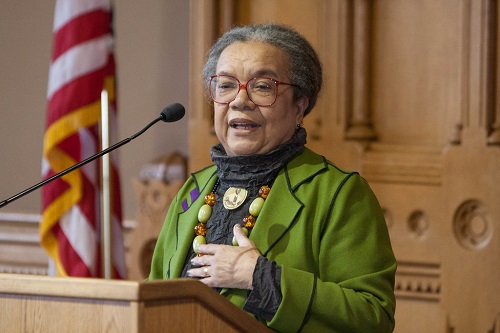
    Niejadlik began teaching in 1930 at a one-room school house in Pomfret, where she taught grades 1 through 8. She left Pomfret for a job in nearby Brooklyn, where she was hired, according to her contract, “to be principal, to teach and to assume custodial duties.” Mrs. Niejadlik paid a student 50 cents a week from her $1,000-a-year salary to light the cast iron stove that heated the school in Brooklyn. She later taught fifth and sixth grade and junior high school in Killingly and Waterford.

    She continued her own education throughout her career, obtaining a teacher preparatory degree from Willimantic State Teachers College, the predecessor to Eastern Connecticut State University, in 1930. She obtained a bachelor’s degree from Eastern in 1950 and studied at the University of Connecticut.

    Later in her career, Mrs. Niejadlik worked as a teacher, elementary school principal, guidance counselor and psychological examiner. She was president of the Killingly Education Association, the Connecticut Education Association as well as other professional groups.
    She was chairwoman of the Board of Trustees for Connecticut State Colleges for 10 years beginning in 1967 and became known as a tenacious advocate for the state college and university systems.

    In a book about the establishment of the state university system, James Frost, president emeritus of the system, said of Niejadlik, “I admire and respect this remarkable woman. She is intelligent, people-wise, forceful, considerate of others and secure in herself. She reached adulthood with the determination to make her life enjoyable to herself and of service to others, and she did.”

    Niejadlik retired in 1992 and became involved in volunteer activities.

1994

  • Marian Wright EdelmanMarian Wright Edelman, founder and president of the Children’s Defense Fund (CDF), has been an advocate for disadvantaged Americans for her entire professional life. Under her leadership, CDF has become the nation’s strongest voice for children and families. The Children’s Defense Fund’s Leave No Child Behind mission is to ensure every child a Healthy Start, a Head Start, a Fair Start, a Safe Start, and a Moral Start in life and successful passage to adulthood with the help of caring families and communities.
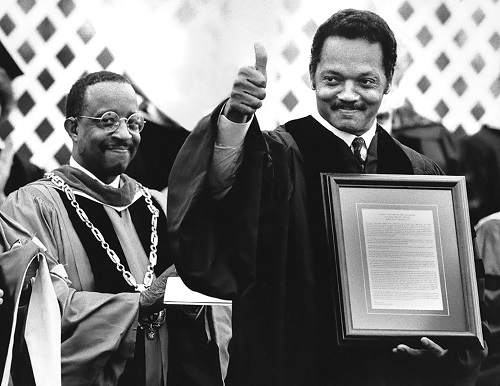
    A graduate of Spelman College and Yale Law School, Edelman began her career in the mid-60s when, as the first black woman admitted to the Mississippi Bar, she directed the NAACP Legal Defense and Educational Fund office in Jackson, MS. In l968, she moved to Washington, D.C., as counsel for the Poor People’s Campaign, which Dr. Martin Luther King, Jr. began organizing before his death. She founded the Washington Research Project, a public interest law firm and the parent body of the Children’s Defense Fund. For two years she served as the director of the Center for Law and Education at Harvard University and in l973 began CDF.

    Edelman served on the Board of Trustees of Spelman College, which she chaired from 1976 to 1987, and was the first woman elected by alumni as a member of the Yale University Corporation, on which she served from 1971 to 1977. She has received more than 100 honorary degrees and many awards including the Albert Schweitzer Humanitarian Prize, the Heinz Award and a MacArthur Foundation Prize Fellowship.

    In 2000, she received the Presidential Medal of Freedom, the nation’s highest civilian award, and the Robert F. Kennedy Lifetime Achievement Award for her writings which include: Families in Peril: An Agenda for Social Change; The Measure of Our Success: A Letter to My Children and Yours; Guide My Feet: Meditations and Prayers on Loving and Working for Children; Stand for Children; Lanterns: A Memoir of Mentors; Hold My Hand: Prayers for Building a Movement to Leave No Child Behind; I’m Your Child, God: Prayers for Our Children; I Can Make a Difference: A Treasury to Inspire Our Children; and The Sea Is So Wide and My Boat Is So Small: Charting a Course for the Next Generation.

    She is a board member of the Robin Hood Foundation and the Association to Benefit Children, and is a member of the Council on Foreign Relations, the American Philosophical Society, the American Academy of Arts and Sciences, and the Institute of Medicine of the National Academy of Sciences.

    Marian Wright Edelman is married to Peter Edelman, a professor at Georgetown Law School. They have three sons, Joshua, Jonah and Ezra, two granddaughters, Ellika and Zoe, and two grandsons, Elijah and Levi.

  • Richard “Skip” Hayward’s vision and determination led the Mashantucket Pequots to rebuild their nation and establish many successful enterprises, including Mashantucket High Stakes Bingo, Foxwoods Resort Casino, Pequot Pharmaceutical Network, Mashantucket Pequot Museum & Research Center, Pequot River Shipworks, Fox Navigation, Pequot Hotel Group, Randall’s Ordinary, and Lake of Isles golf course.

    For his lifelong contributions to Mashantucket and Indian Country, Hayward became the inaugural recipient of the Tribe’s first Lifetime Achievement Award in 2017.

    When Hayward was elected chairman of the Mashantucket Pequot Tribe in 1975, only 214 acres remained of the Tribe’s historic Mashantucket land in southeastern Connecticut — the oldest continually occupied Indian reservation within what would become the continental United States.

    An “Industry Pioneer” inductee to the American Gaming Association’s Hall of Fame and recipient of the Mashantucket Pequots’ first-ever Lifetime Achievement Award, Hayward’s leadership arose from humble beginnings and an extraordinary vision for community development.

    In 1977, Hayward established the first Tribal housing authority in the state of Connecticut, and built the first on-reservation housing development with a grant from the U.S. Department of Housing and Urban Development. Since several early business ideas lacked the revenue generating capacity to provide economic stability for his tribal community, upon winning federal recognition in 1983, Hayward championed the construction of the Mashantucket Pequot High Stakes Bingo Hall, which opened in 1986.

    Following the Bingo success, Hayward secured a $60 million investment from Malaysian billionaire Tan Sri Lim Goh Tong, with which the first Native American casino was built — Foxwoods Resort Casino — which resulted in hundreds of construction jobs and more than ten thousand employment positions during an early nineties’ economic recession.

    Hayward’s vision and determination led the Mashantucket Pequots to rebuild their nation and establish many successful enterprises, including Mashantucket High Stakes Bingo, Foxwoods Resort Casino, Pequot Pharmaceutical Network, the Mashantucket Pequot Museum and Research Center, Pequot River Shipworks, Fox Navigation, Pequot Hotel Group, Randall’s Ordinary, and Lake of Isles golf course, to name a few.

    Hayward also spearheaded the Tribe’s community infrastructure development, which included housing, a community center, public safety and public works facilities, a wastewater treatment plant, a child development center, a tribal court, and much more. From 214 acres, the Mashantucket reservation grew to nearly 1,500 acres of land held in trust by the federal government and is designated a National Historic Landmark. On November 18, 1988, U.S. Secretary of the Interior Donald Hodel awarded Hayward the National Historic Preservation award.

    Hayward also represented his Tribe with a number of prominent organizations, including the U.S. Department of Housing and Urban Development and the United South and Eastern Tribes. Mr. Hayward served as chairman of the Board of Directors of the Native American Rights Fund in Boulder, Colorado, from 1988 to 1994, and continued serving on the organization’s Executive Board for many years. Hayward also served as a committee member for the 1995 Special Olympics World Games held in Connecticut, to which the Tribe donated $2 million.

    Richard A. “Skip” Hayward served as the Tribe’s Chairman until 1998, and then Vice Chairman until his retirement in 2004. He and his wife, Carol, live in Mashantucket.

1992

  • Jesse JacksonThe Reverend Jesse Jackson was an prominent civil rights activist, Baptist minister and political figure who influenced U.S. politics and advocated for social justice for more than six decades. An aide and protégé of Dr. Martin Luther King Jr., he founded the Rainbow PUSH Coalition and ran for president in 1984 and 1988.

    Born in Greenville, South Carolina, Jackson became a prominent figure in the Southern Christian Leadership Conference (SCLC) in the 1960s, working closely with Dr. King. He was director of Operation Breadbasket, the SCLC’s economic arm, organized to fight for economic justice and later founded Operation PUSH (People United to Save Humanity).

    In 1984 and 1988, Jackson ran for the Democratic presidential nomination, becoming the first major Black candidate to run a nationwide campaign. His "Rainbow Coalition" aimed to unite marginalized voters across racial lines, setting the stage for future Black political leadership. Initially viewed as a fringe candidate, he finished third for the Democratic nomination behind former vice president Walter Mondale and Senator Gary Hart. He continued his activism and mounted a second presidential bid in 1988, finishing as the runner‑up for the Democratic nomination to Massachusetts governor Michael Dukakis.

    Known for his private diplomacy, Jackson negotiated the release of American captives in Syria (1984), Cuba (1984), and Iraq/Kuwait (1990s). From 1991 to 1997, he served as a shadow delegate and shadow senator for the District of Columbia.

    Jackson hosted Both Sides with Jesse Jackson on CNN from 1992 to 2000. A critic of police brutality, the Republican Party, and conservative policies, he was widely regarded as one of the most influential African‑American activists of his era.

    In the small, racially segregated town of Greenville, South Carolina, as a child Jackson and his mother had to sit in the back of the bus, while his Black elementary school lacked the amenities the town's white people elementary school had. "There was no grass in the yard," Jackson later recalled. "I couldn't play, couldn't roll over because our school yard was full of sand. And if it rained, it turned into red dirt."

    In school, Jackson was a good student and an exceptional athlete. He was elected class president, and in the fall of 1959 he attended the University of Illinois on a football scholarship.

    In 1964, Jackson graduated from college with a degree in sociology. The next year he went to Selma, Alabama, to march with Dr. King, eventually becoming a worker in King's Southern Christian Leadership Conference (SCLC).

    In 2000, President Bill Clinton awarded Jackson the Presidential Medal of Freedom. That same year he received a Master of Divinity degree from the Chicago Theological Seminary.

    A noted author, his books include Straight from the Heart (1987) and Legal Lynching: Racism, Injustice, and the Death Penalty (1995). Famous quotations attributed to Rev. Jackson include:

    “Deliberation and debate is the way you stir the soul of our democracy.”

    “We must not measure greatness from the mansion down, but from the manger up.”

    If my mind can conceive it, my heart can believe it, I know I can achieve it.”