
- Apply
- Visit
- Request Info
- Give



Written by Collin Moffitt '27
Published on September 30, 2026
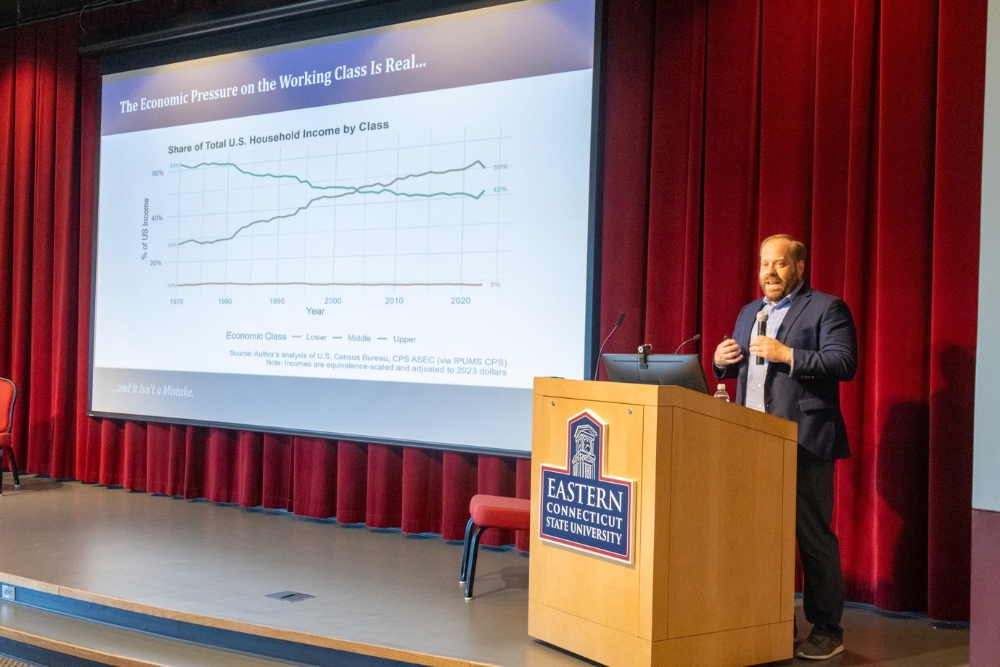
Eastern Connecticut State University hosted guest speaker Chris Rivers of Building a Better Future LLC for a University Hour presentation on Sept. 23. A renaissance man with a background in the military, engineering, politics, foreign policy, and public service, Rivers is also the author of the book “You Shouldn’t Have to Kill to Get Ahead.”
How we got here
Drawing from his diverse background, Rivers offered a challenging but manageable look at a future in his presentation titled “How we can fix a country that often feels broken.”
Rivers began by sharing his view of what led to America's current economic state, providing context for why so many may feel hopeless about succeeding economically. He pointed to the controversial economic reforms implemented by President Ronald Reagan in the 1980s, known as “Reaganomics.”
“We had Reagan, and he brought in … an era of deregulation, of getting rid of bureaucracy and red tape and tax cuts,” said Rivers.
Rivers explained that wages from 1985 to 2023 have decreased when adjusted for inflation, while the cost of living, education, healthcare, and median home price have skyrocketed.
Rivers clarified that Reagan, a republican, wasn’t the only one to blame, and that democrats continued Reaganomics into the 1990s, leading to a majority of wealth going to the upper class.
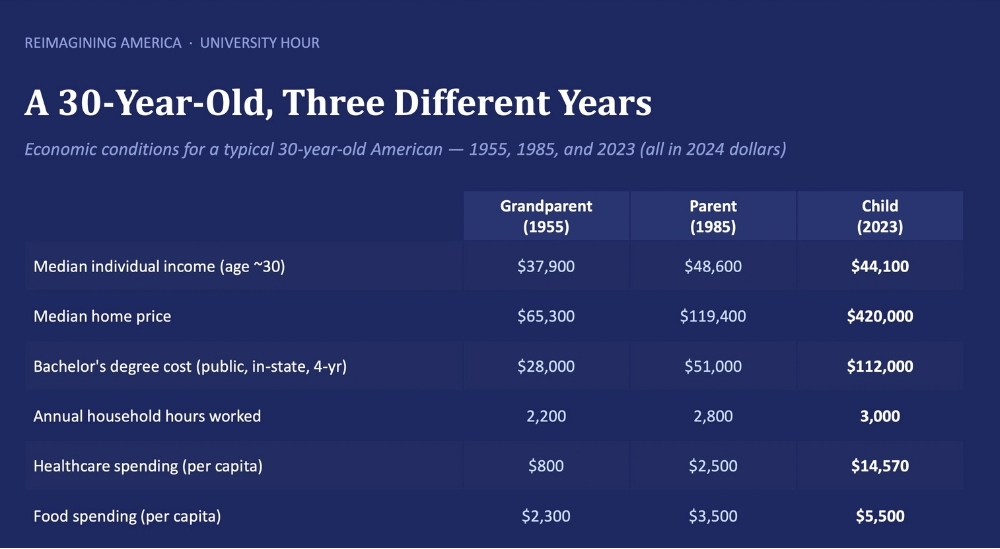
A graph showing the average cost of living for a 30-year-old in America in the years 1955, 1985, and 2023.
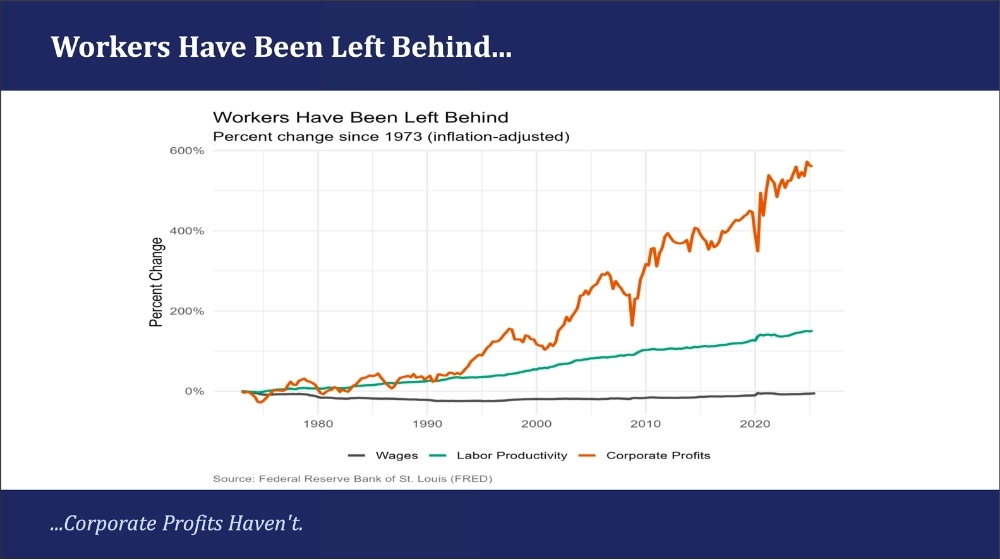
A graph showing how wages have stagnated while labor hours and corporate profits have increased.
“The philosophy that our economy and our politics have been based on for a very long time — decades now — is that companies [need to] maximize profits,” said Rivers. “It's called shareholder supremacy.”
Rivers compared the power of the dollar today to the post-World War II economy, drawing on what his grandparents were able to afford on a single-income household with seven children.
“My grandparents paid off their house in a very reasonable time, and that's because the median home price was just under half what he was earning,” said Rivers.
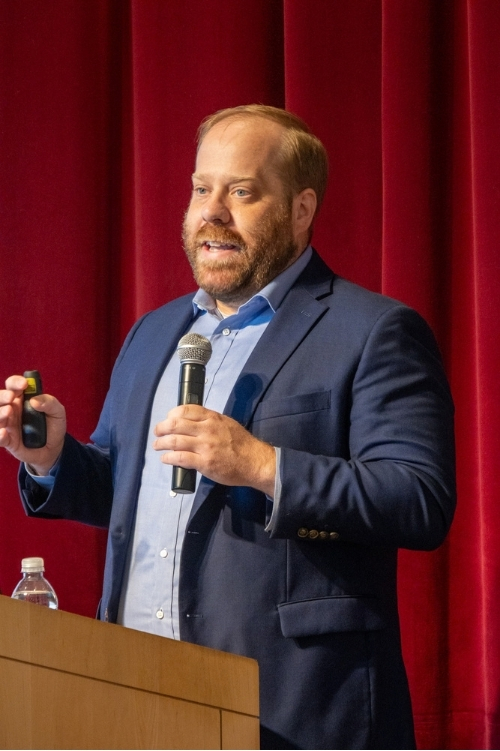
Rivers then tied in the lack of wage growth with the American national debt by correlating it with economic shocks in the '70s and '80s due to conflicts in the Middle East. In his opinion, the cost of the War on Terror is the main reason the national debt is so high, and that the American people are paying the price.
“The national debt is an obligation for every future worker to have to worry about paying,” said Rivers. “Every future decision we are going to have to face as a country... we're going to have to wonder: Can we afford it?”
How we can fix it
Despite the uncertainty of the future, Rivers stressed that the time for change is now. Urging people to get involved in local politics, vote in primaries, and engage in civil discourse with peers if they want to see change in their community.
“Our political system is made by the people who show up,” said Rivers. “Only about 20% of Americans actually show up to vote in primaries.”
Rivers then spoke on a cycle he noticed in every federal election, in which voters on both ends of the political spectrum feel the need to pick the lesser of two evils.
Rivers then closed out the presentation by explaining that the media is an "outrage machine" meant to demonize the opposite side, when in reality most people want the same future; a future with stability, opportunity, and an accessible "American Dream."
“We're mostly plugged into the outrage machine over and over and over again,” said Rivers. “If we want to actually influence American politics at a systemic level, we'd better be able to start talking about it with the people we care most about.”