- Apply
- Visit
- Request Info
- Give


Written by Kyle Berson '26
Published on October 12, 2026
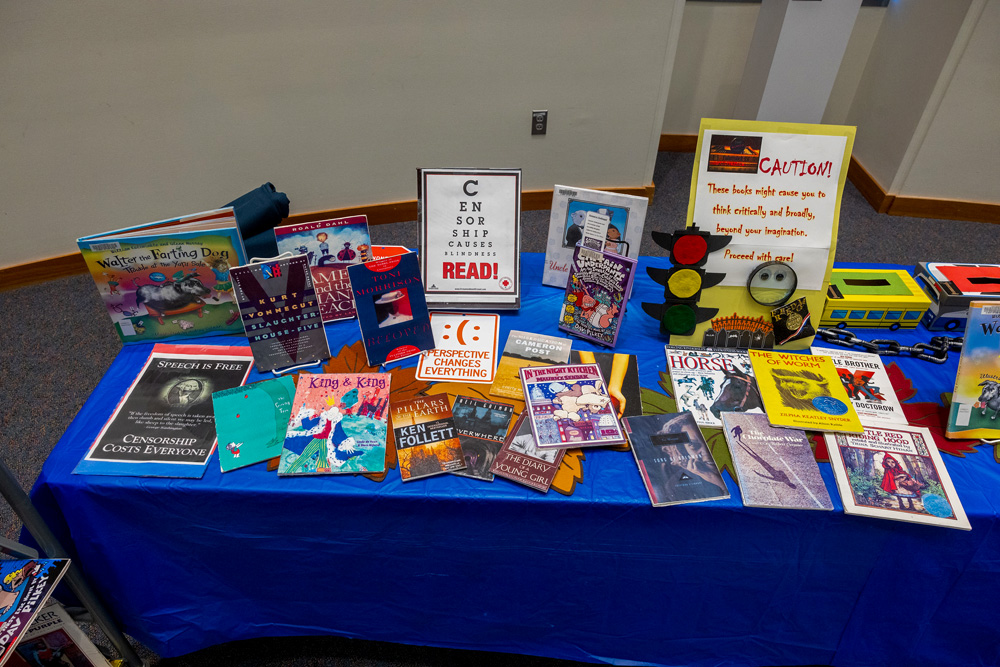
A display showing a collection of the most challenged and banned books in the United States.
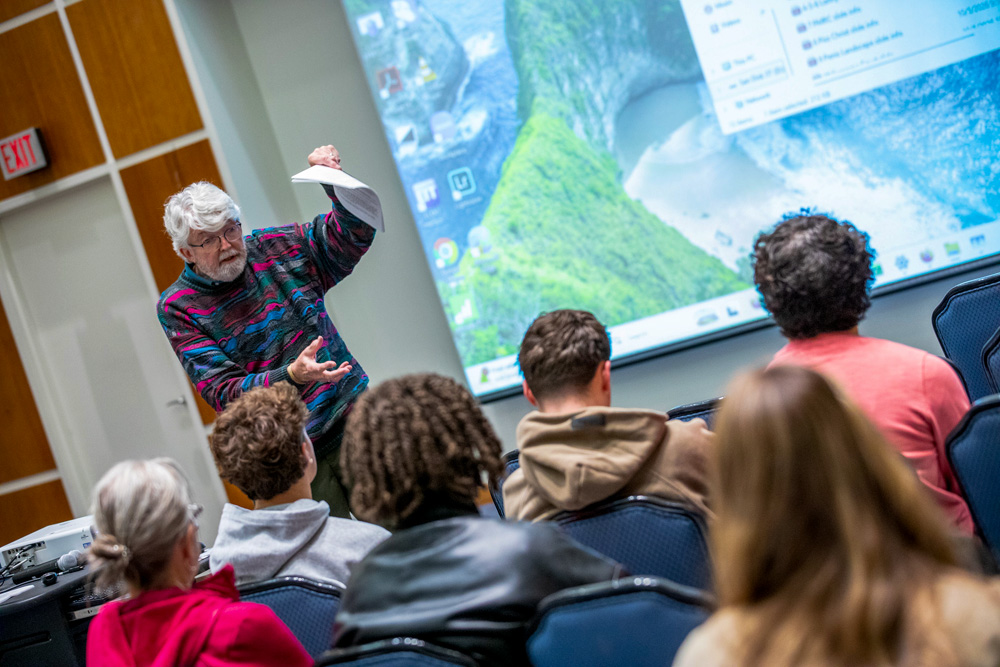
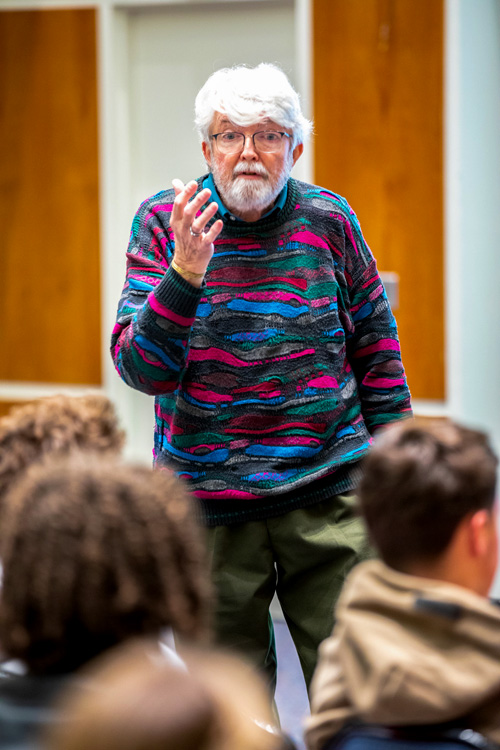
John Murphy, communication, film, and theatre lecturer, discusses censorship in broadcast media.
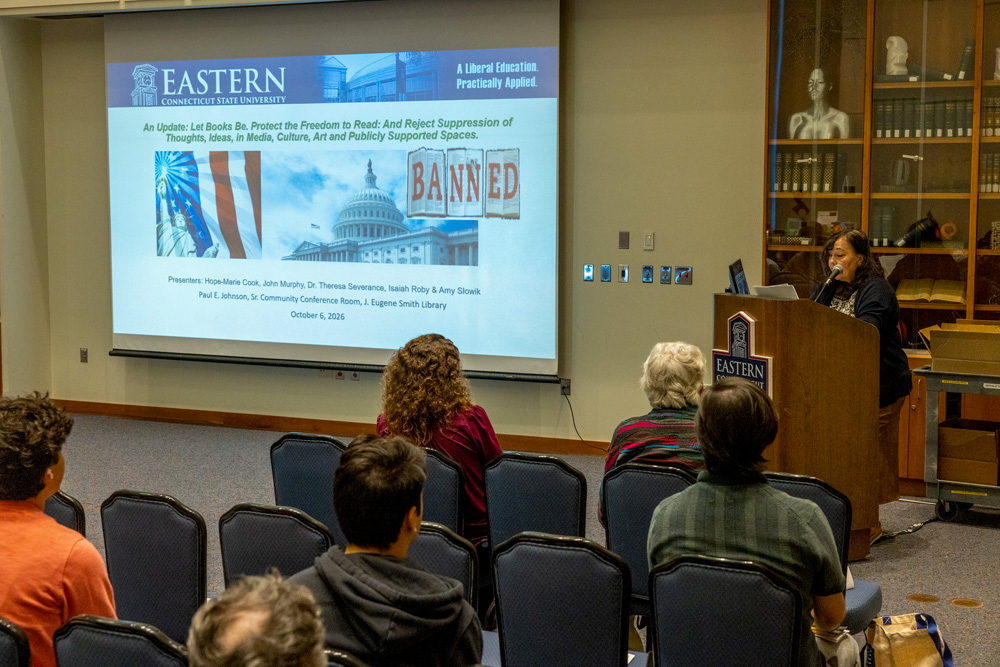
Hope-Marie Cook, librarian for education, gives a lecture on the state of censorship in American public schools and libraries.
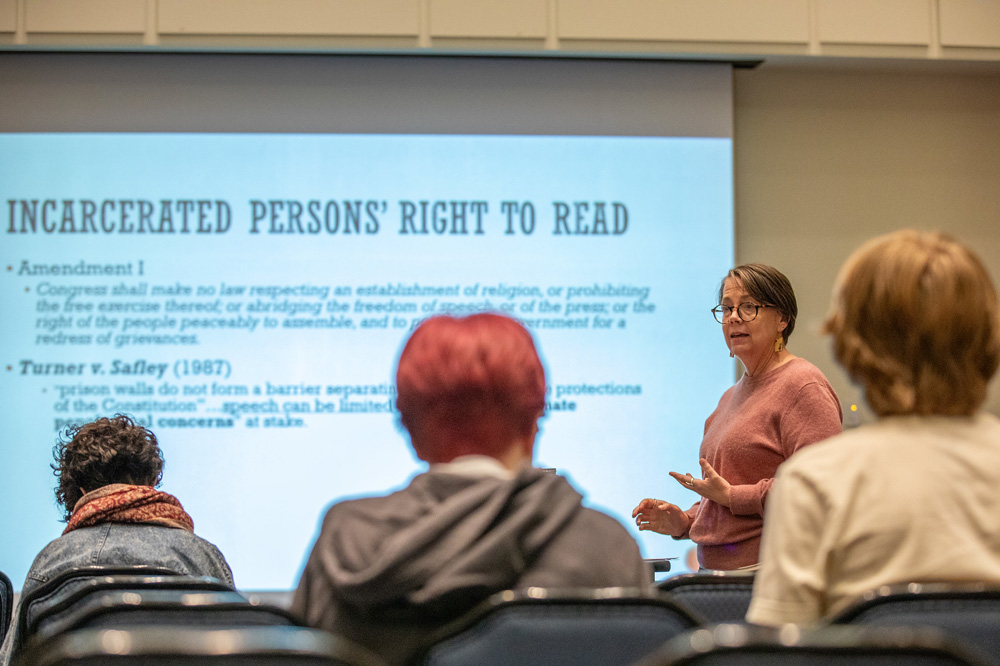
Theresa Severance, criminology professor, gives a lecture on the state of censorship within correctional institutions.
Eastern faculty, alumni, and guest speakers examined the state of censorship at a Banned Books Week-inspired event on Oct. 6.
Launched in 1982 in response to a surge in challenged books in public institutions, Banned Books Week -- Oct. 4-10 -- raises awareness of censorship in books and media and promotes free, open access to information. The week of events is observed nationwide and highlights the effects of censorship on intellectual freedom.
Eastern's program, titled “An Update: Let Books Be. Protect the Freedom to Read and Reject Suppression of Thoughts, Ideas in Media, Culture, Art, and Publicly Supported Spaces,” featured presentations by Librarian Hope-Marie Cook, Professors John Murphy and Theresa Severance, Russell Library Head of Youth and Family Learning Amy Slowik, and a video message from Eastern alum Isaiah Roby ‘13.
Hope-Marie Cook: ‘Knowledge is power’
Hope-Marie Cook, librarian for education and head of the Curriculum Center, provided an overview of the current state of censorship in the United States. “The number of books being censored has reached an all-time high since we first started these events almost 25 years ago,” she said.
She explained that in 2014, 300 books were challenged in American schools, while during the 2025-2026 academic year, that number rose to more than 12,000.
Cook also said that organized groups are increasingly driving challenges. According to the American Library Association (ALA), in 2025, 92% of book challenges in libraries and schools were put forward by organized campaigns rather than community members.
“Knowledge is power,” Cook said.
She asserted that censorship in libraries and schools can have significant consequences for students, educators, and communities.
She also explained how resistance to book bans has led to severe consequences for librarians and educators. “Librarians have lost their jobs and have even been threatened with confinement and jail time not removing books from their library or school.”
Cook holds concerns about the rise of censorship in schools and libraries, and hopes to raise awareness about people's rights to read whatever they deem appropriate. She also stressed that restricting access to diverse ideas and perspectives can hinder children's education and critical thinking skills.
John Murphy: ‘the internet is changing everything’
Communications, Film, and Theatre (CFT) Lecturer John Murphy discussed legal boundaries and regulations constituting censorship in broadcast media, and how modern technology challenges decades of legislation meant to protect children and families.
Broadcast radio and television are governed by the Federal Communications Commission (FCC), and are bound by their rules regarding obscene and indecent content. Murphy discussed the history of these rules, explained their implications on free speech and censorship, and discussed their importance in the digital age.
Murphy delved into two Supreme Court cases that shaped these rules.
“Miller v. California” (1973) classified obscene content as speech that met three criteria: an average person finds the material prurient, the material is sexually offensive according to local standards, and lacks any literary, artistic, political, or scientific value.
He explained that obscene content is not protected under the First Amendment of the United States Constitution, while indecent content is.
“Federal Communications Commission v. Pacifica Foundation” (1978) defined indecent content as potentially offensive material according to local standards. Indecent speech is protected under the First Amendment but is still prohibited in FCC-regulated broadcasts during daytime hours, meant to protect children from being exposed to indecent content.
While the FCC has prevented indecent and obscene material from reaching impressionable audiences since the 1970s, the popularization of the internet and social media has presented new challenges.
“These rules are still in play, but the internet is changing everything,” Murphy said. He explained that “the law has yet to catch up with technological advancements. Young people have access to content that has historically been inaccessible.”
He urged that stronger protections and regulations are required in the digital age to protect children and impressionable audiences from harmful content.
Theresa Severance: ‘a lot is up to discretion’
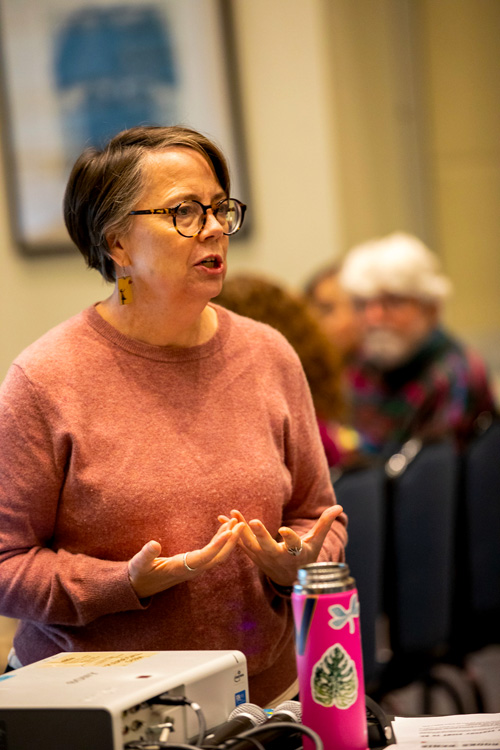
Theresa Severance, a criminology professor, discussed the state of censorship within correctional institutions and its effects on incarcerated people.
Drawing from her research in corrections, juvenile justice, and incarcerated women, Severance explored insights into how incarcerated populations consume information, and how restrictions shape their understanding of the world beyond prison walls.
“Why should we care?” she asked. Severance explained that 95% of incarcerated people will be readmitted into society, and that access to books, information, and education while in prison noticeably reduces reoffender rates after release.
“Incarcerated people still have a lot of rights, but they have limits,” she said, explaining that they still enjoy their First Amendment rights, but with restrictions.
She cited “Turner v. Safley” (1987), a Supreme Court decision that ruled correctional facilities may restrict incarcerated people's First Amendment rights if legitimate penological concerns about safety or security exist.
Severance said the Supreme Court’s vague language led to inequality between facilities.
“A lot is up to discretion,” She said. “Whose discretion?”
She continued that many decisions regarding speech and permitted materials are entirely up to the leadership of private correctional companies.
Severance said that commonly restricted material in prisons includes sexual content and nudity, depictions of crime, building plans, foreign-language dictionaries, and racial or LGBTQ+-focused content.
Although many restrictions are justified with regard to security and safety, she said some limitations unnecessarily impede access to information and educational resources.
She recalled teaching at York Correctional Institution, Connecticut’s only high-security women’s institution. Content restrictions were so far-reaching that she had trouble effectively teaching her students.
Severance concluded her presentation with a daunting reality – the same literacy programs that reduce re-offender rates don’t receive sufficient government funding.
“Our prison education programs regularly face steep budget cuts,” she said. “They’re mostly funded through philanthropy.”
The state of American censorship
While very few materials are banned for private sale and consumption in the United States, speakers said there has been a large surge of censorship in public libraries, public schools, and higher education institutions in the past decade. Challenges to ban materials in these spaces have not only surged, but the strategy, sentiment, and playbook for banning books and materials has changed in recent decades.
According to the American Library Association, 88% of challenges in 2025 occurred in public libraries and school libraries, while 8% were toward school curricula and 3% involved higher education institutions.
In libraries, the most frequently challenged titles often contain LGBTQ+ themes or references to sex or sexual content. Event organizers created a display of the nation’s most challenged titles.
Speakers also discussed the role of artificial intelligence in book challenges. An article by Gizmodo reported an Iowa school district used a chatbot to scan books for “supposed sexual content,” which led to the ban of several books without a formal complaint from a student, parent, or teacher.
Panelists also addressed censorship in government. According to the National Coalition Against Censorship, executive orders signed by President Donald Trump restrict officials’ ability to voice opinions on topics the administration deems controversial.
Executive orders also restrict the rhetoric surrounding American history, forcing the Smithsonian to reword and adjust several exhibits and events in the past year.