
- Apply
- Visit
- Request Info
- Give



Written by Kyle Berson '26 and Tim Stevens
Published on October 22, 2026

A breathtaking view of a vineyard in Tuscany with the sun rising, casting long shadows. Photo: Pixabay.

Global Wine Business Institute representatives and stakeholders at an event in Lisbon, Portugal.
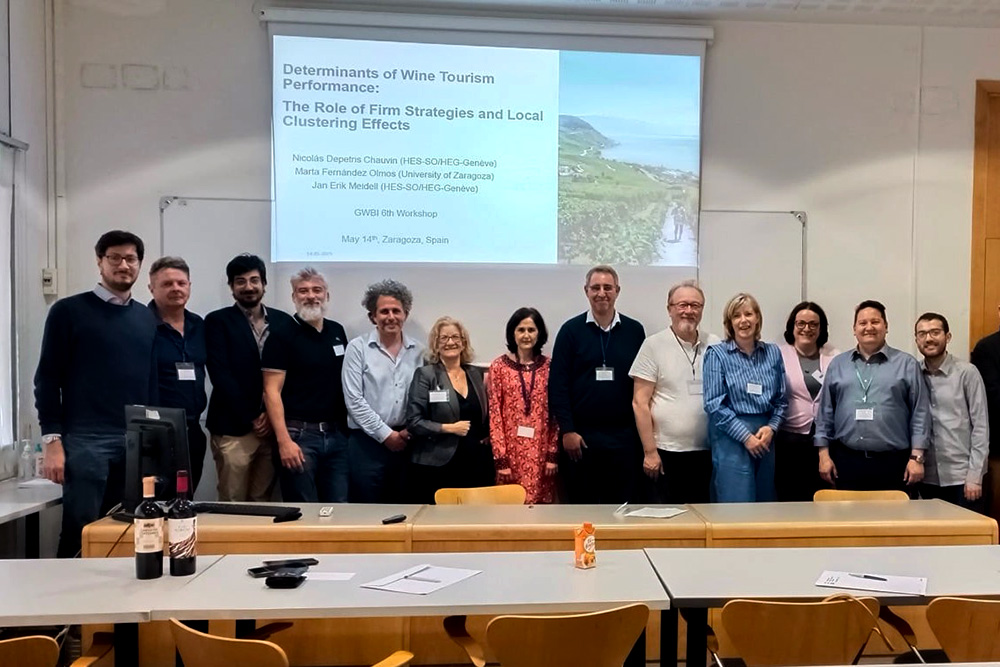
Global Wine Business Institute representatives and stakeholders at an event in Zaragoza, Spain.
For more than 8,000 years of recorded history, wine has held a place of significance in human ritual, socialization, and celebration. Today, while many consumers enjoy a wide variety of the fermented fruit of the vine at a multitude of occasions, few understand the existential threats facing the hundred-billion-dollar industry. The industry, on the other hand, is all too aware.

The Global Wine Business Institute (GWBI), co-founded by Eastern business administration professor Emiliano Villanueva, is also aware. It seeks to answer a growing call for adaptation amid rapidly changing consumer tastes and rising costs by providing a research, communications, and networking platform for wine professionals.
“The wine industry is undergoing significant structural transformation,” he said. “Changes in consumption, climate, technology, tourism, international trade, and consumer preferences are affecting virtually every wine-producing region.”
Inspiration for the organization came from the culmination of decades of discussions. Led by the Geneva School of Business Administration in Geneva, Switzerland, Eastern joined a coalition of 16 member institutions. Villanueva worked closely with Lead Founding Member Nicolás Depetris-Chauvin, a professor at the Geneva Business School. The duo has a long history of research and professional collaboration.
For Villanueva, the wine business has been a longstanding academic and personal interest.

“I am an Argentine-Italian national born in the wine country of Mendoza,” he said in a faculty spotlight series. “I come from a family with a long tradition in winemaking in Europe and South America.”
Villanueva has contributed several scholarly works to the field. In 2025, the professor became an assistant editor of the "Wine Business Journal," an open-source journal for wine business research and insights.
Connecting his work in academia, business administration, and wine research, Villanueva took great pride in the launch of the GWBI and in Eastern’s role as a founding institution.
“This allows me to represent Eastern within an international network while creating opportunities for our faculty, students, and institution to participate in collaborative research, conferences, workshops, and global industry engagement,” he said.
Depetris-Chauvin, on the other hand, began his research career in coffee. A move to Switzerland, however, facilitated a change in research pursuits. For the professor, wine immediately proved a compellingly similar industry.
“What stands out most is how deeply human the industry is. Wine is fundamentally about people, territory, and a shared culture,” Depetris-Chauvin said, highlighting the connections between coffee and wine.
“The Global Wine Business Institute originates in academia,” Villanueva said, “but its purpose extends well beyond academic collaboration.”
“Traditionally, academic incentives reward publishing in peer-reviewed journals, which can inadvertently detach research from the immediate operational realities of a business,” Depetris-Chauvin elaborated.
The institute connects wine research, organizations, wineries, and other stakeholders to directly contribute to improving the global wine industry. It also works as an open-source networking platform, allowing researchers, businesses, and partner institutions to easily share research and knowledge. The goal is to become a collective of information to help the global industry – from local wineries to broader communities – respond more effectively to a rapidly changing business climate.
“The wine industry is vast and highly diverse,” Villanueva said. “Each region has its own history, regulations, production systems, consumer markets, and competitive advantages.”
He continued, “International organizations help bring that expertise together. They improve communication, allow regions to learn from solutions developed in other contexts, and help industry participants make better-informed decisions.”
“High-quality empirical research often remains locked in academic silos, while winery managers and regional bodies lack a single, reliable hub for data-driven strategic insights,” Depetris-Chauvin added. “The GWBI was built to bridge that disconnect.”
Committed to change
So far, GWBI has gathered data from more than 5,000 wineries across 21 countries, gaining valuable insights into global, national, and regional wine production. The organization also meets wineries at home, hosting meetings and conferences in Italy, Spain, Portugal, and Australia, with plans to expand to reach new communities soon.
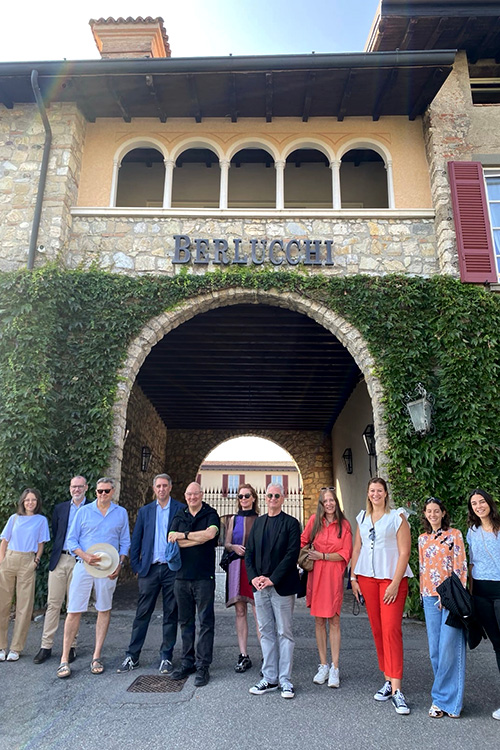
Although GWBI has global institutional support, most of its contributions are from volunteer academics, industry professionals, and organizations.
“That creates an extraordinary level of commitment,” Villanueva said. “But it also means that financial and time constraints are always present. Building an international organization requires sustained coordination and a great deal of goodwill.”
Connecting with winemakers, economists, and viticulturists at GWBI workshops has led Depetris-Chauvin to a striking realization.
“Despite differing hemispheres and histories, their vulnerabilities and hopes are identical,” he reflected. “Connecting those personal stories and the hard realities of resilience and market shifts made it obvious that the GWBI had to be more than just data, it had to be a bridge between people who care deeply about the same world.”
The organization’s success so far has Villanueva focused on expanding the institute’s international network, encouraging collaborative initiatives between institutions and businesses, and supporting innovative industry research. He also sees the success of the GWBI as pointing the way for similar academic institutes.
“Having international professional organizations like the GWBI is critical,” he said. “They provide a space for communication, collaboration, and knowledge exchange across countries and regions that often face similar challenges under very different conditions.”