- Apply
- Visit
- Request Info
- Give


Written by Kyle Berson '26 and Timothy Stevens
Published on October 14, 2026
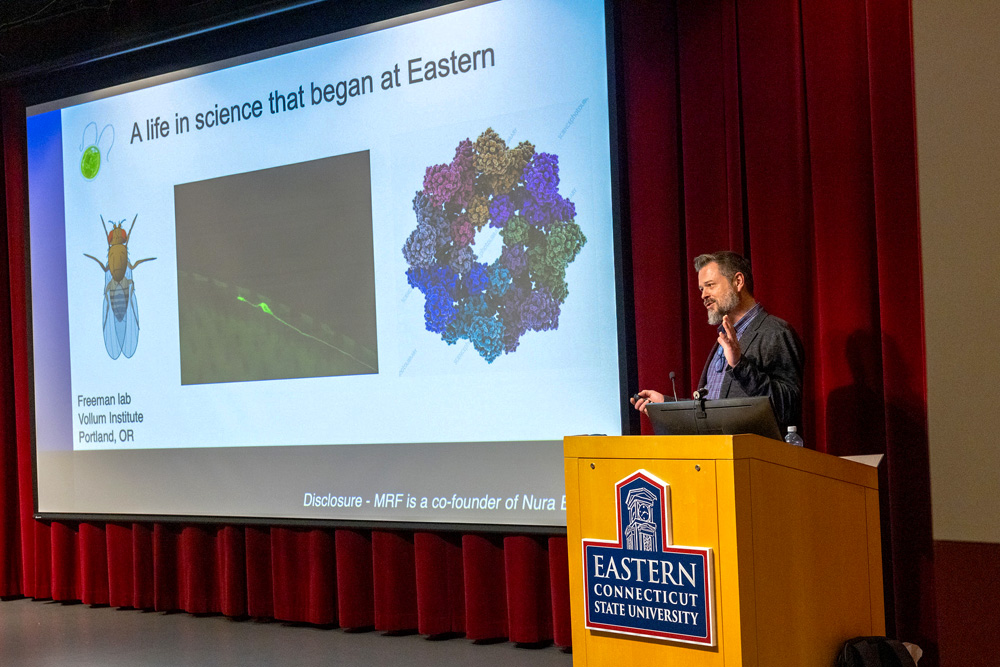
Everyone wants to become the top brass in their field, but award-winning neurobiologist Marc Freeman ‘93 did it. Freeman returned to Eastern Connecticut State University on Oct. 12 to share how his Eastern education helped him become a leading neurobiologist despite never taking a class in the subject.
Widely recognized as one of Eastern’s most distinguished alumni, Freeman is a 2026 inductee of the American Society of Arts and Sciences. As the director of the Vollum Institute — a leading research institution at Oregon Health and Science University (OHSU) — he is currently researching and developing a drug aimed at combating neurodegeneration in patients.
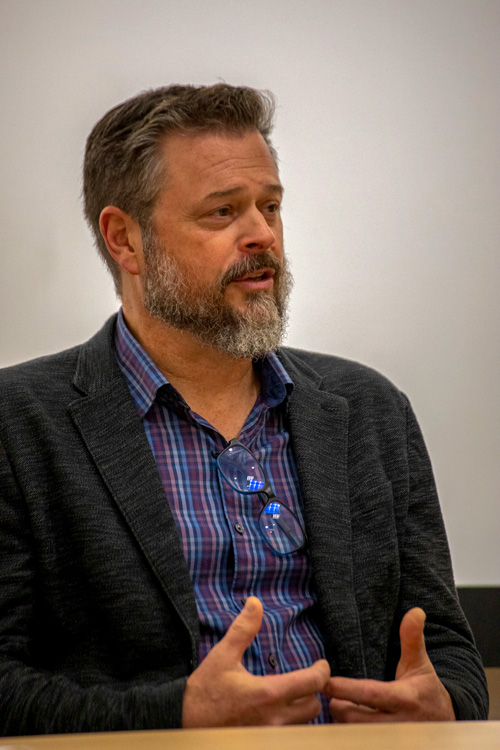
At Vollum Institute, Freeman and his department want to answer a big question: Can we reduce the cognitive effects of neurodegenerative disorders like Alzheimer's disease, Parkinson's, or amyotrophic lateral sclerosis (ALS)?
In a discovery that Freeman attributes mostly to luck, a student at the institute chose to research genetic mutations that may prevent axon (a part of the neuron) degeneration in flies. Through genetically subtracting random parts of the fly genome, the researchers discovered a new protein, SARM1, that contributes to axonal degeneration.
After the discovery in flies, the researchers genetically removed the gene responsible for SARM1 production from rodents. Tests showed that when injured, only neurons directly damaged died, while surrounding neurons stayed intact. Another unintended discovery – removing the gene from rodents had no observable negative side effects.
While genes can't be removed from living humans, researchers asked if a SARM1-inhibiting drug could be produced to inhibit the enzyme to replicate the outcome of the rodent test in humans. To facilitate that goal, Freeman co-founded Nura Bio with Steve McKnight of UT Southwestern Medical Center in 2018. The company secured hundreds of millions of dollars in funding to support research, development, and clinical trials. Five years later, the company started its first phase of human clinical trials. Currently, they are focusing their research on how the drug affects ALS patients.
Freeman wasn't always fond of academia. That changed at Eastern, when the late biology professor Michael Adams helped spark an appreciation for biology and genealogy, providing Freeman with mentorship and laboratory and research opportunities.
“He had an enormous effect on my life and the lives of many other people,” Freeman said. "Eighty percent or 90% of what I learned when I was at Eastern was from just standing next to him [in the lab], asking question after question.”
With support from Adams and others, Freeman became one of 12 Connecticut State Colleges and Universities (CSCU) students to receive the 1993 Henry Barnard Scholarship, a prestigious student award recognizing high academic achievement and impactful community service.
While his original career aspirations were to become a high school biology teacher, another Eastern mentor, Professor Chuck Woo, pushed Freeman to reconsider, encouraging him to remain in academia and pursue a doctorate degree instead. As a result, Freeman joined Yale University, earning a Ph.D. after six years of research into smell receptors in the brains of flies, which later became a major foundation for his future research.
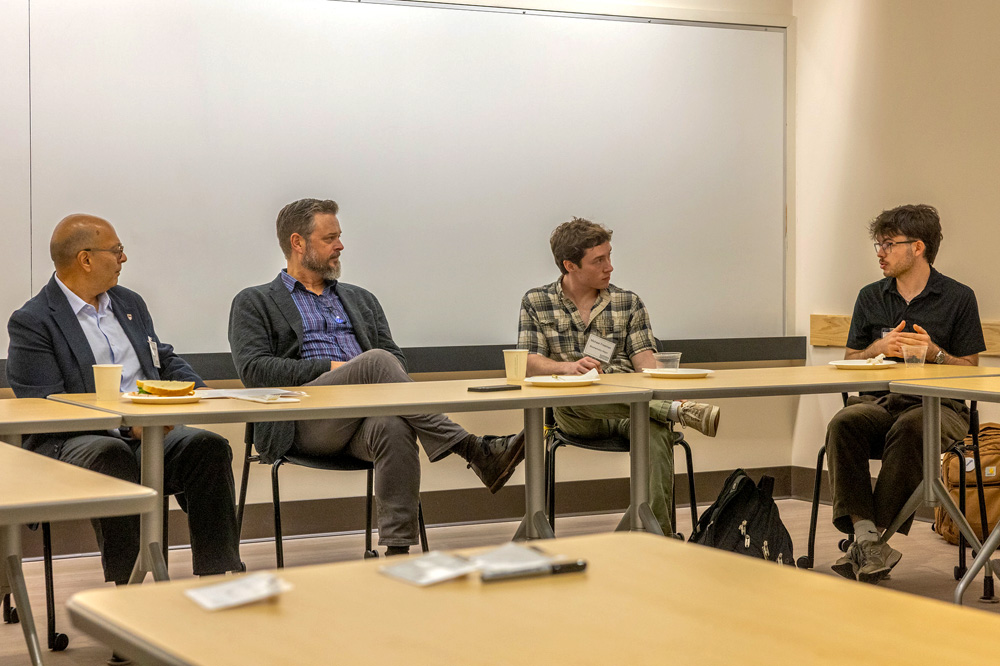
After earning his doctorate degree, Freeman continued research as a postdoctoral associate at the University of Oregon in 1999 where he learned two important lessons.
Lesson 1: “It’s better to be right than first.” One of his early papers at Oregon corrected another institution’s research that, in a rush to make a discovery, drew inaccurate conclusions. He explained that a paper he published corrected another institution's research that rushed to a discovery.
Lesson 2: “You have to be able to forget what you know, because you could be completely wrong.” Only by keeping your mind malleable can you do your best scientific research, he said.
In 2004, Freeman became an associate professor at the University of Massachusetts Medical School and eventually started his own laboratory in the Department of Neurobiology.
Admitting he initially struggled with his transition to leadership, Freeman reassured the audience, “Any normal non-sociopathic human should have some level of impostor syndrome. I think having a little bit of self-doubt is good, because it motivates you to work hard.”
Throughout his academic journey, Freeman collected several accolades, including being selected as a Smith Family New Investigator in 2004 and an Alfred P. Sloan Research Fellow in 2005. From 2009 to 2012, he served as one of 50 Howard Hughes Medical Institute (HHMI) Early Career Scientists, and as an HHMI investigator from 2013 to 2016.
After 13 years at UMASS, Freeman moved to director of the Vollum Institute, where he oversees 16 full-time faculty studying molecular transmission and a graduate program with 60 students.
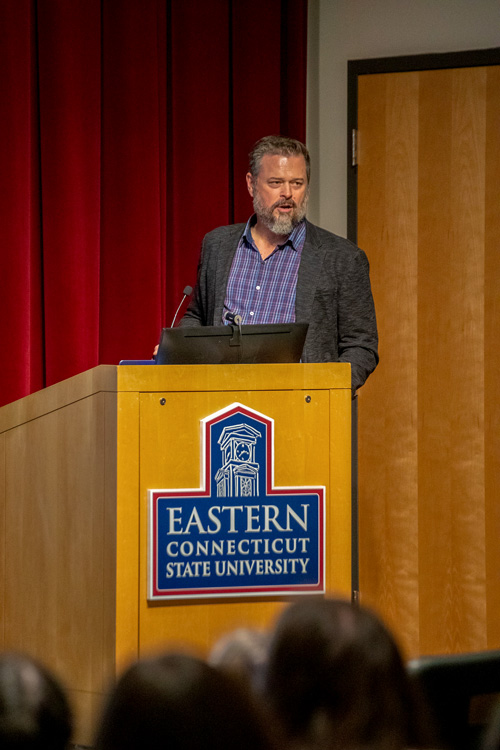
After Freeman’s presentation, the audience joined a question-and-answer session, where he offered industry and career advice based on his experience.
“Right now is a moment in science where, as young people, there are a lot of forces making it harder to become a scientist,” he admitted. “Don’t worry about those. We will survive it, and science really can be a wonderful career.”
Freeman attributed part of his success in neuroscience to luck and studying the “weird.” “Find the weirdest thing in your field and study it,” he encouraged students.
Another point Freeman stressed was that communication skills are a must in science. From securing grants to speaking with media, “you have to tell the world about your cool science, or else no one will care.”
That’s especially the case when it comes to funding proposals. Whether soliciting the government or private donors for research funds, having a well-communicated proposal drastically increases the chances of being accepted.
He also gave future leaders in the audience advice in team building. "You'll do better if you just hire good people," he said.
He referenced when many faculty members retired at Vollum Institute, Freeman was responsible for hiring their replacements. He took pride in the team he built, highlighting that making good recruitment decisions early on can have favorable long-term effects.