- Apply
- Visit
- Request Info
- Give



Written by Savannah Striano ‘25
Published on October 14, 2026
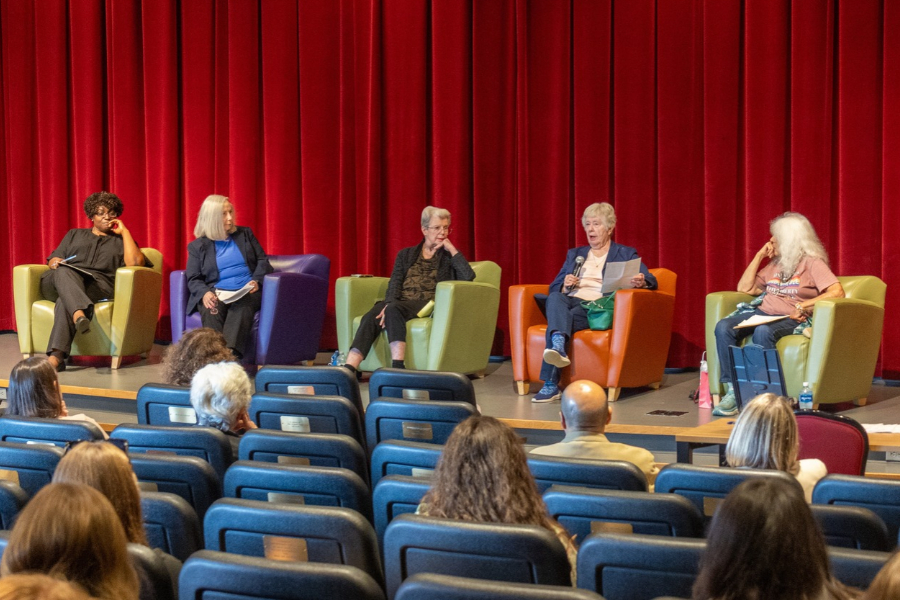
Eastern hosts a panel titled "Why Women's and Gender Studies Still Matters," featuring Nana Amos, Sarah Smith, Marcia McGowan, Sue Harkness, and Loretta Wrobel.
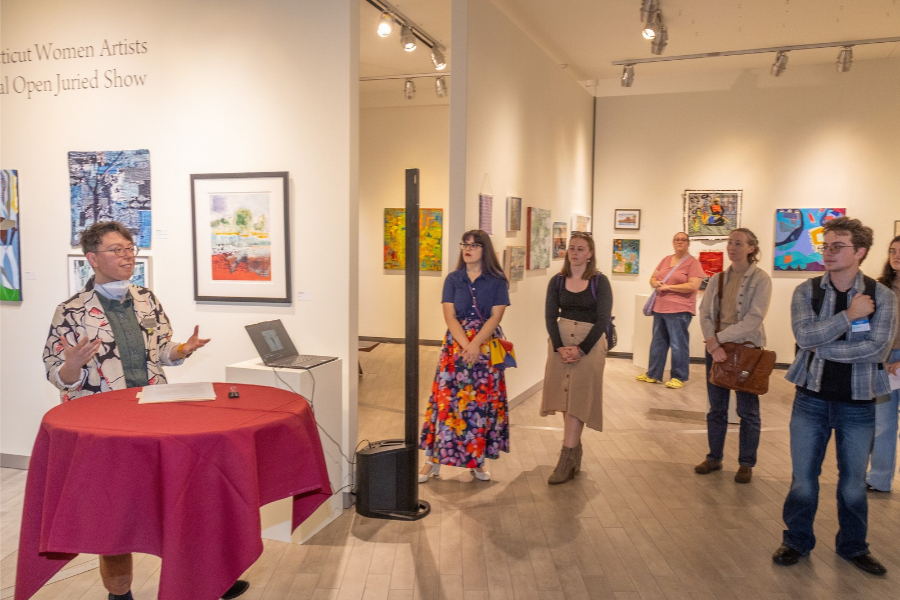
Maeve Doyle, art history professor and WGS co-director, speaks during the program’s 45th anniversary celebration.
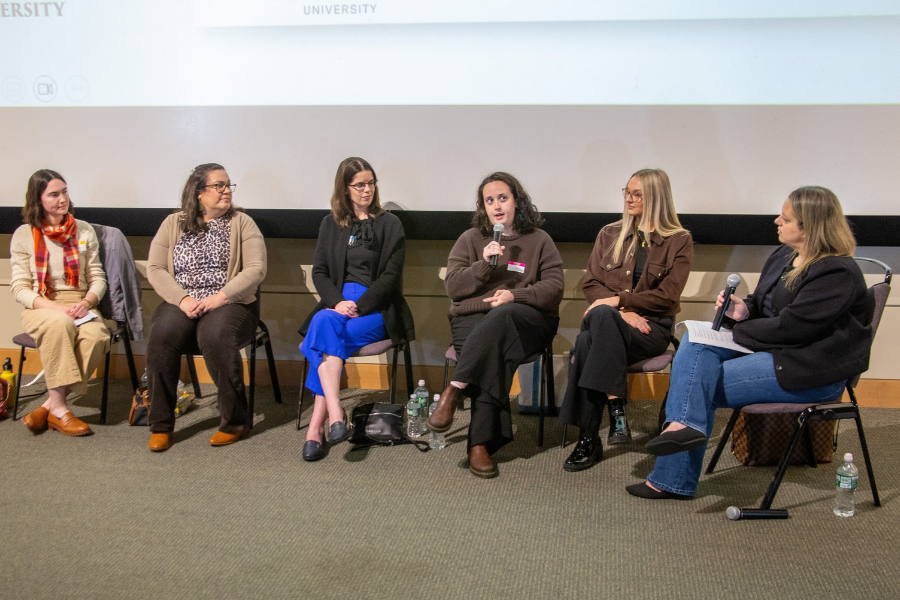
Alumni participate in a panel discussion during the 45th anniversary celebration of Eastern's WGS program.
When Marcia McGowan applied for a credit card in her 20s, she was told she needed her husband’s signature. At the time, he was stationed in Greenland with the Coast Guard.
“It kind of made me a little bit angry,” McGowan said. “In fact, it made me very angry.”
That anger helped push McGowan, now a distinguished professor emerita of English, to help found Eastern Connecticut State University’s women’s and gender studies (WGS) program. This fall, the program marked its 45th birthday with several events over two weeks.
The anniversary events included a panel of members of the American Association of University Women and a birthday party on Sept. 30, as well as a student research showcase and alumni panel on Oct. 6, among others.
“So why do women’s and gender studies matter? I’m gonna be honest. Some people think it doesn’t,” said Cara Bergstrom-Lynch, professor of sociology and the WGS program's co-director. She pointed to the University of Texas at Austin, which announced in September that it would eliminate its WGS major.
Eastern, by contrast, is the only institution in the Connecticut State Colleges and Universities system with an undergraduate major in WGS.
When asked why she thinks the field matters, Bergstrom-Lynch had many names and phrases come to mind, but the most prominent: “Things like equal pay, paid leave, freedom of choice, transgender equality, the #MeToo [movement].”
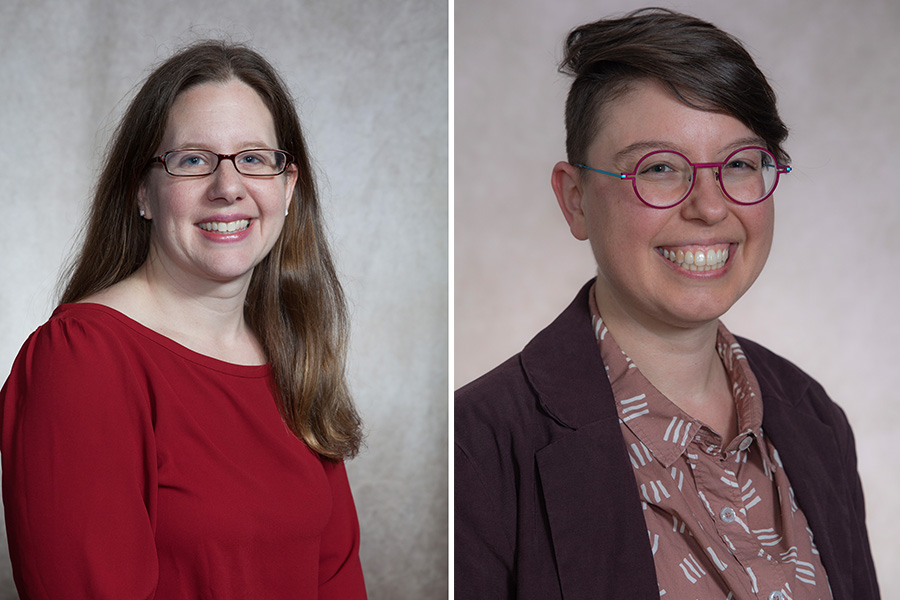
The inspiration behind the celebration grew out of a library internship. Bergstrom-Lynch credited Madison Dashnaw ’26, a recent graduate whose work cataloging the program’s history with archivist Tara Hurt “sparked the idea for these celebrations.”
The program began in 1981 as a women’s studies minor and became a major in 2012, renamed WGS, according to Bergstrom-Lynch, “to acknowledge that the field had expanded.”
In the minor’s early days, students could choose from eight classes in four disciplines, according to Maeve Doyle, the program’s other co-director and chair of the Department of Art and Art History. Today, 11 disciplines contribute to the major.
‘Progress is not an escalator’
At the Sept. 30 panel, “Why Women's and Gender Studies (Still) Matters,” McGowan said she and colleagues, including longtime program director Maureen McDonnell, organized a few scattered courses into a minor and later a major, despite resistance from some members of the campus community.
Sue Harkness ’87 recalled working in the University’s then-new Women's Center nearly 40 years ago for $7 an hour.
Sarah Smith, a retired teacher, asked the audience to imagine 1960. “As an American woman, you could be legally fired for being pregnant,” she said. She added that women could be turned away from banks without a father’s or husband’s approval.
Smith traced the laws that followed, citing the Equal Pay Act and Title IX, but warned that the reversal of Roe v. Wade showed such rights can be lost. “History has revealed that progress is not an escalator,” she said.
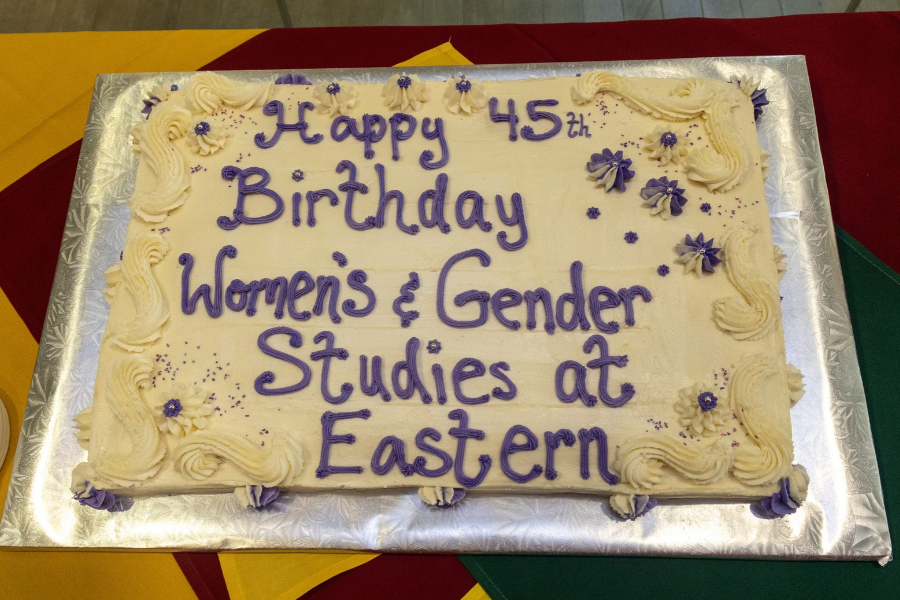
A cake commemorates the 45th anniversary of women’s and gender studies at Eastern.
Nana Amos, president of the American Association of University Women (AAUW) Connecticut, spoke of her own experience as a Black woman who has spent much of her career in higher education.
She said women on campuses still face bias, harassment, and barriers to advancement, and that WGS gives them the language to name it.
“Maybe the question we should be asking our students, and ourselves, is, what will we do with what we know?” Amos said.
Loretta Wrobel, co-president of the AAUW's Storrs-Willimantic branch, helped start a women's center, a safehouse and domestic violence shelter program, and a feminist therapy collective in Hartford in the 1970s. Now, she said, that progress is eroding.
“Use your loud outside voice,” she told students.
After the panel, guests moved to the art gallery for a birthday party where they celebrated with cake, music, and good conversation.
Shannon Carbonell, an English and education senior, recently received a $500 scholarship for excellence in WGS. She called the anniversary “45 years of accomplishment,” much of it long overlooked. “Now we're getting noticed,” she said.
Research beyond the classroom
At the research showcase, students presented interview-based projects exploring topics like reproductive health care, body image, and gender identity. Natalia Grant, a history and social sciences senior, worked with classmates Kendall Garrity and Sawyer Joslin on a project examining gender inequalities.
Grant said the field still faces skepticism. “It's definitely a field that a lot of people don't take seriously,” she said. That makes it meaningful, she said, that Eastern is “taking this stance to not only provide this as a major and a minor, but also celebrating its birthday on campus.”
Carbonell presented her project on women’s madness in the fiction of Louisa May Alcott. Madness in 19th-century literature is often read as a symbol of feminist rebellion, she said, “but there's actually so much more to it.” Alcott’s women find a way through, she said, with the help of community.
“Women's and gender studies is about being in a coalition. We work with all other groups,” Carbonell said. “You're fighting for justice for all. Not just one group.”
Leopoldine Bertrand, a psychology senior, studied how fear of immigration enforcement affects Haitian immigrant women’s access to health care. The federal government ended Temporary Protected Status for Haiti effective July 27, 2026. Bertrand said seeing “your own community hurt by this, and especially women,” has been “very emotional.”
She continued: “Whatever has to do with one population has to do with all when it comes to feminism.”
Alumni put their degrees to work
The Oct. 6 alumni panel took on one of the major’s most frequently asked questions: What do you do with that degree? Moderator Katie D'Antonio ‘08, an academic advisor at UConn and lecturer at Eastern, said people still ask her, “What do you teach?”
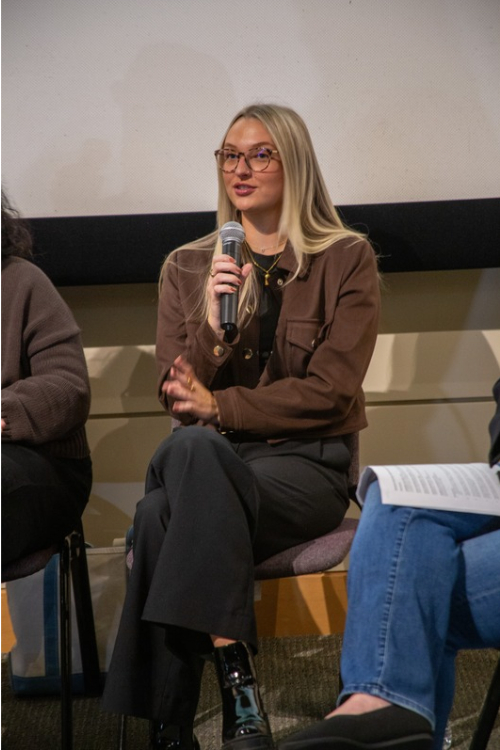
Panelists Andrea Slater ‘18, Julie Rodriguez Cadell ‘15, Jackie Bessette ‘19, Isabella Esposito ‘24 and Alex Comstock ‘22 have built careers in archives, dental billing, therapy, public health, and financial aid. Several said the major taught them to see what others overlook.
Bessette, a therapist, said some clients chose her because her online bio lists her WGS degree. The field also taught her to speak up. “I can have a voice,” she said. “I don’t have to tolerate being treated poorly in a workplace.”
Slater, an archivist at the Connecticut Museum of Culture and History, works to fill gaps in the historical record. “The way that we document history and the things we have kept is not always representative of all the people,” she said.
Comstock, a senior financial aid counselor at Goodwin University, changed careers after graduating but said, “I was still able to use every skill that I learned from this major.”
The next 45 years
Looking ahead, Bergstrom-Lynch pointed to recent setbacks, including restrictions on reproductive health care and anti-transgender legislation.
“Over the next 45 years, I anticipate a new generation of feminist leaders — including many of our current Eastern students — will raise their voices to address the issues they see,” she said.
Doyle said the field’s central issues, including social justice, equity, and acceptance, affect everyone. They hope students see Eastern’'s learning outcomes, like ethical reasoning and critical thinking, as more than classroom objectives, calling them “tools for realizing actual change in the world.”