- Apply
- Visit
- Request Info
- Give



Written by Tim Stevens
Published on October 28, 2026
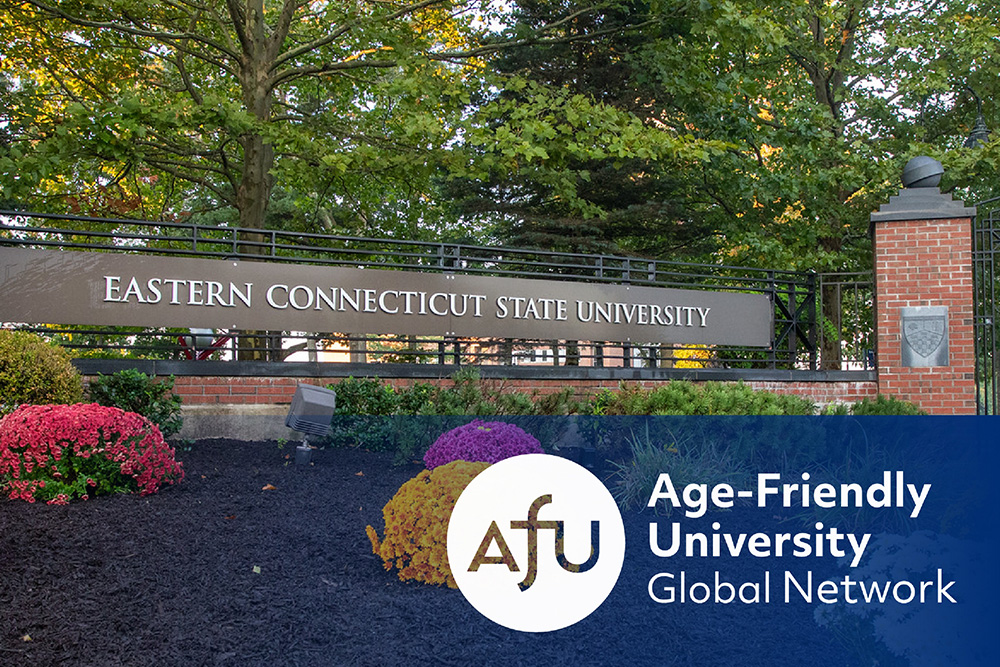
Eastern Connecticut State University is committed to being an environment where students from all backgrounds gather. It is that commitment that led the University to join the Age-Friendly University (AFU) Global Network this fall.
The organization, which began in Dublin in 2012, describes itself as “a consortium of higher education institutions committed to promoting positive and healthy aging and enhancing the lives of older members of the global community.”
The AFU network commits to several core principles, including lifelong learning and career development; diverse and accessible educational opportunities; intergenerational learning; research and public dialogue on aging; understanding the benefits of longevity; access to health, wellness, and cultural programs; engagement with university retirees; and collaboration with organizations representing older adults.
These principles align with activities already underway at Eastern. Psychology Professor Jennifer Leszczyński, who helped bring the AFU network to campus, hopes formally declaring Eastern age-friendly will support additional campus efforts.
“[Joining] gives us a centralized location to have discussions about what we’re doing already and, then, what we could do next,” she said.
Returning retirees
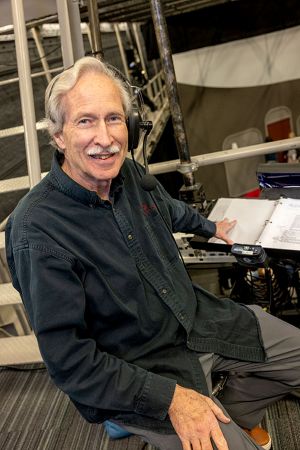
When Tom Goodin ’73 first attended Eastern, the University’s strong reputation for teacher training and affordable tuition were its main draws. More than five decades after graduation, Goodin returned to campus.
After retiring in 2012, he felt increasingly drawn to his longtime passion, theatre. That, combined with his alma mater’s new Fine Arts Instructional Center (FAIC) and performance venues, inspired him to return to pursue a degree in communication, film, and theatre (CFT) with a concentration in performance.
He exemplifies one of those efforts already underway. In the past five years, Eastern has graduated 54 students over the age of 50, including Larraine Rubacha ’25, who received her diploma five months after turning 81.
“At my age I was a little concerned whether other students would be comfortable with my presence, but that was never a problem,” Goodin recalled. “The professors and students were welcoming. It felt like a community.
“Enrolling as a new student was easy,” he added. “The staff was helpful and informative.”
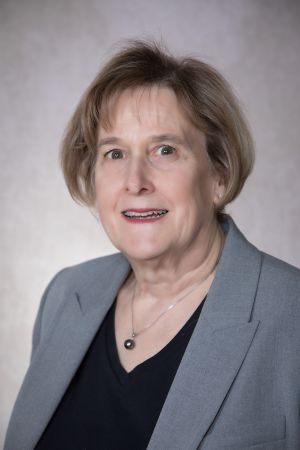
Academically, the University’s commitment to age-friendliness doesn’t stop with students. Efforts have already begun to give professors emerita opportunities to continue teaching after retirement. Professor Marsha Davis is one teacher happily embracing this new opportunity. She sees it as a chance to finish a project she started as a full professor.
“I helped create the applied data science master’s program and would like to see it succeed,” she said. “I have continued to teach the [online] graduate data science courses that I developed through BISK” — the service provider for the University’s online graduate programs.
"Endless opportunities"
Cultivating connections between the University and older adults doesn’t stop with the classroom, either. For instance, the Center for Community Engagement (CCE) regularly brings student volunteers to St. Joseph Living Center and Douglas Manor. This creates opportunities for two populations who have plenty to offer each other but rarely intermingle or have a chance to meet and interact.
Students and the residents play games, bake, celebrate birthdays, and even attend magic shows together. At Douglas Manor in particular, student leaders get to step up and not just participate in events but plan them. The CCE is also planning a third volunteer option at the Windham Senior Center, where students will teach older members of the Willimantic community how to use and feel comfortable with current technology.
Leszczyński anticipates these opportunities will soon flow in the other direction as well, with seniors coming onto campus so traditional students can learn from them. For example, the nursing program is looking to set up a simulation lab with seniors as volunteers. She also cited her own class, Psychology of Adulthood and Aging, as one such area where conversations are taking place.
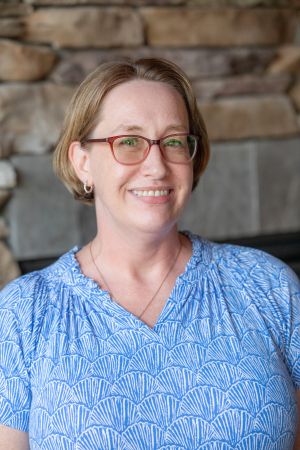
In part because of those conversations, Leszczyński says one of her students in that class went on to organize Eastern’s participation in a fundraising walk to benefit Alzheimer’s Disease research. This initiative has become a recurring campus event. She argues that facilitating these encounters is both a fruitful initiative and surprisingly easy.
“Seniors learn and our students learn when you get them together,” Leszczyński said. “All you have to do is just give them a simple question.”
The professor emphasized that building an age-friendly campus will be a collaborative effort. Eastern will report on its progress to the AFU network after five years, giving the University time to develop ideas and build on existing programs. While she has ideas of her own, she views herself as more of a conduit, a place where people across campus can bring their thoughts and projects going forward. Working together, driven by a multitude of perspectives, is the smartest way to build the best possible age-friendly campus.
“The opportunities are endless,” she stressed. “What everybody imagines it to be is what it can be.”
Although the University has just started the process, it already has at least one endorsement.
Goodin asserted, “I would tell any senior citizen interested in college courses or pursuing a degree, Eastern Connecticut has a beautiful campus and a great community.”