- Apply
- Visit
- Request Info
- Give



Written by Tim Stevens
Published on October 29, 2026
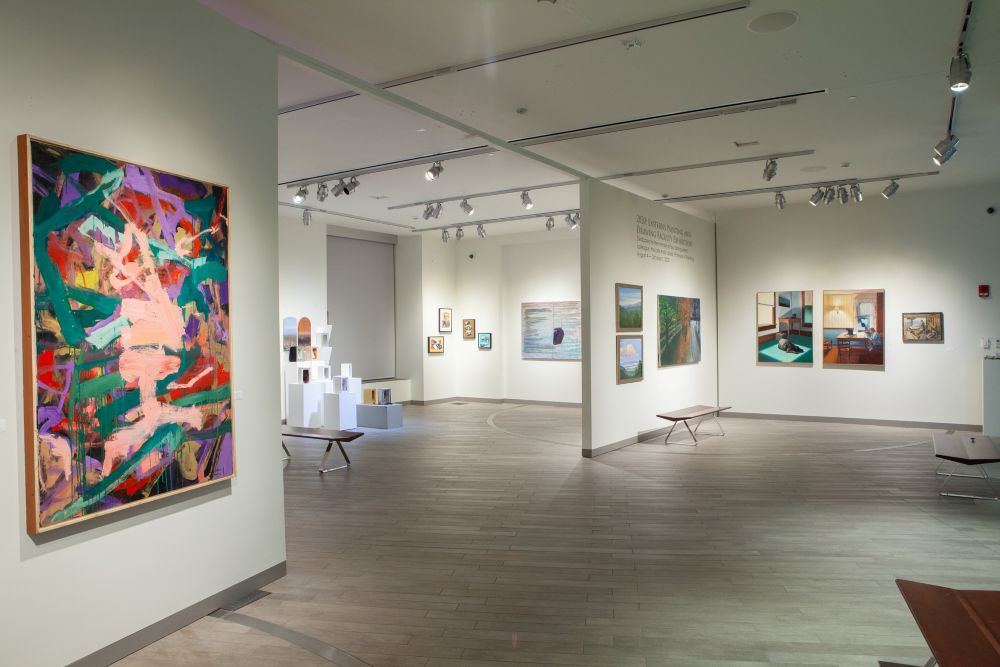
For Art Professor Sarah Churchill, Eastern’s new Art Gallery Director, art exhibitions are about storytelling. To be an effective and ethical director, one must ask who historically has been given the right to tell their stories and who has been left out, she believes.
Those questions are at the center of her decision to move the University’s art gallery toward a community curation model. The approach broadens who is involved in selecting and approving exhibitions, while rejecting the idea that a single curatorial voice should guide the gallery.
“This gallery is a public institution; what we do is for the public,” she asserted. “My instinct, then, is that this is a responsibility that should be shaped and shared by the community itself.”
With that responsibility at the forefront of her mind, Churchill hopes to draw on her background in cultural and art history and museum education to mold the gallery into something more than a place to encounter art. She sees it as evolving into a space that reflects the University’s public mission, fosters relationships between students and professional artists, and creates greater opportunities for the community to participate in the exhibition process.
A commitment to public education
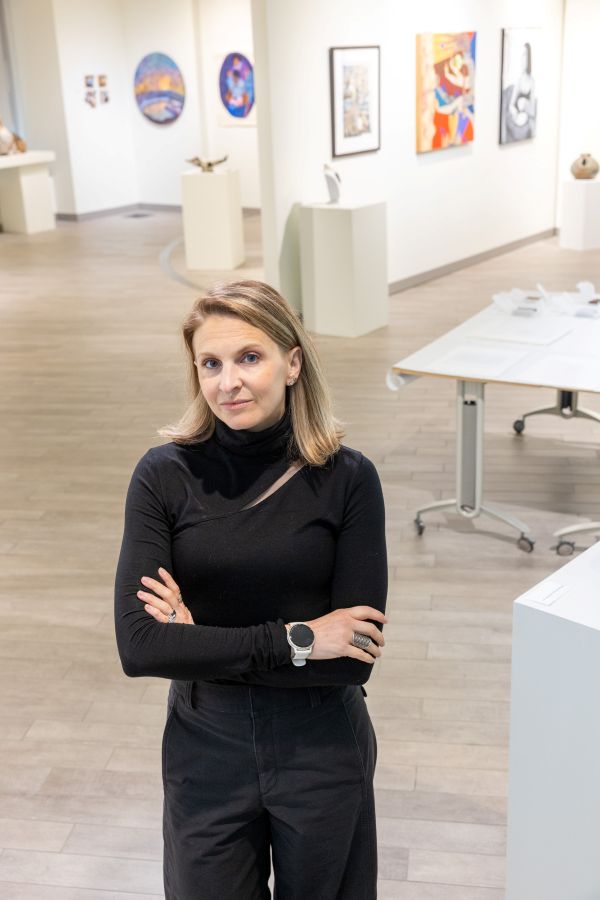
Churchill’s dedication to public higher education started with her own undergraduate experience.
“I went to Massachusetts College of Art and Design, which is the only public art school in the entire country,” she said. “So, I am the product of a public university … a working-class academic.”
Those roots continue to guide her today, inspiring her to act as “a passionate advocate for not just public higher ed, but for workers’ rights in all regards.” That commitment extends to the artists whose work she hopes to bring to Eastern.
“Artists deserve funds for all the work that goes into exhibition preparation,” she said.
For Churchill, however, limited funding means making difficult choices. Transportation costs can put some exhibitions beyond the gallery’s budget, making local projects more feasible to support.
“When we say we would love to work with anyone, we absolutely would,” she said. “The reality is … we’re probably best able to fund projects that are more local.”
From creation to education
Churchill’s path to teaching and curation began with her own creative pursuits, with early work as an illustrator and artist leading to a deep interest in art history. Inspired, she headed to Ireland for a master’s program at Trinity College Dublin. Posts at the Wadsworth, the New Britain Museum of American Art, and the Barnum Museum followed.
Then came an opportunity to work at Ireland’s Great Hunger Institute at Quinnipiac University. There, she was involved in educational outreach as well as exhibition and event planning. Those experiences lit a fire under her to achieve her Ph.D. in cultural history. In doing so, she found another reason to pursue community curation.
“My focus really has been on the role that art, and specifically visual culture, photography, plays in shaping our perception of the world,” she explained.
Sharing the curatorial voice
That focus is another tenet of Churchill’s enthusiasm for community curation. For her, it gives the gallery a way to reconsider the traditional assumptions at the heart of so many acts of curation.
“An important part of my training, particularly in my Ph.D., has been the study of museum decolonization, where we begin to rethink and unpack all the ways in which single dominant narrative viewpoints have shaped collections, institutions, exhibitions,” she reflected.
In community curation, the next step after questioning the old paradigms is offering a new path forward. At Eastern, the approach will allow students to help review professional proposals from artists interested in exhibiting at the gallery. That involvement is as much about learning as it is about representation, according to the professor.
“Allowing students into this process of being able to review professional proposals from artists who want to show in our gallery means they kind of get this front-row seat to see how the business is operating,” said Churchill.
From that seat, she believes students will gain a more complete vision of the field. In the classroom, they will hone their creative skills. At the same time, helping with exhibition decisions will give them insight into how artists present their work, reach audiences, and pursue further professional opportunities.
What comes next
While the gallery’s next exhibition, “Echoes of the Circle: The Eastern Community Mandala,” was planned before Churchill’s arrival on campus, its mix of faculty, staff, and student works offers at least some indication of what community curation in action may look like.
With the first round of proposals due in November, the gallery director hopes students will begin reviewing them in December. That’s their first step in joining the decision-making process that will guide the gallery’s future.
She also hopes to attract artists interested in contributing to student learning beyond the exhibition itself. She envisions workshops, artist talks, portfolio reviews, and more.
Churchill said, “We would love to have artists who would be really excited to work with our students.”
By giving students and community members a greater voice in what appears on the gallery walls, Churchill hopes to broaden not only the range of art Eastern presents, but also the range of perspectives its exhibitions bring into view.