- Apply
- Visit
- Request Info
- Give


Published on September 30, 2026
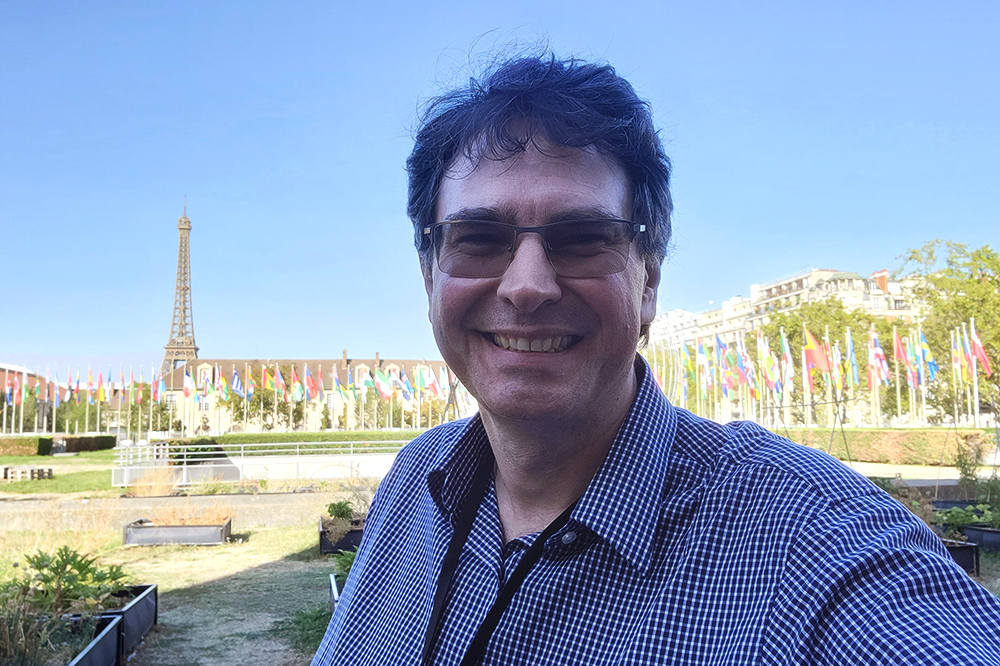
Eastern sociology Professor Nicolas Simon participated in a digital learning conference this September in Paris, France, hosted by the United Nations Educational, Scientific, and Cultural Organization (UNESCO).
This year’s conference placed a particular emphasis on artificial intelligence and its rapidly expanding role in education, providing an international forum for educators, researchers, policymakers, and other stakeholders to explore both the opportunities and challenges created by AI.
Simon’s participation built upon his longstanding work in open educational resources (OER) and open education. At the center of his work are passions for the creation, sharing, and democratization of knowledge.
On campus, Simon works closely with Eastern’s Center for Community Engagement and is a leading voice for expanding access to OER resources -- free and easily accessible learning materials -- in local classrooms. Last year, he translated galleries, libraries, archives, and museums (GLAM) OER resources from English to French, expanding access to the resources for the Francophone world.
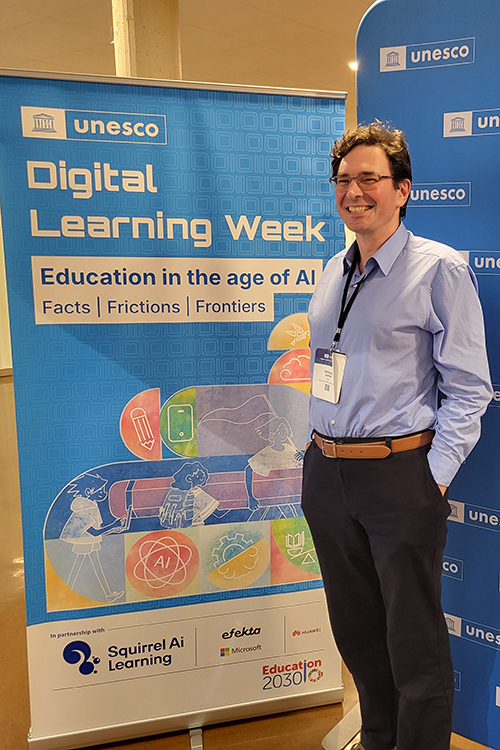
The discussions at this year's UNESCO "Digital Learning Week" reinforced his belief that, in an age when artificial intelligence can generate information and content almost instantaneously, a liberal arts education is more important than ever.
“AI can create an extraordinary amount of content, but students still need to know how to evaluate what AI creates,” said Simon.
“The question is no longer simply whether students can access information or generate content. ... They need the critical thinking, ethical reasoning, creativity, communication, and quantitative literacy skills necessary to question, interpret, evaluate, and improve that content.”
For Simon, the growth of generative AI therefore does not diminish the importance of the liberal arts; instead, it reinforces their value.
As AI becomes increasingly integrated into education, workplaces, and everyday life, Simon attests that students need the intellectual tools to distinguish reliable information from misinformation, recognize bias, examine ethical implications, and understand the social consequences of emerging technologies.
Simon plans to bring ideas and perspectives from Digital Learning Week into his teaching and ongoing work at Eastern, continuing to explore how open education and artificial intelligence can contribute to knowledge creation while preparing students to engage thoughtfully and critically with an AI-driven world.