- Apply
- Visit
- Request Info
- Give



Written by Ed Osborn
Published on September 01, 2026
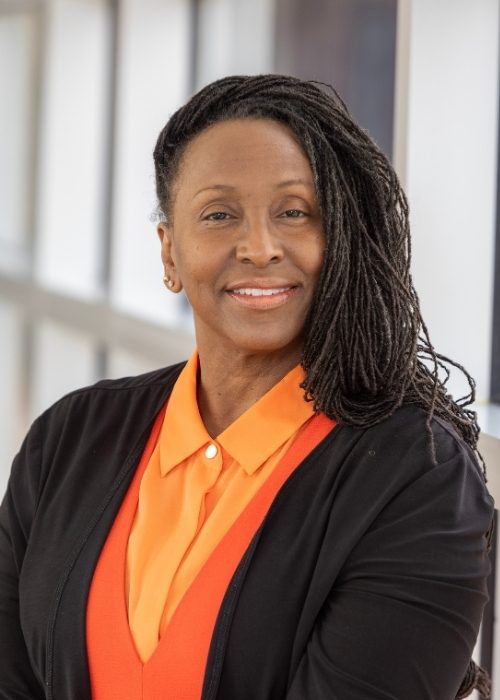
Kim Ward, professor of mathematical sciences at Eastern Connecticut State University, has been selected as the recipient of the 2026 Council of Public Liberal Arts Colleges (COPLAC) Charles Dunn Award for Faculty. Named in honor of former Henderson State University President Charles Dunn, the award honors faculty who are dedicated to the success and support of their students.
“On behalf of the 26-member COPLAC Board of Directors, and the 2026 Dunn Award Selection Committee, I offer my heartfelt congratulations to you for this well-deserved recognition,” wrote Jeanine Went, executive director of the Council of Public Liberal Arts Colleges. “Your work exemplifies the mission of public liberal arts education, and we are proud to celebrate your achievements! Your selection for this award is a testament to the extraordinary impact you have had on both your students’ academic journeys and their lives beyond Eastern Connecticut State University.”
“I’m truly honored to receive the Charles Dunn Award,” said Ward. “Although my love of teaching, mentoring, and promoting student success in academia and in life has never wavered, receiving this award emboldens me to continue on my journey of assisting students with all-around success.”
One of Ward’s students and now an alumnus wrote, “I appreciate the extra work you put in to helping students learn work and organizational habits and adjust to a professional setting. Most professors pass the buck and have kids figure everything out on their own, but you don’t. I was never a bad student, but I’ve never been as organized as I am after taking a class with you. I hope I have the chance to recommend you to friends, and I hope you don’t stop teaching.”
Another Eastern graduate and former student of Ward wrote, “Dr. Ward’s mentorship has greatly impacted my life and education. She taught me valuable lessons, like giving my best effort and avoiding regret by always striving for excellence. Dr. Ward also reminded me that opportunities can arise unexpectedly, and being prepared for them is essential. Her guidance has helped me in college and my career, shaping me into the person I am today.”
A graduate of Virginia Commonwealth University, Ward earned her Ph.D. at Old Dominion University in Computational and Applied Mathematics in 1998. Hired by Eastern in 2002, she has long believed that its small campus and close-knit community is the perfect place for her to teach. “Working at Eastern, with its smaller class sizes, is a great fit. Getting to know my students and watching them grow, both academically and personally, over their time at Eastern and beyond is very rewarding,” she said.
Describing her teaching philosophy, Ward explained, “As a former underachieving high school student, and a first-generation college student from a low-income family, I recognize the power that teaching and mentoring has on one’s life and their progeny. A vital key to my continual growth, as a teacher, is my remembrance of where I once was, and the paths taken to where I am now.
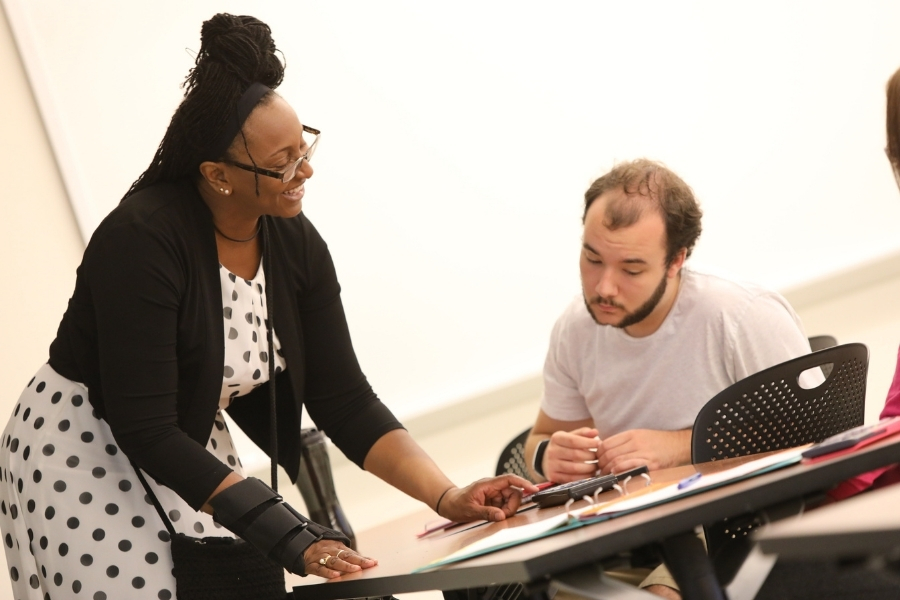
“The knowledge I acquired from my academic and personal journey and challenges combined with academic success factors identified through research, shapes the teacher that I am today. I teach my students how to learn through my style of instruction, which includes active learning, organizational skills, time management skills, note-taking skills, study skills, test-taking skills, stress management skills, and student responsibility and accountability. My style of instruction enhances classroom effectiveness by teaching life-long learning skills that can be applied to both their academic and personal lives. Stronger academic success skills yield self-directed learners, which in turn increases their persistence to graduation and success beyond. I love teaching.”
While many full professors at major universities focus on working with upperclassmen and graduate students, Ward’s favorite classes are first-year and sophomore math majors and non-majors. “Having access to students during this time of their lives affords me the opportunity to help them with transitioning from high school to higher education. This includes assisting my students with building, strengthening, and maintaining their academic success skills.”
In her nomination letter to COPLAC, Eastern’s Provost Cheryl Wilson wrote, “From her own lived experience, [Kim] understands that transformational change — developing the skills needed to succeed at college and cultivating resiliency and self-advocacy — happens when carefully designed programs give students the opportunity to be mentored closely by faculty and to see themselves as valuable members of the university community.”
As strong a mentor and teacher as Ward is within the classroom, Wilson noted it is the behind-the-scenes “little things” that illustrate her caring for students. “She always has snacks in her office because she knows it is harder for hungry students to learn; she sends students birthday texts and reaches out to them regularly with concern and support; she led conversations about the importance of textbook affordability; and she is always scanning the landscape in anticipation of what a student might need.”
Ward has served for many years as the coordinator of Eastern’s Mathematics Foundation program, and was a key leader in creating the Mathematics Achievement Center, a drop-in math tutoring service for all Eastern students. For 17 years, Ward coordinated and taught in the math section of the highly successful Summer Transition to Eastern Program/Contract Admissions Program (STEP/CAP), a residential summer bridge program to help underprepared students transition to college.
In addition to working closely and directly with students, Ward has used her research and exploratory skills to advance scholarship around mathematics and improve the mathematical performance of underserved student populations. She helped manage a National Science Foundation S-STEM grant to implement ‘Beyond the Curriculum: A Learning Community for Success’ scholarship program. Students from lower socioeconomic backgrounds received support through scholarships and purposeful faculty and peer relationships to foster academic learning and trust, ultimately leading to improved achievement, retention, and graduation rates.
Ward was also Eastern’s lead coordinator for a statewide National Science Foundation-funded grant to support underserved student populations pursuing STEM careers. The Louis Stokes Alliance for Minority Participation (LSAMP) was canceled by the federal government in May 2025, and Ward led the successful start-up of a program to replace LSAMP at Eastern with the Eastern STEM Scholars Program, with a mission to increase STEM participation and graduation rates among historically underrepresented students.
“Finally, my quest to continue to lessen and/or remove financial barriers for students involves utilizing open educational resources (OER), such as free online course management systems, free textbooks and free software packages that combine elements of geometry software, computer algebra systems and spreadsheets,” said Ward. “I’m proud to have been a part of establishing the use of OER in several courses in the Mathematical Sciences Department.”
“My most memorable moments at Eastern occur every time I meet a former student, excelling academically and/or in life, who still utilizes academic success skills I teach in my classes. This happened just last week.”
Her life advice to graduates? “Be the best person that you can be, in every aspect of life, and in all that you do.”