
- Apply
- Visit
- Request Info
- Give



Written by Ed Osborn
Published on September 03, 2026
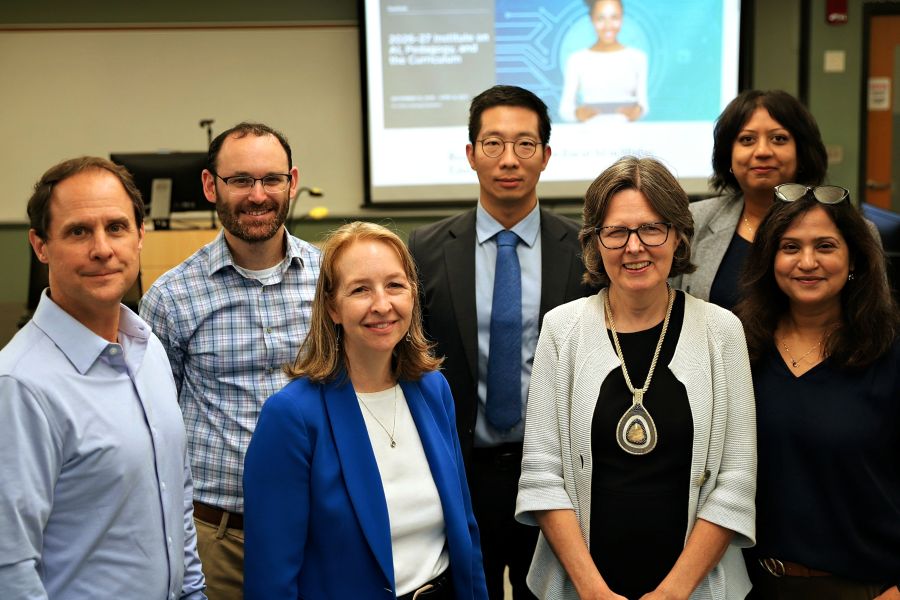
Eastern Connecticut State University has been accepted into the 2026-27 Institute on AI, Pedagogy and the Curriculum, a multi-campus initiative of the American Association of Colleges and Universities (AAC&U). The institute runs from September 2026 to April 2027.
This team-based program helps colleges and universities respond to the opportunities and challenges artificial intelligence presents for teaching, learning, and academic programs. Over the past two years, 316 teams from 296 institutions have participated. The institute provides expert guidance, design sessions, and customized mentoring throughout the academic year, ensuring that institutions can develop and implement an action plan that prepares their students and campuses for success in a rapidly changing world.
“The prevalence of artificial intelligence in higher education has brought with it many new challenges and opportunities for both learning and teaching,” said Cheryl Wilson, provost and vice president for academic affairs. “Our team for the AAC&U institute brings together an interdisciplinary group of faculty and academic affairs leaders to strategically build Eastern’s capacity to engage thoughtfully with AI through our liberal arts lens and institutional mission.”
According to the AAC&U website, the institute “is designed for departments, programs, colleges, and universities seeking to rethink pedagogical and assessment approaches within and across courses; address academic integrity concerns and consider new policies and guidance; examine the ethical and equity implications of AI; adopt competencies and literacies as course or program learning outcomes; and/or explore ways AI can support administrative and operational functions across the institution.”
Eastern’s goals during the institute include:
The AAC&U website further explains the program: “Participating teams — comprised of faculty, staff, and administrators — will design and implement pedagogical, curricular, and/or operational strategies that respond to the evolving challenges and opportunities presented by AI. In short, the institute is ideal for any department, program, or institution that is ready to lead in this new era.”
To date, Eastern has moved forward on implementing AI on campus by creating opportunities for faculty to explore new teaching and research practices, and by developing Eastern’s role as a public liberal arts institution in leading regional efforts to advance AI. Eastern’s Center for Teaching, Learning and Assessment (CTLA) has hosted workshops, supported curricular development through a National Endowment for the Humanities grant; surveyed faculty; and sponsored a colloquium on AI and the liberal arts. It is also providing regional opportunities through the University’s Small Business Resource Center (SBRC); through professional development programming for the state’s technical high schools; and by envisioning a Center for AI and the Future of Work.
“The AAC&U Institute on AI, Pedagogy and the Curriculum will support us as we build on the AI-related initiatives at Eastern over the past few years, which have included workshops, faculty learning communities, and an AI and the Liberal Arts Education in the Age of AI colloquium,” said Garrett Dancik, professor and chair of Eastern’s Department of Computer Science. “Ultimately, the institute will support us in our efforts to better prepare students to lead successful and fulfilling lives in a rapidly changing AI landscape.”
Dancik and Associate Professor of Education Kwangwon Lee are the two lead contacts for the project. Other Eastern participants include Emily Todd, dean of the School of Arts and Sciences; Niti Pandey, dean of the School of Education and Professional Studies; Julia DeLapp, director of the CTLA; Stephen Ferruci, professor and chair of the Department of English; and Sukeshini Grandhi, professor of business administration.
The Institute’s format is designed as a “hands-on, immersive process that blends expert guidance with collaborative design.” Participants will “learn from national experts in AI, pedagogy, and organizational change; apply design-thinking methods to real challenges through creativity, empathy, and rapid prototyping; collaborate across departments to set shared goals that align curriculum, student learning, and institutional priorities; and build pathways that ensure all students benefit from AI-informed teaching and learning practices.”
In addition to the online sessions and offline support Eastern’s participants will receive, the institute creates a lively network of educational professionals across institutions, state boundaries, and academic disciplines.