
- Apply
- Visit
- Request Info
- Give



Written by Savannah Striano ‘25
Published on September 29, 2026
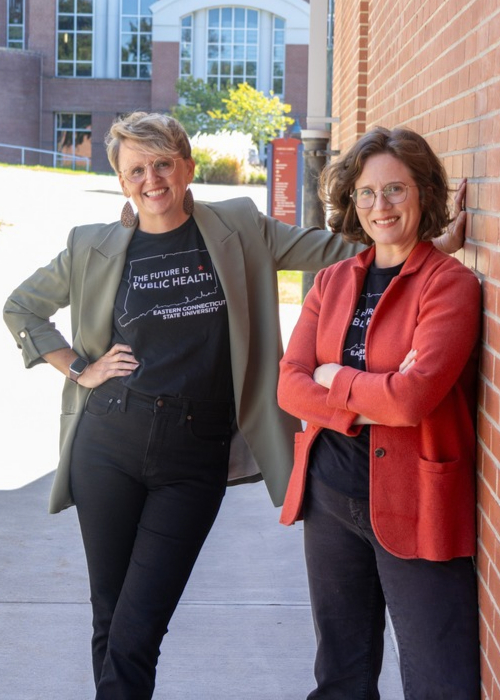
When Sara Carroll and Sarah Walters met at a public health conference years ago, they never expected to see each other again. Now the two have neighboring offices in Eastern’s Department of Health Sciences and Nursing, where the duo leads the University’s public health concentration with love, laughter, and persistence.
The two seemingly share a brain; when they talk about their work, they finish each other's thoughts, argue over word choice, and laugh at inside jokes. As the leaders of Eastern's public health concentration, they do almost everything together.
“We put our whole self into all of our projects,” Walters said. “We care a lot.”
That might explain why they describe themselves as “kind of a lot.” But for Carroll and Walters, being “a lot” is not just about how much they do. It is also about how much they care, especially when it comes to their students and the future of public health at Eastern.
Two Roads to Public Health
Neither Carroll nor Walters originally set out to become public health professionals. Both found the field through unexpected turns in their education -- experiences that now shape how they introduce students to public health.
Carroll discovered a love for public health as a biology and anthropology undergraduate at the University of Denver, taking a nutritional anthropology course.
“I had a moment of, ‘oh my gosh, you can use social science to understand people’s health,’” she said.
After presenting her undergraduate honors thesis on this realization, a future mentor asked what she would do to advance the use of social science to understand health. Carroll had not realized that was an option.
“Public health gave me an avenue [to continue this work]. It was really exciting.”
Walters, on the other hand, was on the pre-med track. She had taken the Medical College Admission Test (MCAT) and applied to medical school. During her final undergraduate semester, she took an introductory epidemiology course at a different campus.
“That was the first time I thought about preventing disease before it happens,” she said. “That’s kind of where I decided at the last minute to change course completely.”
Nowadays, Carroll and Walters joke about influencing students to pivot their studies the same way they were called to the profession. “We shepherd students through that [exploration] all the time,” Carroll said.
‘I picked Sarah up at a conference’
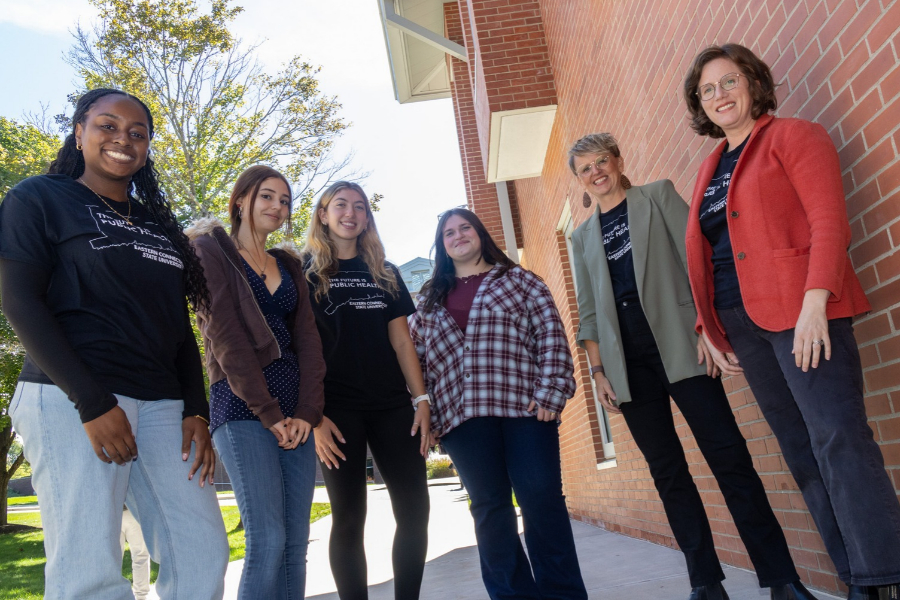
Carroll joined Eastern in 2021 from another public liberal arts institution, while Walters had spent about 16 years working in public health in New York City before moving into state public health work in Connecticut.
Carroll met Walters at a Connecticut Public Health Association conference, where Walters was serving as a moderator and panelist.
“I picked Sarah up at a conference,” Carroll said, laughing.
They hit it off right away. “I was mostly like, I want to be your friend,” she continued.
They exchanged business cards but assumed the distance between them would make it difficult to stay connected or collaborate. When Walters began looking for a new job, she reached out to Carroll for leads. Eastern happened to be hiring, and Carroll was chairing the search.
Walters had never taught before, so Carroll had to make a strong case for her. Her argument was simple: Public health is an applied field, and students need someone who understands what that work looks like outside of academia.
“She’s the reason why I’m here,” Walters affirmed.
A friendship that began with a conference business card eventually became two offices side by side in Goddard Hall.
The art and the science
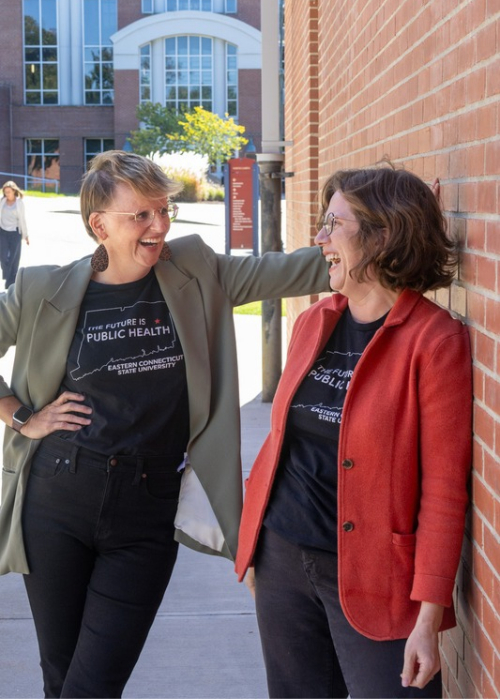
Their partnership isn’t built on their similarities. The two professors view public health from vastly different perspectives.
Walters describes herself as more left-brained, while Carroll is more right-brained. Walters works in quantitative hard science, focusing on environmental and climate issues. Carroll brings a qualitative, social-science perspective rooted in storytelling and understanding people.
“She gets scared by numbers. I get scared by words,” Walters said.
Their content areas do not always overlap, so each can fill gaps in the other’s knowledge. Walters brings years of pub
lic health practice into their conversations, while Carroll brings a different way of looking at people, behavior, and health.
Their partnership, they say, mirrors public health itself.
“She’s the art, I’m the science,” Walters said.
That difference shows up in the classroom. Carroll often uses stories and images to teach, while Walters prefers a story told by data.
For Carroll and Walters, those differences are not a problem to solve. They are what make their partnership work.
More Than Two Professors
The two describe themselves as "systems thinkers." They are constantly looking at how things work, where they could work better, and what they can do to improve those systems.
That mindset shows up in the way they work together, too. Last spring, they led two major events: National Public Health Week and Trans Day of Visibility. Each took the lead on one event while the other helped, but afterward, they decided they did not want to do it separately again.
They saw the same dynamic during an open-classroom lecture about voting, civic engagement, public health, and policy.
“I did feel like we were a lot that day,” Carroll jokingly said. “But that was a good highlight of how we can do really big, important things with the support of each other.”
But for Carroll and Walters, the biggest measure of their partnership is not the size of an event. It is what happens with their students.
The two co-mentor students who have a tendency to become deeply invested in public health. When one former student was accepted to Columbia University to study social epidemiology, she texted both professors.
“She basically married us,” Carroll laughed, because the student’s work brought together the two sides of public health they represent.
But they do not measure student success only by graduate-school acceptances.
They also work together to support students who are struggling. One student facing health challenges had been away from class for several weeks. The professors talked about how they could best support the student and eventually celebrated when the student returned to class fully engaged.
Why Eastern
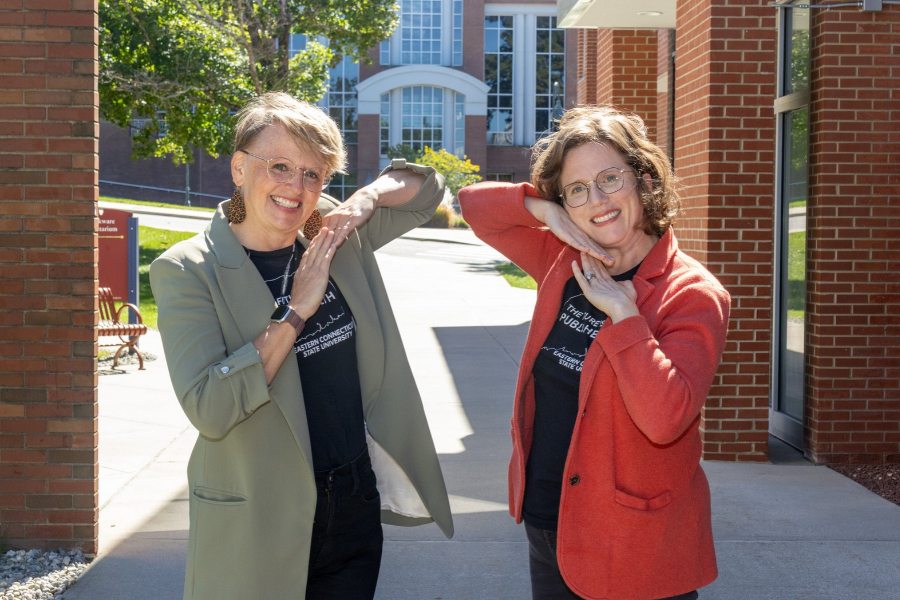
Both Carroll and Walters see Eastern’s liberal arts environment as a natural home for public health education.
Public health is an applied field that draws from science, social science, ethics, community engagement, and policy. “The very nature of the field is what liberal arts education should be,” Carroll said. “I feel like I’m the professor that I would have always wanted, but never had.”
They see experiential learning and internships as another important part of the program, giving students opportunities to connect what they learn in class with public health work beyond the classroom.
And because public health can lead to so many different careers, the two hear one question often: What do you do with public health?
Their answer is complicated. “A thousand different things,” they said.
There is not always a direct path from a public health degree to one specific job, which is why Carroll and Walters are looking at ways to build relationships with other institutions and create pathways for students, particularly into graduate programs.
Building what comes next
Carroll and Walters hope to grow Eastern’s public health concentration into a full major, which is part of a five-year vision for the program.
They are also exploring interdisciplinary opportunities, including a possible public policy certificate with political science, as well as pathways to graduate programs and other institutions.
They envision courses that connect students’ learning across the curriculum. The duo pitched an idea to co-teach an introductory public health course, with each professor covering the areas she knows best.
They have also discussed connecting their existing courses so that students in Carroll’s program-planning class could design a program, and students in Walters’ research class could evaluate it.
Their plans also extend beyond the two of them. Eastern’s public health program relies on part-time faculty members who help teach courses and shape the curriculum, something Carroll and Walters are quick to acknowledge.
Still, the two are always thinking about what comes next. They want students to have a better understanding of what public health is, where it can take them, and how their education at Eastern can prepare them for that future.
For students who are curious about the field, their advice is simple: Take a public health class.
“You’ll feel how much we love to teach the subject,” Walters said.