
- Apply
- Visit
- Request Info
- Give



Written by Kyle Berson '26
Published on July 29, 2026
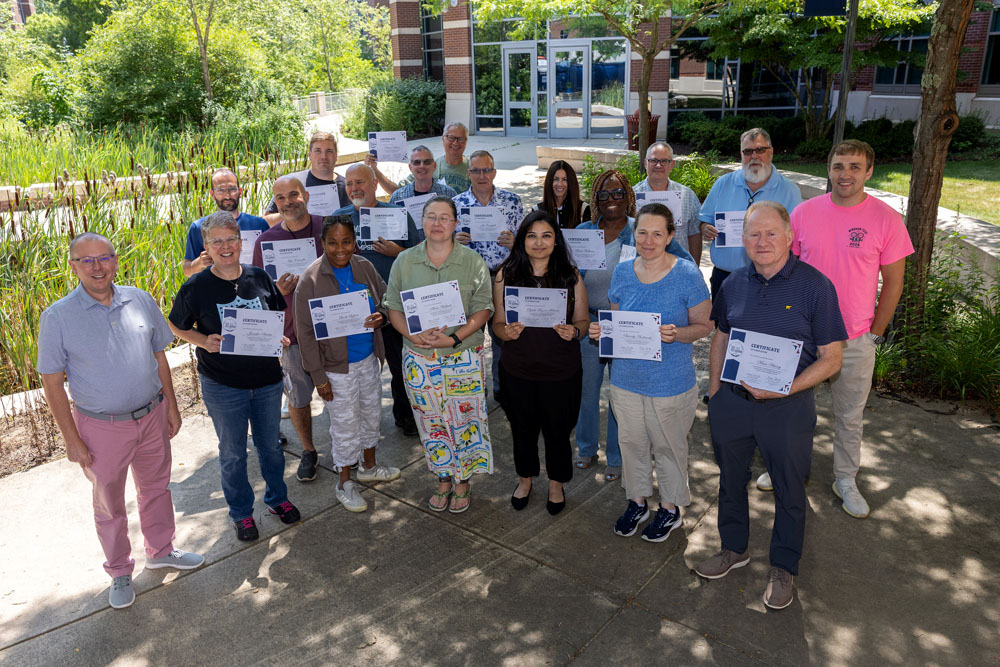
AI Summer Institute participants display their completion certificates in a group photo.

Eastern's Associate Dean of the School of Education and Professional Studies Ryan Colwell gives a lecture to CTECS educators.
Eastern Connecticut State University welcomed 40 educators and administrators from the Connecticut Technical Education and Career System (CTECS) to campus this July for the 2026 AI Summer Institute, a professional development program focused on the responsible use and implementation of generative artificial intelligence (AI) in education.
From July 20 to 23, the institute explored topics like AI-powered learning activities, unit planning, lesson design, and individualization of classroom materials. Through panel discussions, workshops, and hands-on activities, participants expanded their knowledge of practical applications of AI in the classroom while promoting ethical, equitable, and intellectually rigorous classroom practices.
The institute “was a collaborative learning experience that equipped teachers and administrators with the knowledge and skills to integrate AI into classrooms in purposeful and ethical ways,” said Ryan Colwell, associate dean of the School of Education and Professional Studies.
Sessions focused on AI literacy, prompt development, lesson and unit design, lesson personalization for multilingual students and students with disabilities, AI-assisted summative assessment practices, and industry-connected instructional applications.

A 2026 study published by the Pew Research Center found that more than half of high school-aged students use AI chatbots (ChatGPT, Gemini, Copilot, etc.) on school assignments. A recent New York Times article titled “More than half of teens use chatbots for school, survey finds,” noted that multiple studies have suggested that student’s use of AI chatbots for schoolwork can stunt learning and development of critical thinking skills.
Failing to understand the risks and benefits of AI use in the classroom presents a major threat to the success of both students and educators. The AI Summer Institute served as an effort to evaluate, recognize, and implement improvement measures to ensure that the use of AI in CTECS schools is responsible, ethical, and beneficial to student learning outcomes.
“We hope that AI tools can be leveraged to help educators continue to make meaningful and impactful differences for the students they work with,” said event co-coordinator Nicholas Kukla ’19, a science teacher from Windham Technical High School.
Kukla also highlighted the time-saving potential of AI to allow teachers more time with students.
Throughout the four-day institute, educators learned about different tools, methodologies, and implementation strategies surrounding educational AI. A key takeaway from participants was the wide range of creative applications AI tools present to support student success.
“They allowed us to practice with all of the programs we were taught,” said Pat Ciarleglio, a consultant at CTEC’s central office.
During the institute, Ciarleglio used Base44, an AI tool that creates, designs, and codes mobile and web applications, to create a practice test app for Connecticut’s P-2 plumbing license examination.
The app uses AI to create and quiz students on questions similar to those found in the real test, and Ciareglio hopes the app will help increase test scores for future plumbing students.
Rich Pelletier, an auto teacher at Platt Technical High School, said the institute expanded his knowledge of AI tools.
“I didn’t realize there were so many platforms,” he said. “I’m definitely going to apply a lot of this over the next school year.”
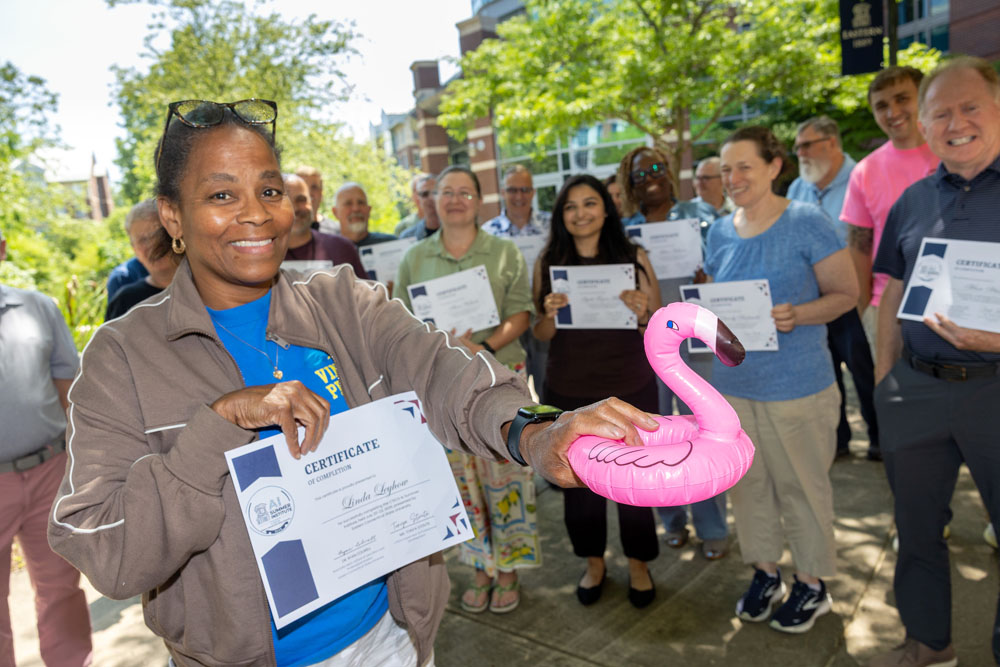
The tools exhibited at the institute also had applications beyond the classroom. Linda Leyhow, CTECS supervisor of Climate, Equity, and Title IX, is hoping AI will help her office work more efficiently while expanding student support efforts.
“The ability to use AI helps us work more efficiently to address student needs more intently,” she said. “We have tools that will really engage lessons, and allow us to be more efficient in the office.”
Denise Dunning, a special education supervisor overseeing four schools and the district’s social workers, plans to use an AI-powered simulator to provide interactive professional training to social workers.
“The AI gives a scenario and social workers respond,” she said. Dunning also commented on the time-saving capability of AI tools. “It’s so good to be able to share that with social workers and special education teachers.”