- Apply
- Visit
- Request Info
- Give



Written by Ed Osborn
Published on March 30, 2026
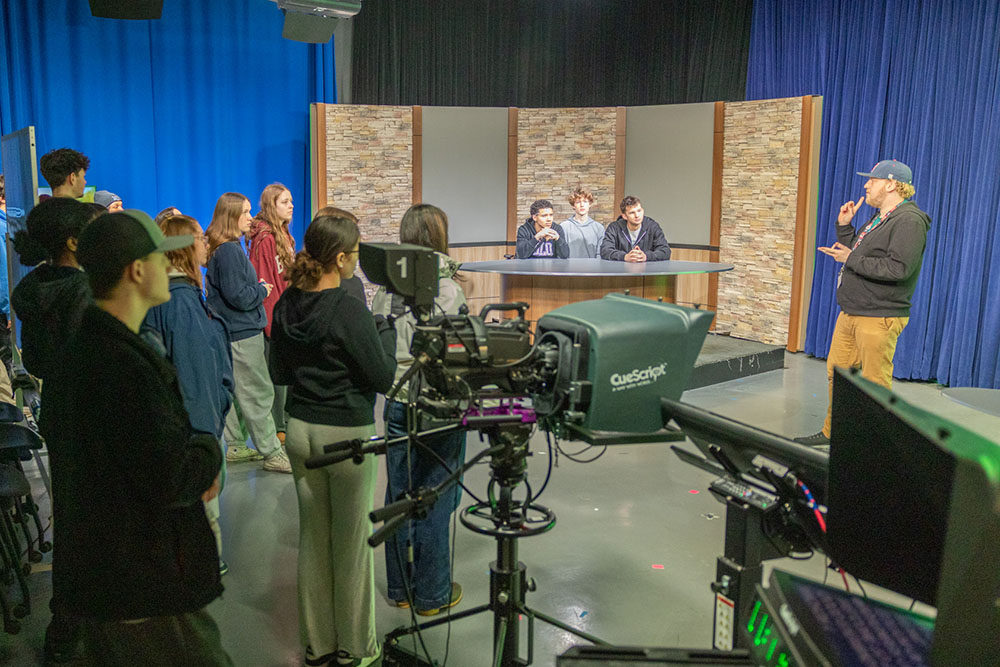
Concurrently enrolled students from Bolton High School tour Eastern TV's studio during a recent visit to campus.
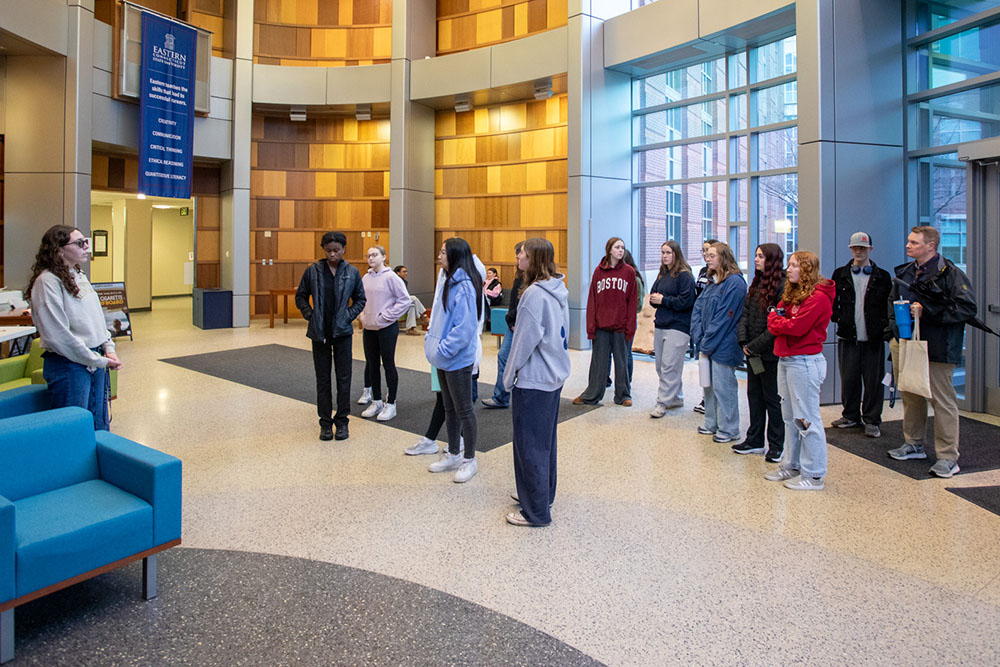
Students tour the Dr. David G. Carter Science Building.
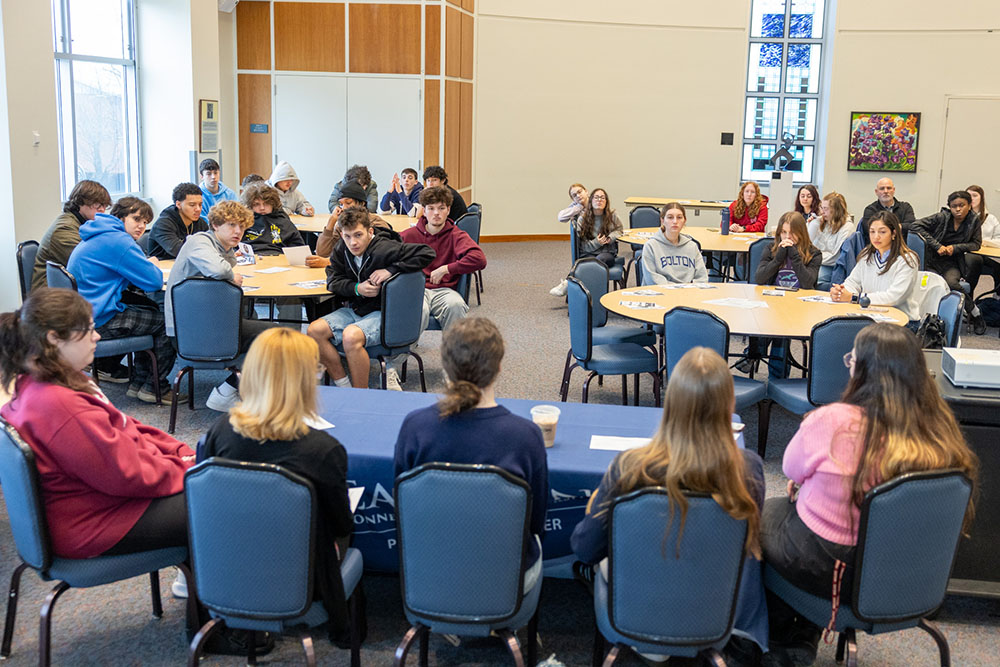
Eastern students lead a panel with concurrently enrolled high school students.
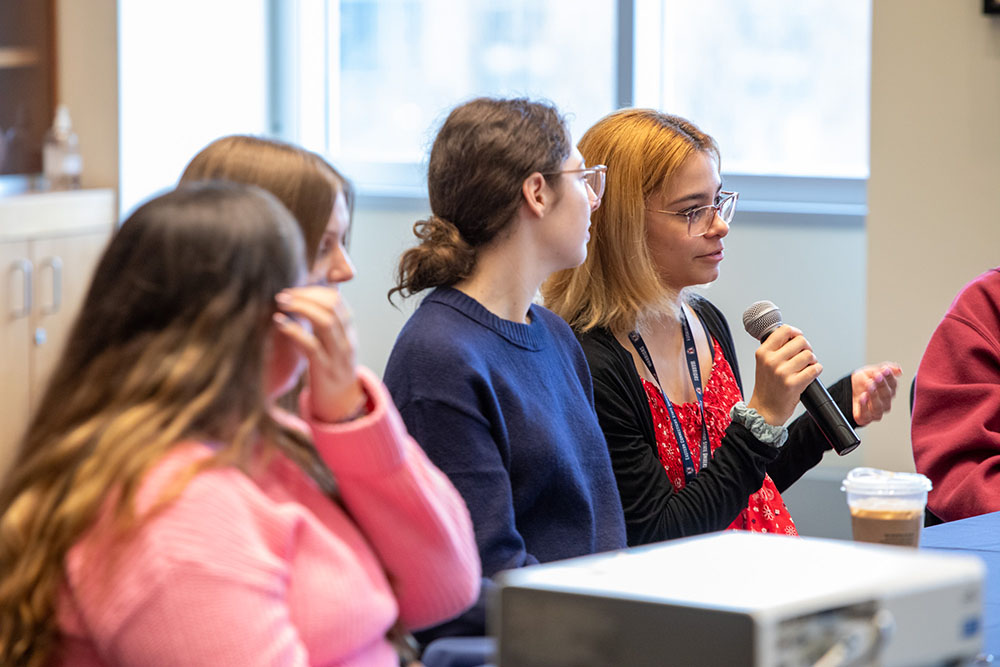
A student panel for concurrently enrolled students.
A growing number of high school students across Connecticut are earning college credits, exploring new academic interests, and getting a head start on their college plans as the result of an innovative “concurrent enrollment” program offered by Eastern Connecticut State University, named the Eastern Early College (EEC) program.
Students take the Eastern courses in their home high school, taught by high school teachers who have been approved by the University faculty. Each course also features an Eastern professor who serves as a liaison to the high school instructor, creating an ongoing collaboration between participating high schools and the corresponding Eastern academic department. Not only do the students earn college credit that they can apply to their college degree, but they also get to take courses not necessarily offered by their high school.
Growth and expansion
Students and high schools throughout the state are enthusiastically responding to the program. Enrollment has almost tripled in the past two years, from 518 students in 2023–24 to 1,481 in the current 2025–26 school year. In 2023–24, 15 high schools participated. This year there are 23, with more planned in the future. Participants include local schools such as Windham, Coventry, NFA, Bolton, and E.O. Smith, as well as Fitch, New London, and Newtown High Schools.
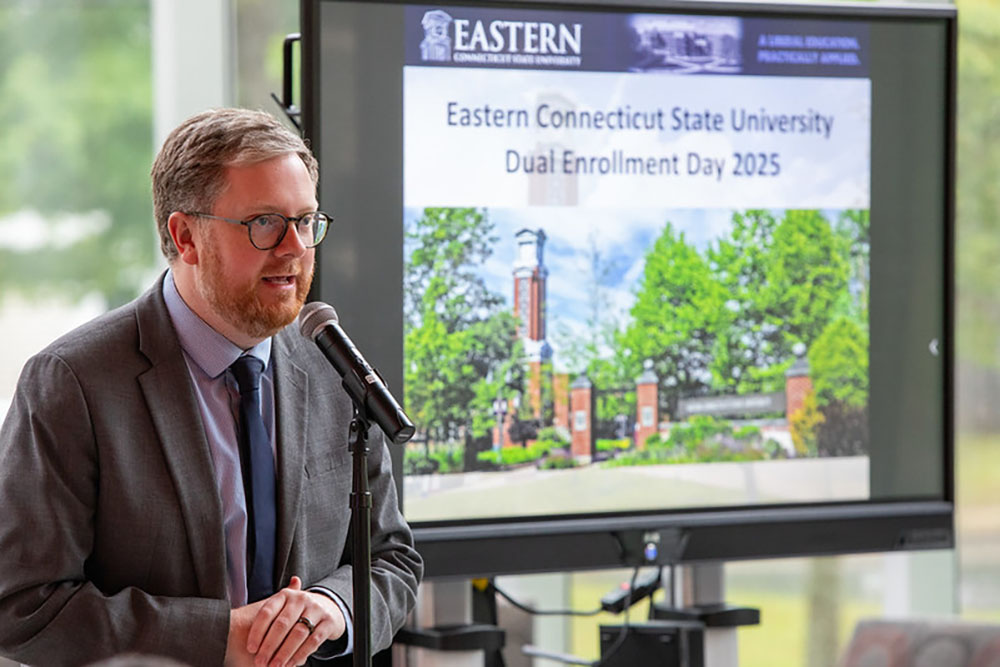
A total of 58 courses are being offered in 104 sections — up from 65 sections in 2023–24 — in 21 subject areas ranging from art to English, economics, sociology, music, psychology, political science, geography and more.
More students are taking more courses as the program grows: the number of credit hours taken has tripled from 2,109 in 2023–24 to 6,433 credits in 2025–26. Since Eastern’s concurrent enrollment program began in 2015, 5,242 students have taken more than 24,000 Eastern credits.
“We have nearly every academic department on campus now offering courses concurrently at partner high schools,” explained Chris Drewry, coordinator of the program in his role as Eastern’s director of co-curricular academic programming.
Both Eastern and its high school partners have benefited from state of Connecticut funding support. In 2023, Governor Lamont announced a Dual Credit Expansion Grant to grow high school dual credit programs, with $3.8 million in funds. The following year, grant funds were offered to institutions of higher education as well. Eastern is in year two of a three-year $178,000 grant to support its concurrent enrollment efforts. The state grant addresses both access and quality by requiring Eastern to waive tuition for low-income families and commit to going through accreditation. The National Alliance of Concurrent Enrollment Programs (NACEP) is the accrediting agency; Eastern hopes to hear from them on its accreditation application in June 2026.
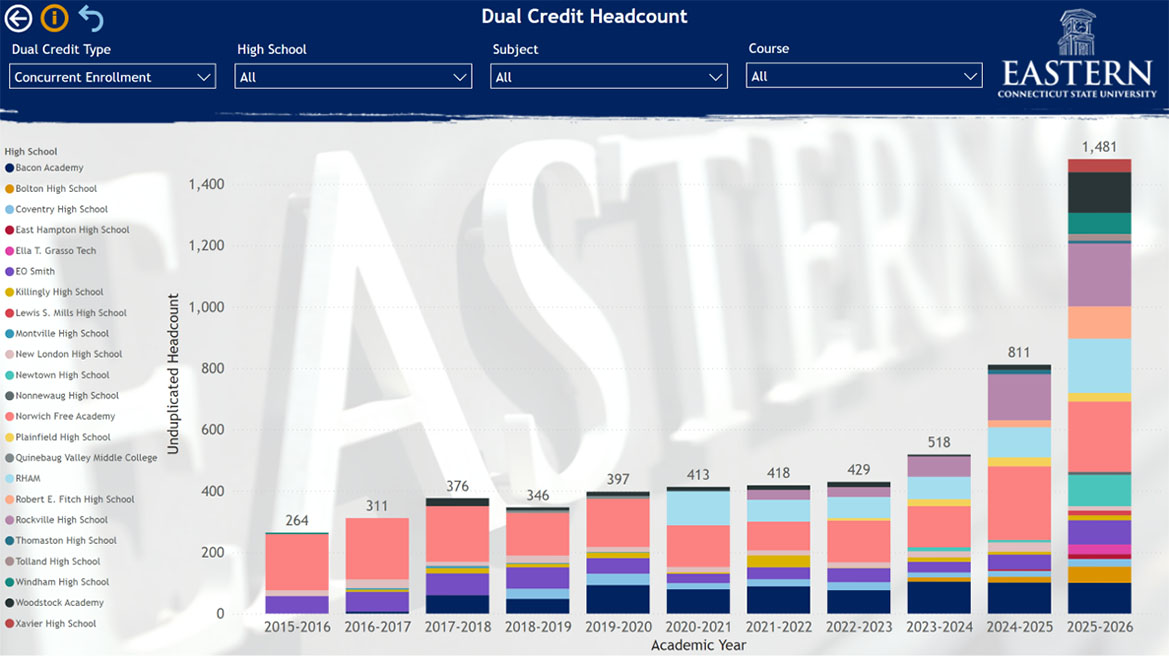
This chart illustrates the number of unique students in Eastern's concurrent enrollment program over the last 11 years.
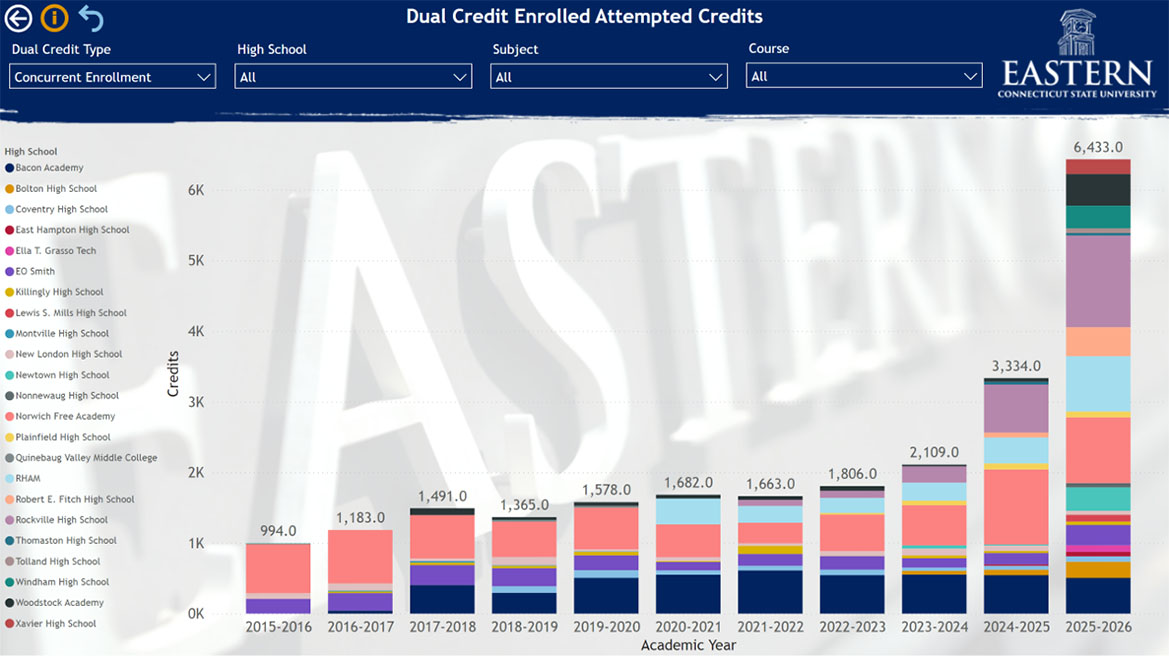
This chart illustrates the growth in college credits earned by concurrently enrolled high school students, due to increased course and subject offerings.
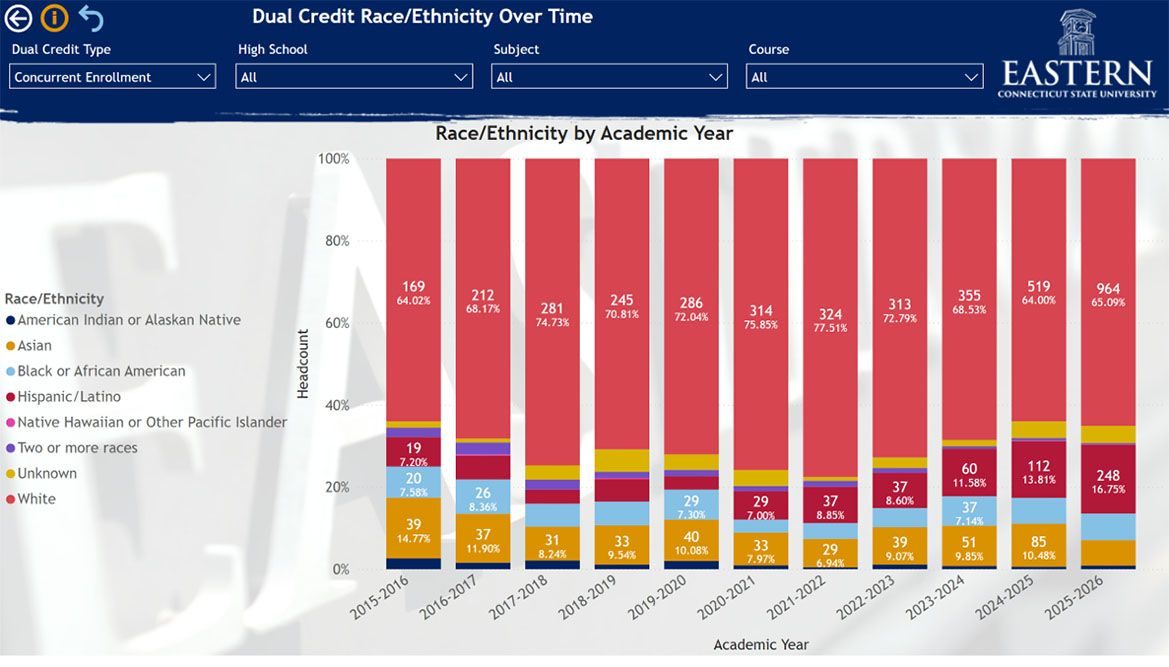
This chart illustrates ethnic diversity percentages for concurrent-enrollment students over the last 11 years.
“We’ve used our funding to provide staffing, particularly from faculty, to improve the quality of programming in preparation for our NACEP accreditation,” said Drewry, who also credited Professor Allison Speicher, lead faculty laison, and University Assistants Katelin Briere and Alison Guillet as integral to the growth of the Eastern Early College program.
Getting to know campus
One of the unique aspects of Eastern’s program is its emphasis on bringing concurrent-enrollment students to campus. “A keystone of our program is our campus visit model,” said Drewry. “We’ve hosted increasingly higher numbers of students on campus each year and make sure that every visit has an academic component during which students are interacting with university faculty, staff, and students, in addition to touring campus and eating in our dining hall. It all adds up to them getting a great introduction to college life and hopefully connecting with Eastern in a meaningful way. Above all, we hope this gets students excited about the idea of higher education, especially if it’s not something they’ve been planning on pursuing up to this point.”
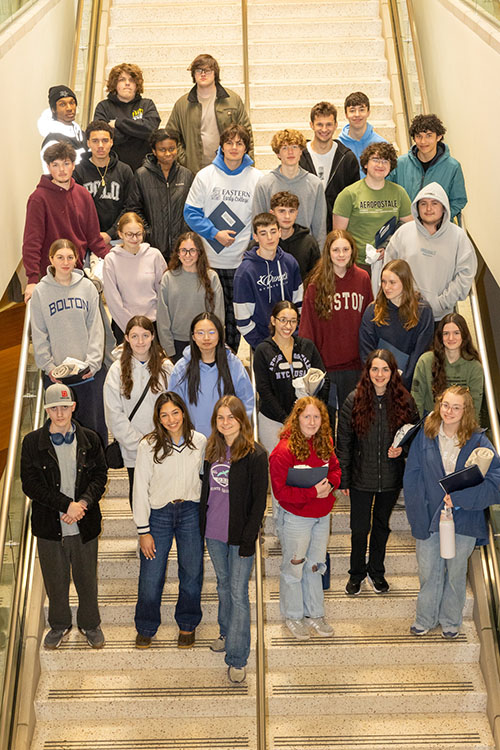
Bolton High School students recently visited Eastern’s campus and several said they enjoyed the experience, citing the new Fine Arts Instructional Center and Science Building as highlights, along with the Academic Success Center and student clubs.
Ervin Dalani is taking pre-calculus and public speaking, saying, “I wanted to challenge myself with more rigorous work.”
Rhianna LeBron is also taking Eastern’s public speaking course: “I'm taking it to get a better knowledge on speaking out more and learning to be better with crowds and not being so nervous.” LeBron has applied to Eastern to go to college, and further explained, “(Public speaking) is a course here and I thought it would be kind of nice to get it out of the way.”
In describing her course in pre-calculus, Katelyn Hoffman said, “It’s valuable because it gives me the experience of knowing what colleges and classes are going to be like.”
Bolton High School guidance counselor Todd Giansanti describes the progress being made at Bolton: “While we began with a single math offering and one teacher, with the support of Chris Drewry we now offer classes in business, communications, and multiple math offerings, which has created a positive environment where students are rising to meet higher expectations and faculty are inspired by their growth. Students are gaining confidence, independence, and a clearer sense of their future, while teachers have the opportunity to support them in more meaningful, college-focused ways. Even as a new program, it is already strengthening our school culture by building excitement around academic opportunity, responsibility, and achievement, as we continue to pursue other offerings in English, psychology, music, art and science.”
A mutual partnership
One student who has gone full circle in the concurrent enrollment program is recent Eastern graduate Ryan Toomey ’25, an aspiring high school teacher. “I had the opportunity to participate in Eastern’s dual enrollment program during my senior year of high school, and it was an incredibly valuable experience,” said Toomey. “It gave me a head start on my college education while also helping me build confidence in my academic abilities and better understand the expectations of college-level work. I am now student teaching at Rockville High School, a strong partner of Eastern’s dual enrollment program. It has been especially meaningful to see this experience from the other side, as I watch my own students benefit from the same opportunity.”

Other Rockville High School teachers are also appreciative of Eastern’s concurrent enrollment program. “We are very proud of our concurrent/dual enrollment programs here at Rockville,” said Peter Ettlinger, director of school counseling. “In recent years, we have had students graduate with almost 30 college credits.”
“I find that it helps me to stay relevant in regard to college expectations, and it allows my students to get a jump start on their higher education,” said William Balsewicz, who is teaching an Eastern communication class.
“Being part of Eastern’s concurrent enrollment program at Rockville High School has been a valuable experience for both my students and our faculty,” said art teacher Stephanie Symkowicz. “In my drawing and painting class, students gain exposure to college-level expectations while still having the support of a high school environment, which builds both confidence and independence.”
Norwich Free Academy is also a strong EEC supporter and partner high school. Stephani Jones, NFA’s director of curriculum and instruction, explained, “Our partnership with Eastern’s Early College program strengthens our academic mission by expanding access to rigorous, college-level coursework within our already diverse curriculum. With a broad range of offerings, ranging from Calculus to Psychology, Public Speaking to Politics, students can easily find courses that challenge them at an advanced level and align with their interests.”
Committed Faculty
Eastern faculty are equally committed to the concurrent enrollment program. “The EEC program allows students to gain access to Eastern's distinctive curriculum long before they set foot on our campus,” said Allison Speicher, Eastern’s lead faculty liaison for the program.

“For some students, strategically earning EEC credits will provide a welcome boost, putting them ahead in both credits and preparation from day one of college; for others, an EEC class might inspire their first realization that college is in fact a place where they belong,” said Speicher. “Thanks to the diligent work of our faculty liaisons and the enthusiastic participation of our high school instructors, the classes we offer mirror the on-campus Eastern experience as closely as possible. … We've also welcomed hundreds of EEC students to campus this semester, for Spanish scavenger hunts, biology lab experiences, theater productions, and more, helping those students and their teachers become visible participants in our campus community.”
Another important goal of the program has been to expand access to students from underrepresented populations. Since 2023-24, the number of Latino students in the program has increased fourfold, from 60 to 248, while the number of African American students has gone from 37 to 96. “We want to make sure that not only are we offering early access, but that we’re offering it in an equitable way, and the program has seen an increase in diversity in terms of ethnicity, especially in recent years,” noted Drewry.
The popular program is likely to continue to grow, especially given the support that Connecticut leaders are giving to dual credit and concurrent enrollment initiatives. Gov. Lamont’s next biennial budget includes $6 million for dual enrollment programs. In addition, the Board of Regents for Higher Education, the governing body for the Connecticut State Colleges and Universities System, has made concurrent enrollment one of its top two strategic objectives.