
- Apply
- Visit
- Request Info
- Give



Written by Savannah Striano ’25
Published on April 15, 2026
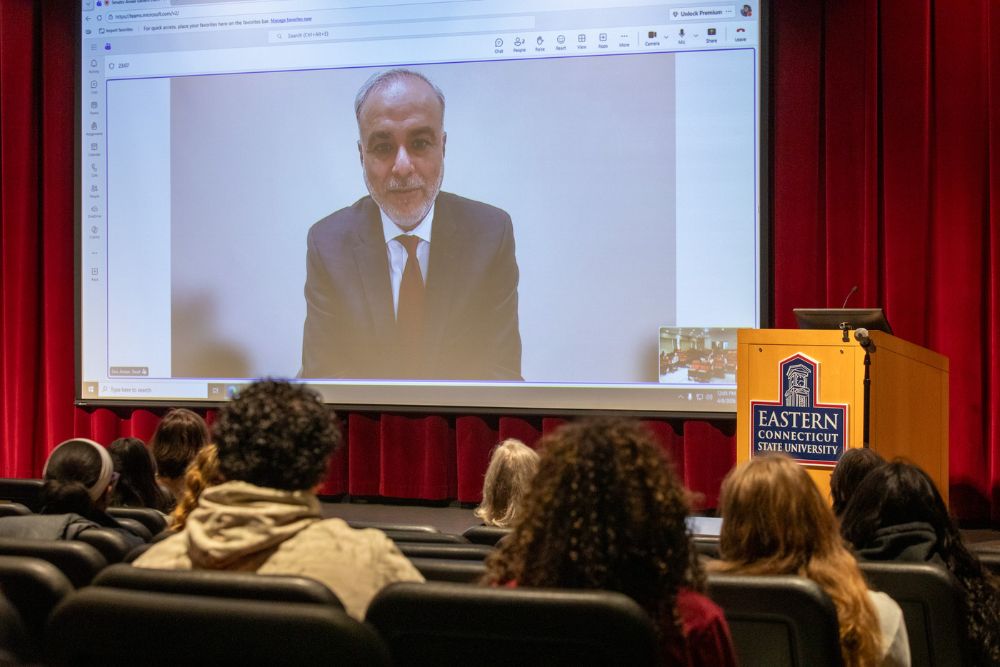
Public health often escapes the spotlight because its damage accumulates quietly, Connecticut State Sen. Saud Anwar told Eastern Connecticut State University students at a National Public Health Week panel discussion on April 8.
A virtual discussion with Anwar and an in-person panel in the Student Center Theatre focused on tackling “wicked problems” -- complex challenges that cut across systems and resist simple solutions -- ranging from chronic disease and addiction to housing and climate threats, before students presented their own public health research during a showcase and networking session.
Anwar, a physician and co-chair of the state Legislature’s Public Health Committee, said the risk can be harder for the public to see because the harm is dispersed, for example, in cases such as when people die from smoking-related diseases or when contamination in drinking water does not show up as an illness in someone for years.
Anwar: proactivity vs. reactivity
Anwar, speaking to students via Zoom, described public health as a “slow-moving crisis” that may receive less visibility than other news items such as storms or other emergencies. He urged students to think proactively about prevention, not just treatment.
Anwar said that one recurring challenge is that planning in the public health field anticipates harm and aims for proactivity, while politics often responds only after something goes wrong.
“To the public health mindset, you want to be proactive, but policy making is reactive,” said Anwar. “Unfortunately, that reactivity results in people just waiting for something bad to happen.”
Anwar added that in Connecticut, there are two to three opioid deaths a day. He then argued that stigma has slowed the adoption of prevention strategies, such as overdose prevention centers.
Despite a recent decrease in opioid deaths due to the availability of naloxone and education surrounding it, Anwar advocated for additional prevention strategies to be enacted through policy:
“We have not reached the level of success that we should be able to. … It’s a no-brainer for what needs to be done, but the stigma and the fear of backlash … have resulted in bills for this cause never making it through.”
Anwar also urged students to share personal stories when pushing for change, saying lawmakers are more likely to remember human impact than statistics. “It’s great to have data, but the data does not stick in everybody’s mind,” he said. “Those stories stay with us.”
In-person panel: factors influencing public health
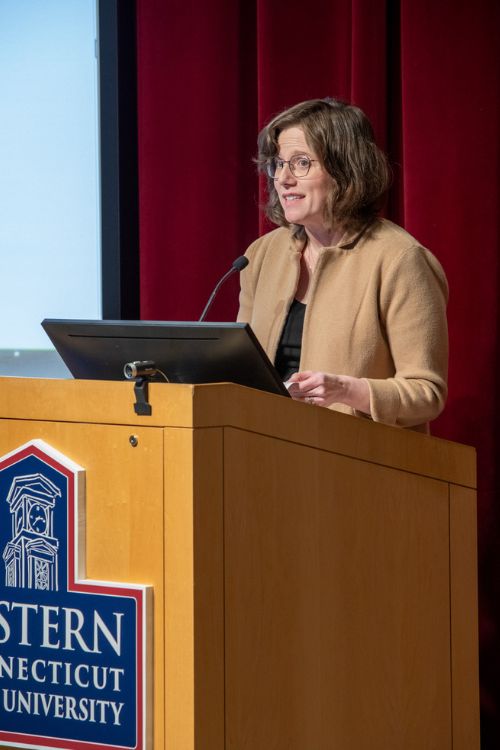
Public health Professor Sara Carroll, panel moderator
Anwar's remarks were followed by an in-person panel, moderated by health sciences and nursing Professor Sara Carroll. Connecticut Department of Public Health Infectious Disease Director Lynn Sosa said prevention can be difficult to sustain in a polarized environment, especially when public health officials are trying to persuade people to act before they feel immediate harm.
“Everything’s really polarized,” she said, and officials often must “figure out where we can come and meet each other” to communicate about issues such as vaccines and smoking.
Sosa added that “the pandemic really reminded us how important relationships are” and that maintaining those connections matters because “we don’t know what the next (crisis) is.”
Emma King, executive director of the Access Community Action Agency in Willimantic, said “poverty, at large, is a public health crisis” and argued that decision-makers are sometimes removed from the day-to-day realities faced by people seeking housing, food, and health care.
King said organizations like hers can end up stuck in “short-term crisis intervention” while trying to pursue long-term goals. She said the challenge therein is “mining the gap between the knowing and the doing,” including “getting the consumer buy-in” from people most affected by policies and programs.
Health sciences and nursing Professor Sarah Walters described climate change as a “threat multiplier” that intensifies problems communities already face, including extreme heat, flooding, and air pollution.
“Health impacts are not evenly distributed,” she said, adding that health outcomes can depend on housing conditions, income, and access to resources such as air conditioning.
Walters said climate-related health protection depends on whether housing, infrastructure, government, data, and social supports are “strong enough,” coordinated, and equitable enough to protect the most vulnerable. “It’s not just about the environment,” she said, describing broader concerns about funding, data systems, and coordination that affect the ability to respond to climate-related events.
After the panel, six students presented research projects addressing public health issues, including climate change, health equity, aging, advocacy, and media influence, during a poster showcase and networking session.
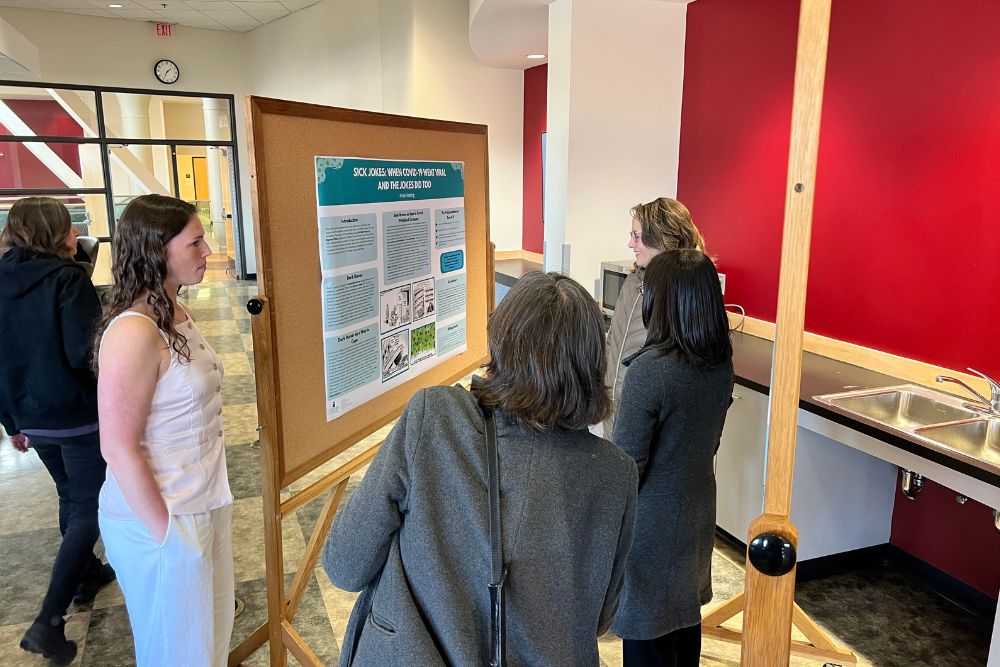
Student Emily Fielding presents her public health research.
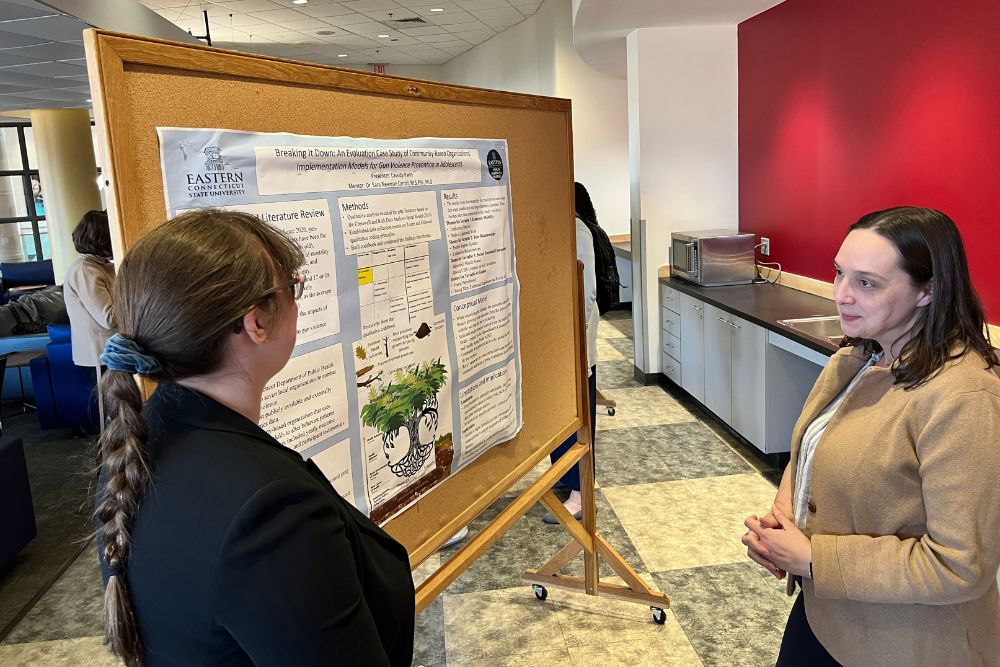
Cassidy Irwin presents her public health research.
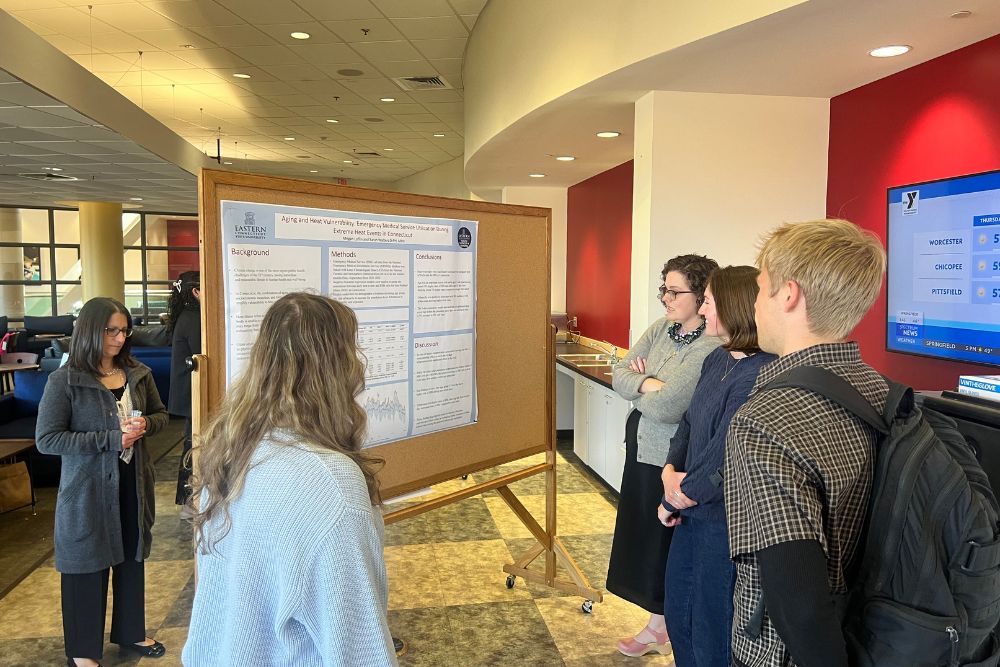
Megan Loflin presents her public health research.
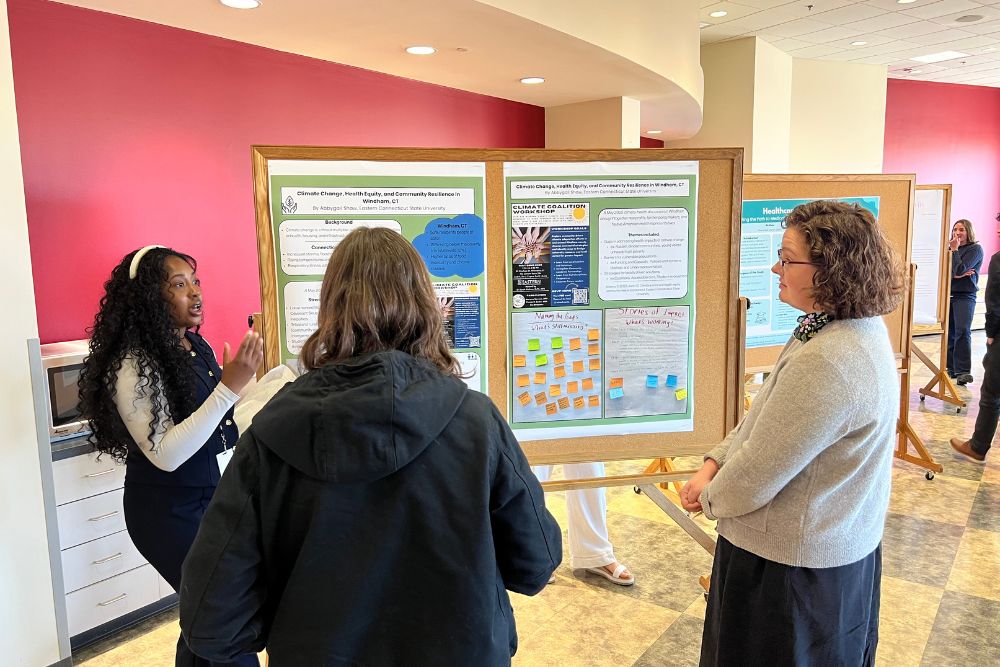
Abbygail Shaw presents her public health research.