
- Apply
- Visit
- Request Info
- Give



Written by Savannah Striano '25
Published on May 20, 2026
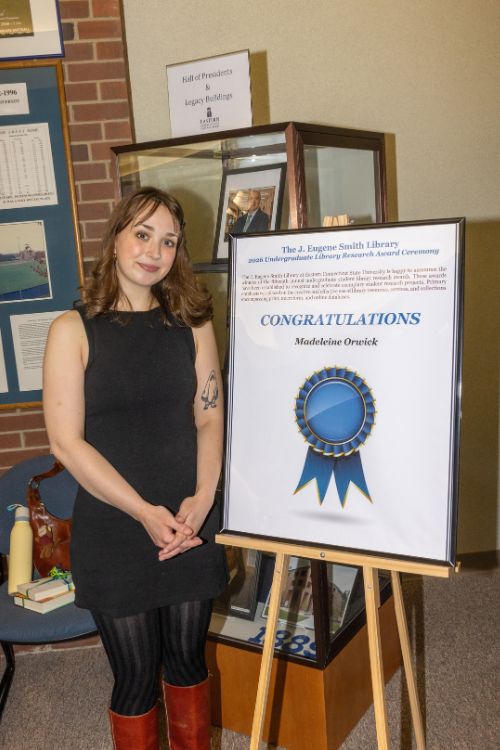
Madeleine Orwick wins the 2026 Library Research Award
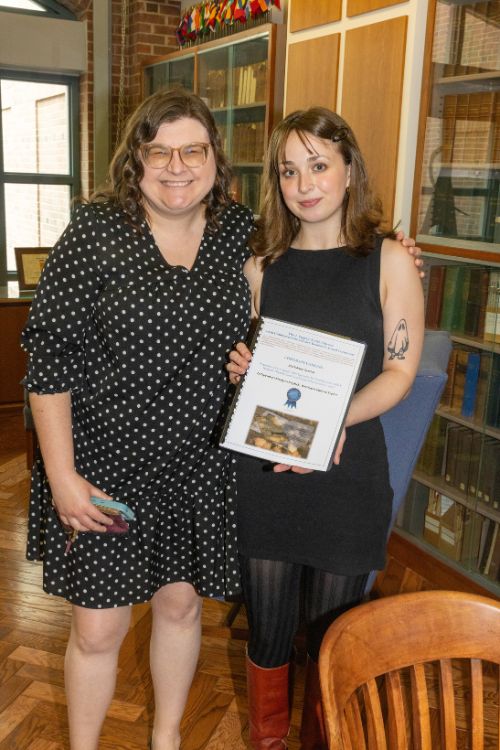
Madeleine Orwick with Professor Allison Speicher
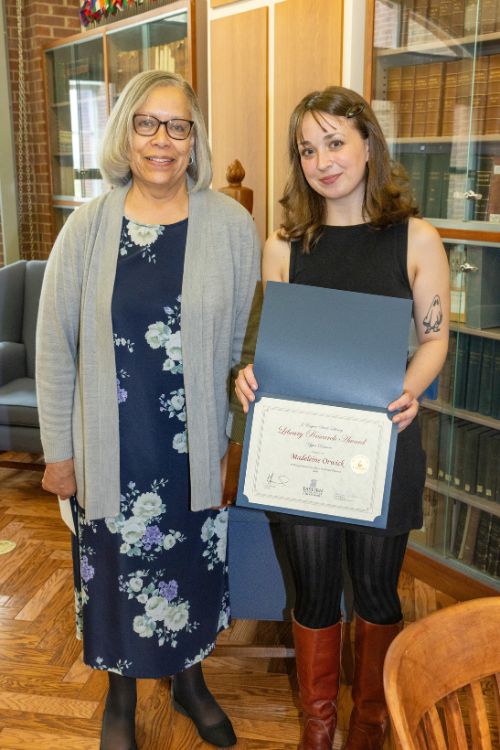
Madeleine Orwick with Janice Wilson, director of library services
The J. Eugene Smith Library hosted its annual Library Research Awards Ceremony on May 13. This year’s winner was English major Madeleine Orwick ’26 for her archival research uncovering the story of Sarah Willie Layton, a Black woman who became a church and community leader in the decades following the Civil War.
Layton was the daughter of William H. Phillips, a man born into slavery who later became a nationally respected Baptist preacher. The Harriet Beecher Stowe Center, which is developing a larger manuscript project on Phillips, served as the starting point for Orwick’s research.
“I started with her father because that was the focus of the larger manuscript project,” Orwick said. “As I searched the names mentioned in the manuscript, I found a line written near the end of his life saying his daughter was still alive in California. That gave me a lead and a location to begin tracing her story.”
Orwick received the opportunity to conduct the research through an internship at the Harriet Beecher Stowe Center. According to English Professor Allison Speicher, who serves as the vice president of the Harriet Beecher Stowe Society, the archival director of the Stowe Society, Cat White, reached out looking for a student who could take on the project involving the Phillips manuscript.
Speicher said she immediately thought of Orwick for the work because of her intellectual curiosity and sharp attention to detail. “Madeleine had taken a children’s literature course with me and showed a lot of interest in the historical period during which Layton lived.”
“It takes a certain penchant to spend hours searching for that one detail — not everybody finds that satisfying, and I knew she would.”
As an English major, Orwick said she enjoyed developing a narrative from scattered pieces of research, something she said became central to the project.
“I organized it in a way that told a story,” Orwick said, “based on what emerged through the research, like her political views, her work in the church, and the organizations she was involved with helping younger Black women.”
Thanks to the digitization of archival materials, Orwick was able to conduct much of her research through online databases. Speicher said increasing access to digitized archives is transforming historical research, particularly for stories involving historically underrepresented voices.
“As more archives become digitized and searchable, it’s changing the game,” Speicher said. “It’s making it possible to represent voices we never would have been able to find before.”
Orwick said she hopes the research will contribute to the broader manuscript project on Phillips and help preserve Layton’s story for future scholarship.