
- Apply
- Visit
- Request Info
- Give



Written by By Savannah Striano ’25
Published on May 05, 2026
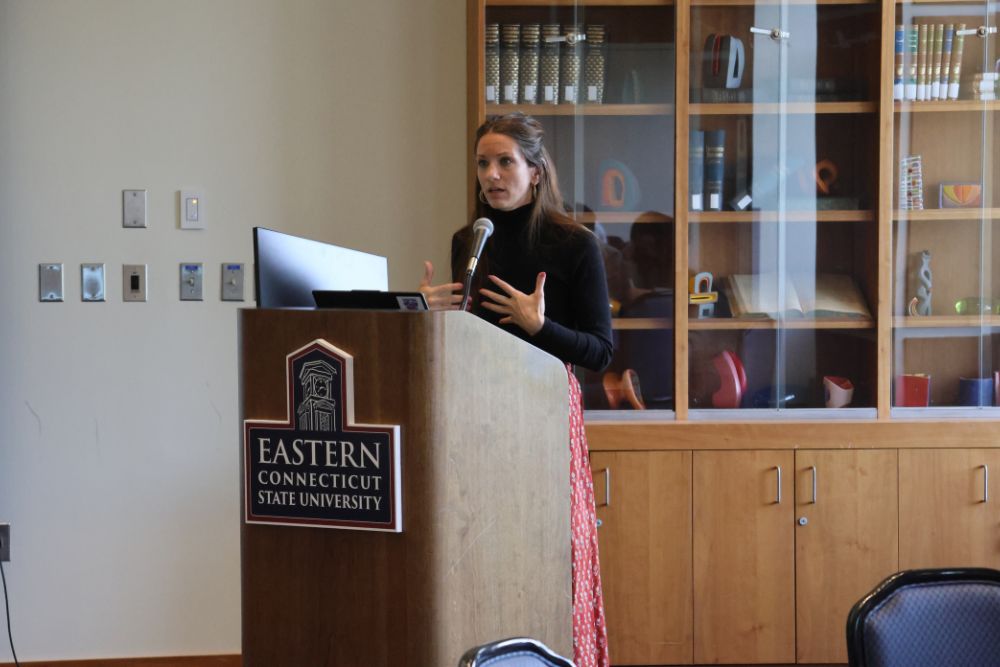
Jennifer Paradis discusses housing insecurity at Eastern.
Eastern hosted the Housing Justice Brown Bag Lunch Series this spring 2026 semester, presented by the Center for Housing Equity & Opportunity (CHEO). The final session was held on April 29, when faculty members, housing advocates, and nonprofit leaders gathered in the Paul E. Johnson, Sr. Community Conference Room.
Jennifer Paradis ’09, executive director of the Beth-El Center, a homeless shelter in Milford, discussed the role of advocacy in combating housing insecurity across Connecticut.
The series brought together seven regional partner organizations, including the Community Foundation of Eastern Connecticut, Partnership for Strong Communities, LISC Connecticut, United Way of Eastern Connecticut, Connecticut College, and Eastern, to examine housing challenges and identify strategies for improving equitable access to housing throughout the region.
The series aimed to connect students, faculty, and community members with housing professionals while addressing rising housing costs and increasing rates of homelessness across Connecticut.
“Together, these organizations are uniting resources and knowledge to strategically channel support throughout the region, with a single focus on ensuring equitable access to housing opportunities for all,” said Nicole McCormack ’17, CHEO project manager, in her opening remarks.
During the session, Paradis drew on her professional leadership and personal experience to frame housing insecurity as a systemic issue requiring collaboration across sectors.
“What I just shared with you is my housing story, and we all have one,” Paradis said. “That’s one of the most powerful and difficult parts of working in housing.”
Paradis, who experienced housing instability as a child after her family lost their home to foreclosure, emphasized that housing justice work involves navigating competing priorities among renters, homeowners, municipalities, developers, landlords, and policymakers. Despite those tensions, she said, there are shared concerns that can serve as the foundation for meaningful progress.
“The cost of housing is too high,” Paradis said. “It’s too expensive to build, rent, and own.”
Paradis also emphasized the connection between housing and education, calling it “an inextricable link” that is gaining broader recognition. She noted that renters, homeowners, and municipalities all have a shared interest in housing stability because of its impact on schools and communities.
“A lot of times, we try to solve problems by adding,” Paradis said. “Before we add, we should ask if there’s something that’s not helpful that we need to take away.”
She described homelessness as a housing problem rooted in affordability and income instability, citing significant increases in homelessness and unsheltered populations across Connecticut in recent years.
“For people experiencing homelessness, this work is a matter of life or death,” Paradis said. “We lost more than 140 individuals last year who were experiencing homelessness.”
Paradis outlined two advocacy priorities critical to addressing the crisis: fully funding the homelessness response system and ending policies that criminalize people experiencing homelessness.
“The moment someone (experiencing housing insecurity) steps into public space, their basic activities of daily living are criminalized,” she said. “These are human needs, not crimes.”
She added that advocacy extends beyond individual actions such as rallies or letters to legislators. Paradis encouraged attendees to view advocacy as sustained relationship-building rather than a single action, emphasizing that progress depends on collective effort.
“Advocacy isn’t just an action,” Paradis said. “The success of advocacy relies on relationships, shared understanding, and alliances strong enough to withstand conflict and pressure.”
She continued: “ We need to build partnerships with organizations, folks with shared understanding and analysis, and relationships with those who might feel different. None of us get what we need without one another.”