- Apply
- Visit
- Request Info
- Give



Written by Kyle Berson '26
Published on April 08, 2026
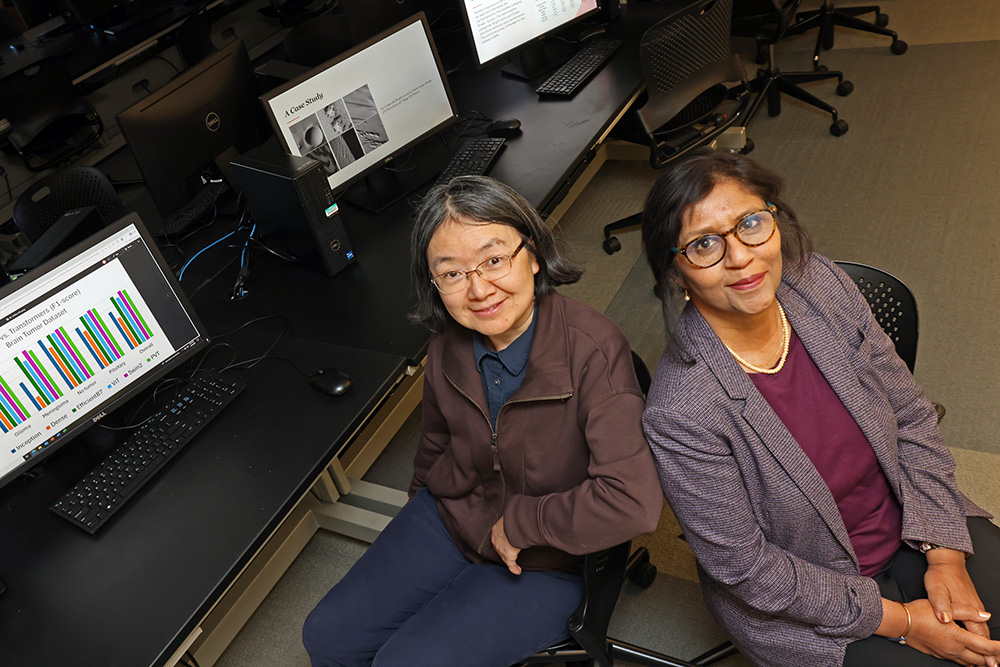
Over the past five years, Eastern computer science Professors Sarah Tasneem and Kehan Gao have become a force to be reckoned with in computer science research. From analyzing COVID-19 data to advancing computer vision research on Mars, the duo has made several contributions to their field of academia.
During that time, Tasneem and Gao have collaborated on five conference publications and presentations, a scholarly journal article, and a chapter of a COVID-19-related textbook. The duo also mentored several undergraduate researchers and oversaw five student research projects, further expanding the reach and impact of their work.
Big data and a global pandemic
Tasneem and Gao’s collaboration began in 2021 during the height of the COVID-19 pandemic. The duo sought to extrapolate large datasets to “better understand the severity and regional impacts of the crisis,” wrote Tasneem and Gao in a joint email.
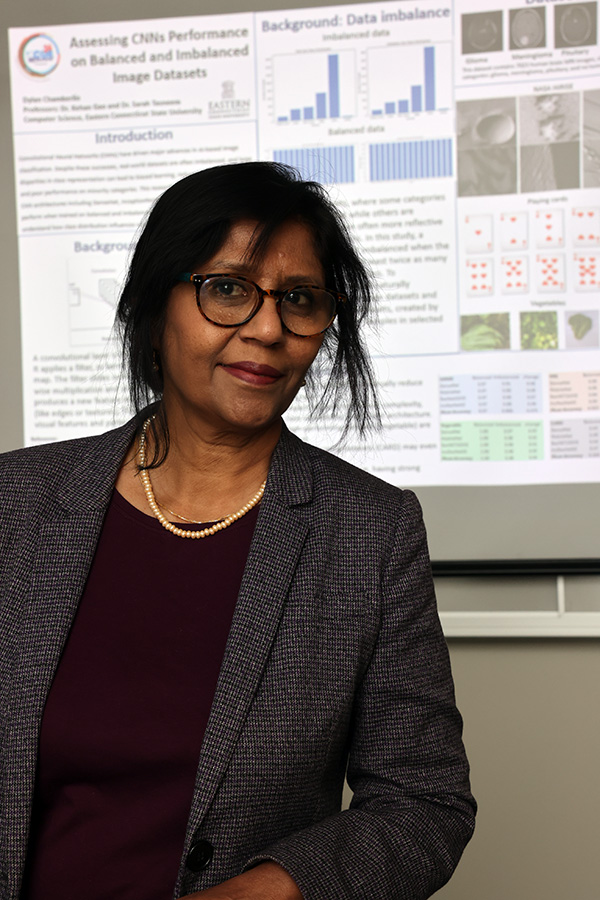
“Rather than remain idle (during the pandemic), we chose to apply our expertise in data analysis and machine learning to rapidly growing public health datasets.”
Their chapter in “Applications in Reliability and Statistical Computing,” titled “Assessing the Severity of COVID-19 in the United States,” was designed to serve as a template for public health officials to convey the disease’s severity as it spread across the country in the early 2020s.
Their initial research on the topic applied data analytics and machine learning techniques, while later research folded in reliability analysis and public health data.
One of Tasneem and Gao’s most pressing discoveries was the fact that the spread of COVID-19 was unequal among geographic locations and demographic populations. “The data clearly showed that the impact of the pandemic was not uniform nationwide and that demographic and regional factors played an important role in shaping outcomes,” they wrote.
“These findings helped illustrate how different regions were affected and highlighted the importance of data-driven decision-making in public health responses.”
Going interplanetary
As the COVID-19 pandemic slowly became history, the duo pivoted toward interplanetary history, publishing several scholarly works in deep learning and classification of images captured on NASA’s unmanned Martian expeditions.
After earning a $10,000 NASA Connecticut Space Grant College Consortium Collaborative Faculty Research Grant, the pair spent multiple years studying the implementation, effectiveness, and impacts of deep learning models classifying and identifying alien landscapes.
Tasneem and Gao have also provided research opportunities for Eastern students. These students further researched deep learning and image classification of interplanetary landscapes. Six have presented findings at academic conferences such as the National Conference for Undergraduate Research (NCUR), the Council of Public Liberal Arts Colleges (COPLAC) undergraduate conferences, Eastern’s Celebrating Research Excellence and Artistic Talent (CREATE) conference, and the NASA Space Grant Exposition.
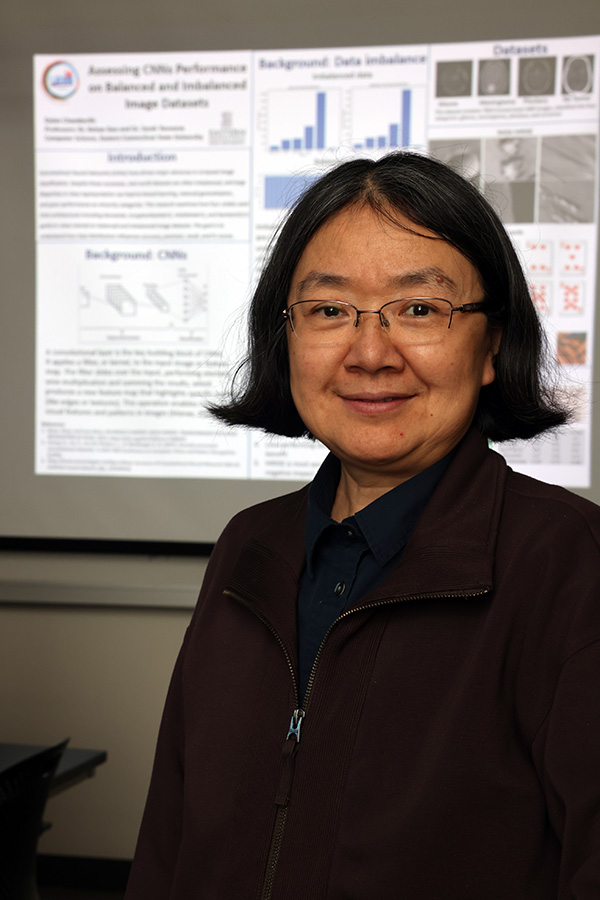
“One of the most rewarding aspects of our collaboration is the opportunity to combine complementary expertise while mentoring undergraduate students in meaningful research projects,” the duo wrote.
During this project, Tasneem and Gao directly involved the students in hands-on deep learning techniques and research to help them build practical skills and experience.
“Seeing undergraduate students becoming excited about research and developing their own projects is one of the most fulfilling aspects of our collaboration,” they added.
Medical implications
Tasneem and Gao are also applying their machine learning expertise to healthcare challenges. Their current research addresses class imbalance, a form of data bias in machine learning.
According to the pair, the way generative AI learns and becomes efficient in image classification is through analysis of massive datasets. For rarer images without a large sample size, it’s hard for machine learning models to accurately identify images with the same accuracy as those with larger sample sizes.
Tasneem and Gao studied X-rays as an example of this bias. If a machine learning model is fed 10,000 images of healthy scans, while only being fed 500 images of fractures and other injuries, the model will be more accurate in identifying healthy scans rather than injuries.
“Our research explores methods to mitigate this issue so that AI systems can produce more accurate and reliable predictions across all categories, especially those representing rare but clinically important cases,” the duo wrote.
Real impact
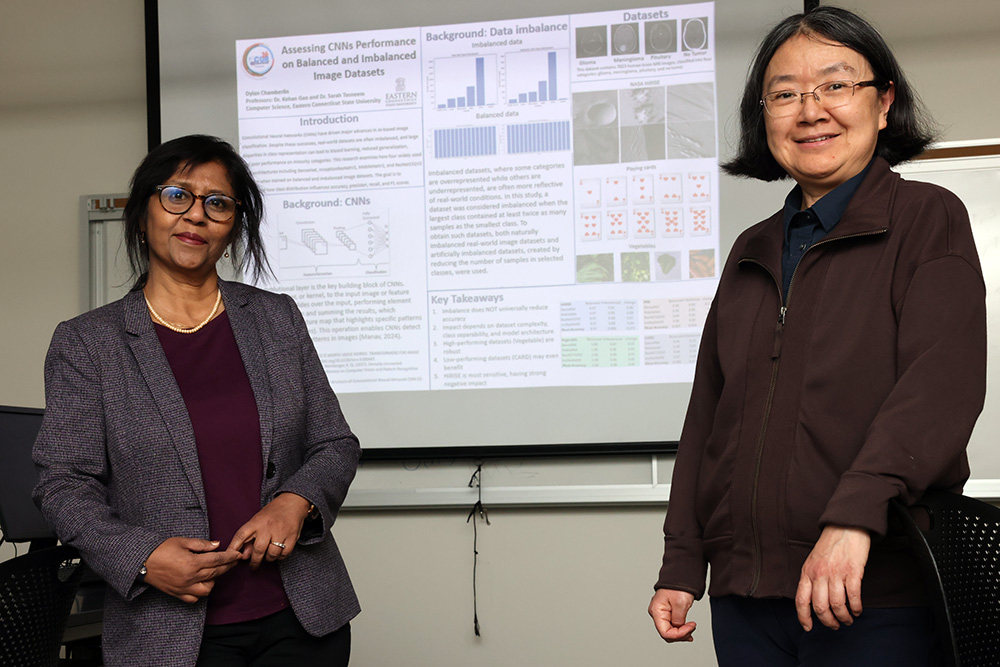
Contributing to timely and relevant research is a cornerstone of academia, and Tasneem and Gao’s research has broad impact. Their COVID-19 research helped public health officials and policymakers make data-driven decisions at the local and regional level. Their contributions to machine learning have helped advance understanding of class imbalance, which could lead to better techniques to address data bias and create more reliable and equitable machine learning models.
“By engaging in timely and impactful research topics such as public health challenges, artificial intelligence, and space exploration, faculty help address pressing global problems while advancing scientific knowledge,” Tasneem and Gao wrote.
The duo also stressed the importance of passing the lantern to undergraduate students. “Giving students opportunities to participate directly in meaningful scholarly work not only contributes to the broader research community, but also prepares the next generation of scientists, engineers, and researchers.”