
- Apply
- Visit
- Request Info
- Give



Written by Noel Teter '24
Published on April 20, 2026
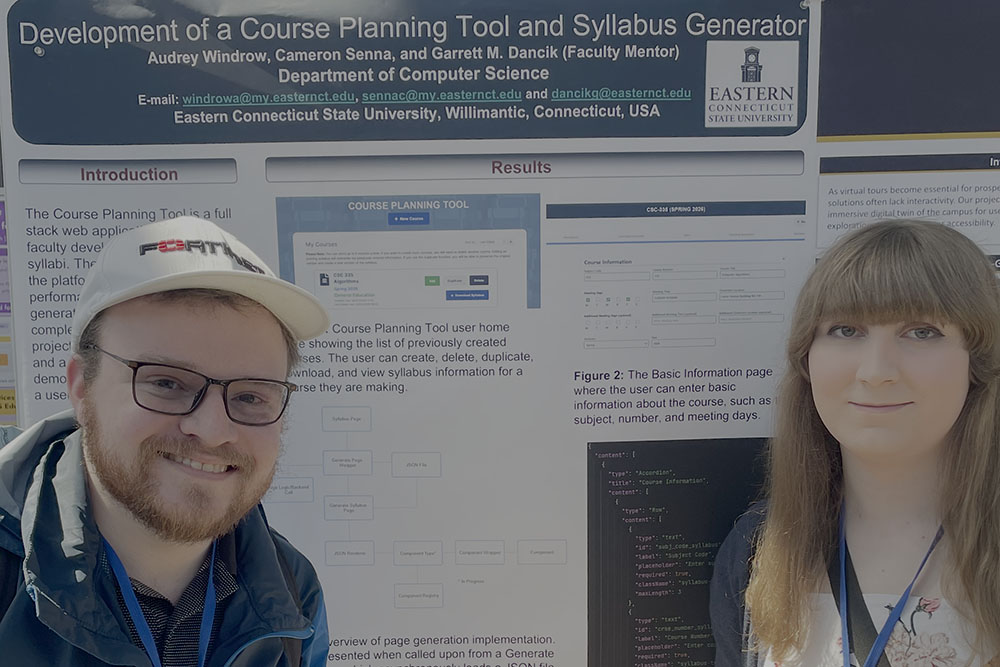
Prior to this year, Eastern computer science Professor and Department Chair Garrett Dancik had never traveled with more than two students to the Annual Meeting of the Consortium for Computing in Colleges Northeast Region (CCSCNE). This year’s group tripled that record, as Dancik brought six students to the conference at Smith College in Northampton, MA, on April 10.
Each student presented an original research poster. Dancik clarified that while some students’ work fell into the category of traditional research, others presented at a session new to the conference this year, titled “Application Development.” This session was inspired by an increasing number of students developing apps.
“I was impressed with the diversity of the work carried out by the students,” wrote Dancik. “The diversity of the work shows both the variety of skills and interests of our students, from AI to applications related to sustainability and curriculum development.”
Projects
Stephen Canavan’s poster was titled “Evaluating ChatGPT's Ability to Answer First-Order Logic-Based Questions.” Canavan’s project arose from an increasing need to understand the accuracy of AI chatbots, which are rising in popularity.
“Using the Logic-Bench dataset and custom questions about Eastern (professor office hours, contact information, and class times), ChatGPT was prompted with different types of logical questions,” wrote Canavan. “Using the logic-based programming language Prolog as a control for perfect performance, ChatGPT was evaluated by its accuracy.”
Canavan continued: “We found that ChatGPT made mistakes across all models given all types of logic and questions. Compared to Prolog, ChatGPT fell short of the perfect standard and had accuracy results varying between 20% and 100% across different logic and question types.”
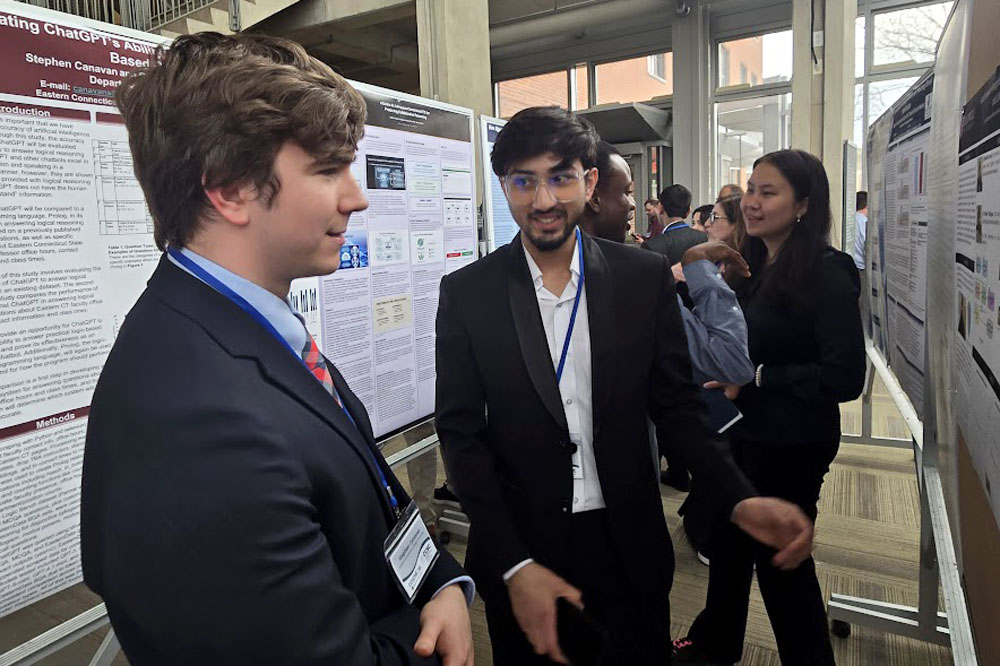
Canavan described the results as indicative that ChatGPT is a “versatile tool with the ability to answer some logic-based questions” but is “not perfect and should be treated as such.”
Regan Cunningham’s project, “Evaluating Large Language Models for Phishing Email Identification,” evaluated the accuracy of three large language models (LLMs) — OpenAI’s ChatGPT-4, Google’s Gemini 1.5 Flash, and Microsoft’s Copilot with GPT-4 — in rooting out emails intended to scam their readers.
“Results show that Gemini achieved 100% accuracy, ChatGPT achieved 94% accuracy, and Copilot achieved 92% accuracy,” wrote Cunningham. “These findings show that popular LLMs can effectively detect phishing emails and can be used by everyday users as an acceptable and reliable tool.”
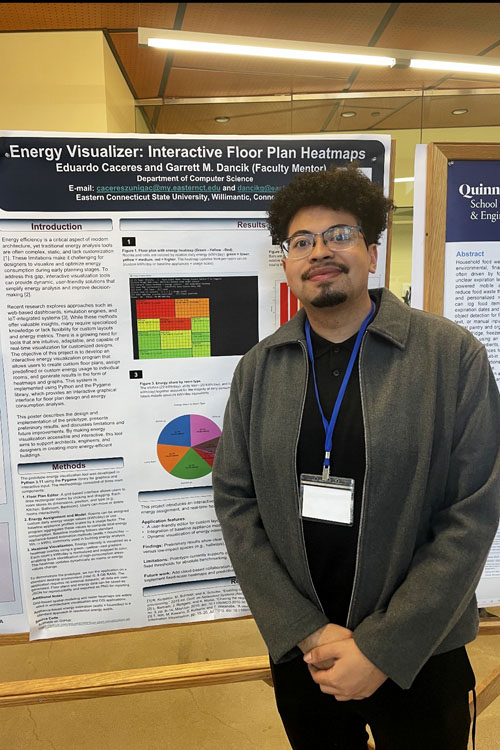
Eduardo Caceres-Zuniga
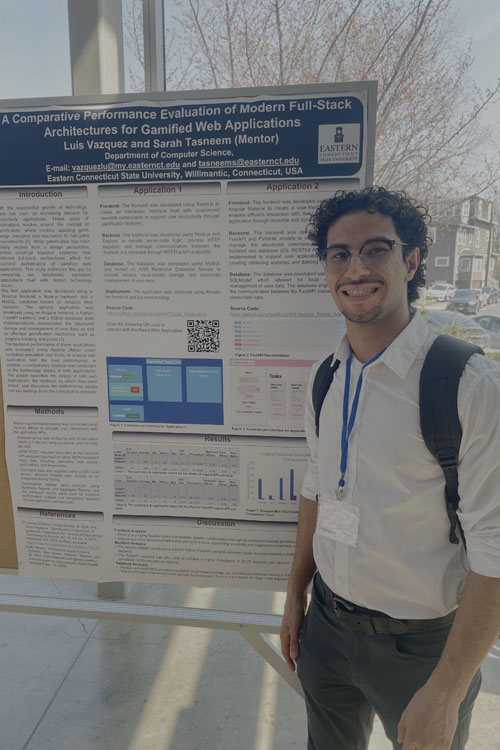
Luis Vazquez
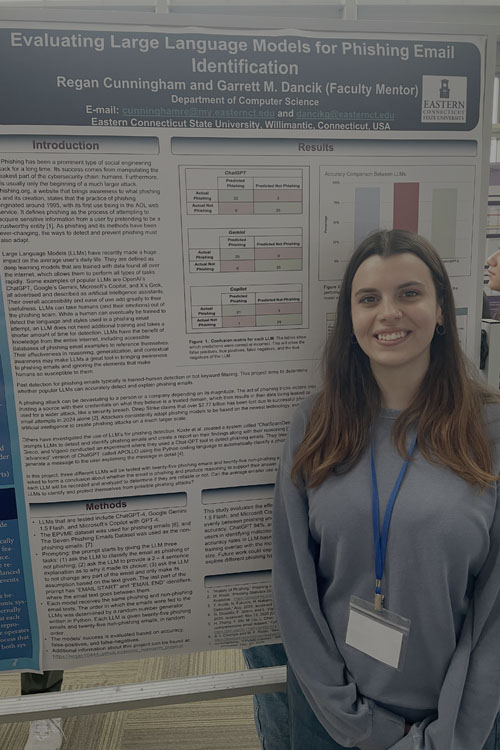
Regan Cunningham
Eduardo Caceres-Zuniga went in a different direction with his project, titled “Interactive Floor Plan Visualization for Energy Consumption Analysis.” The project aimed to help foster sustainable building design through an interactive visualization tool.
“Implemented in Python using the Pygame library, the tool allows users to create a floor plan, assign energy use to each room in kWh, and visualize consumption through colors and a summary graph,” wrote Caceres-Zuniga.
He continued: “A demonstration shows that the visualization tool highlights high energy consumption areas, allowing users to explore various alternative layouts and energy-saving strategies. Limitations include the lack of real-world data integration and predictive modeling that would consider real-world energy use and fluctuations due to weather and other environmental factors, which could be addressed in future updates.”
‘Conversational’ and ‘Accessible’
The students spoke highly of the conference and the approachable nature of its attendees. “I would recommend any computer science student interested in presenting their research in a conversational way to attend this conference,” wrote Canavan.
“There were many speakers who were very knowledgeable about the computer science field and showed great care and passion toward the ideas on how to make computer science more accessible and interesting to all students,” added Cunningham.
Caceres-Zuniga, a senior, viewed the conference as an opportunity to build his professional network. As a rising professional in the computer science field, he also appreciated “seeing how others perceive the ever-changing industry and how each student uses their knowledge to create amazing things.”