
- Apply
- Visit
- Request Info
- Give



Written by Noel Teter '24
Published on April 01, 2026
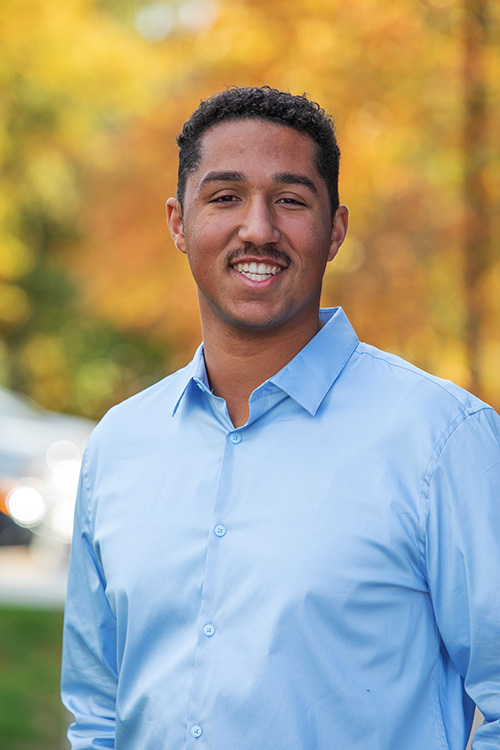
A psychology major at Eastern may be able to help you understand how physical exercise influences your diet and financial decisions. Senior Gabriel Williams earned recognition for his honors thesis research at the Connecticut Association for Behavior Analysis (CTABA) annual conference on Feb. 27 at the Foxwoods Resort Casino in Mashantucket, CT.
Williams earned the “Excellence in Research Design” award for his thesis project, with psychology Professor Christopher Krebs serving as his research mentor. Williams’s project, completed as a requirement for the University's Honors Program, examines the impact of physical exercise on impulsive choices related to food and money.
“Working with exceptional students like Gabriel is what makes my job so rewarding,” wrote Krebs. “The recognition he received from CTABA is a shining testament to his dedication and perseverance, and I couldn't be prouder to see his efforts paying off in such a meaningful way.”
Williams and Krebs investigated past research on the topic, which posited that exercise increases impulsive choices related to food but decreases those related to money, according to Williams. “We tried to replicate the results of past research by using systems of similar boundaries regarding exercise conditions and similar questionnaires,” he said.
Of the research's impact, Williams said, “We were able to add to the literature and hopefully give future directions regarding how people could study exercise and impulsivity in the future."
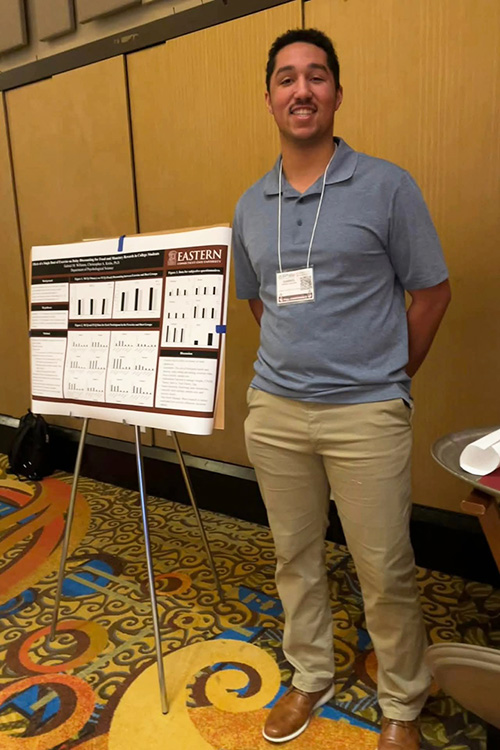
Williams used his research design skills to get his project approved by Eastern’s Institutional Review Board (IRB), which meant his sample was strictly students on campus. “Even though I had limitations in what I could do with the participants, I made sure those limitations would not affect the results,” he said.
Williams randomly assigned his participants to one of two groups. Group one exercised at a moderate intensity for 45 minutes at the start of the research session, while group two rested for 45 minutes. While he could not provide participants with real-life choices involving food and money, he used hypothetical choices as a substitute.
Williams had his participants complete several surveys and questionnaires related to food choices, money choices, and their feelings of fullness, hunger, thirst, nausea, and stress. The latter was completed at three different points during the sessions: before exercise, immediately after exercise or rest, and 30 minutes after exercise or rest.
Williams felt that he accomplished more during his project than simply completing his thesis requirement or earning statewide recognition. “It gave me a chance to explore something I was passionate about in an academic setting,” he said.
Williams continued: “A lot of people end up going through the motions, and they don't find value in learning or in going out of their way to create something that's related to academics. … A lot of people miss out on the joy of being able to connect some of their passions with school and research.”