
- Apply
- Visit
- Request Info
- Give


Written by Michael Rouleau '11
Published on April 08, 2026
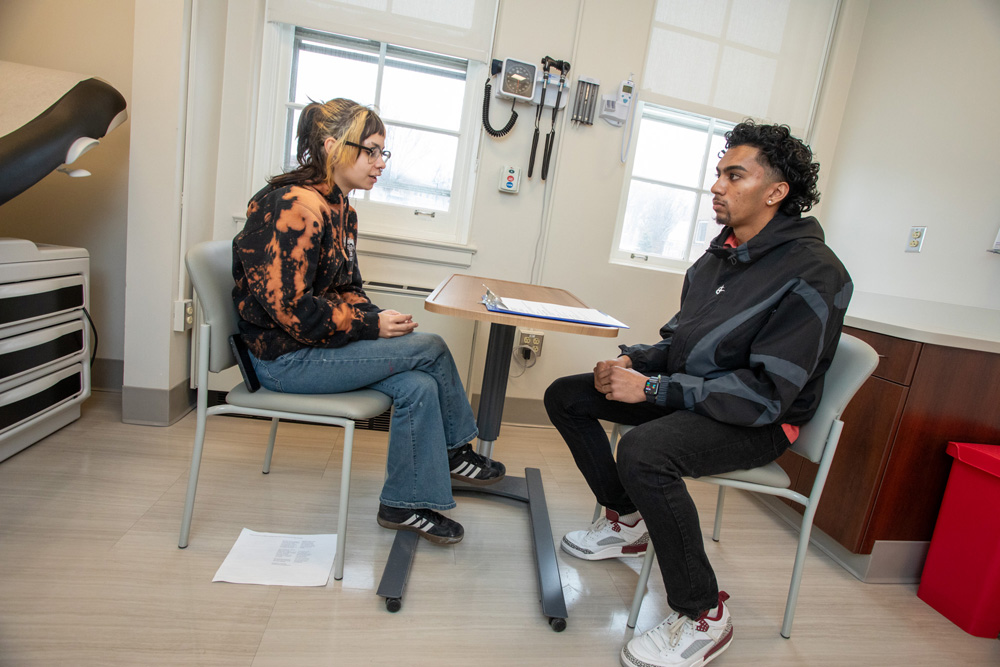
Student Q Asberry serves as a standardized patient for social work major Dustin Sannasi in a clinical simulation.
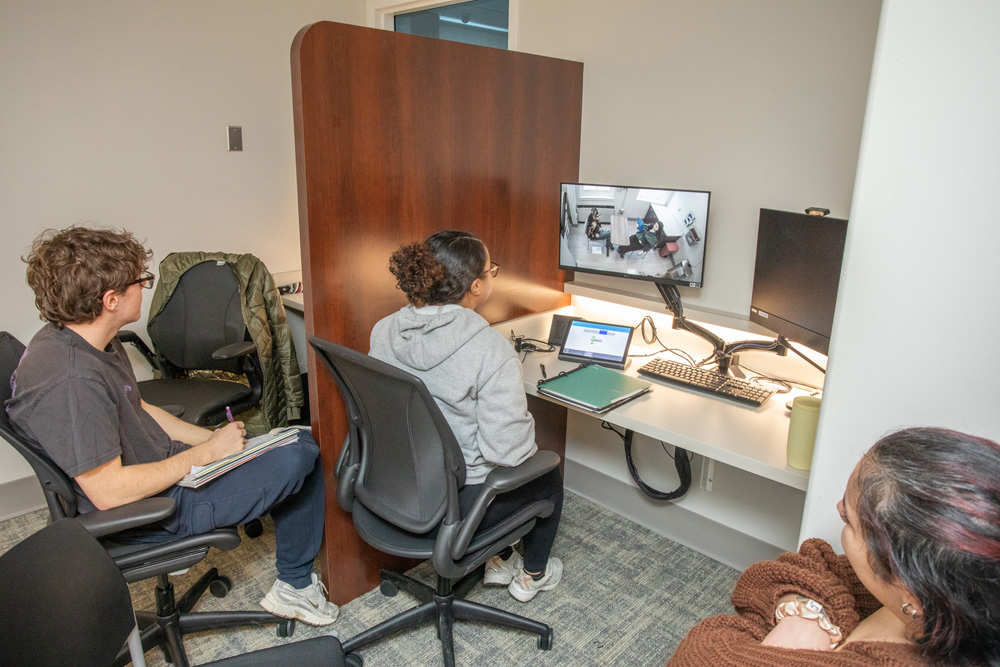
Social work students observe a live recording of their classmate's clinical simulation.
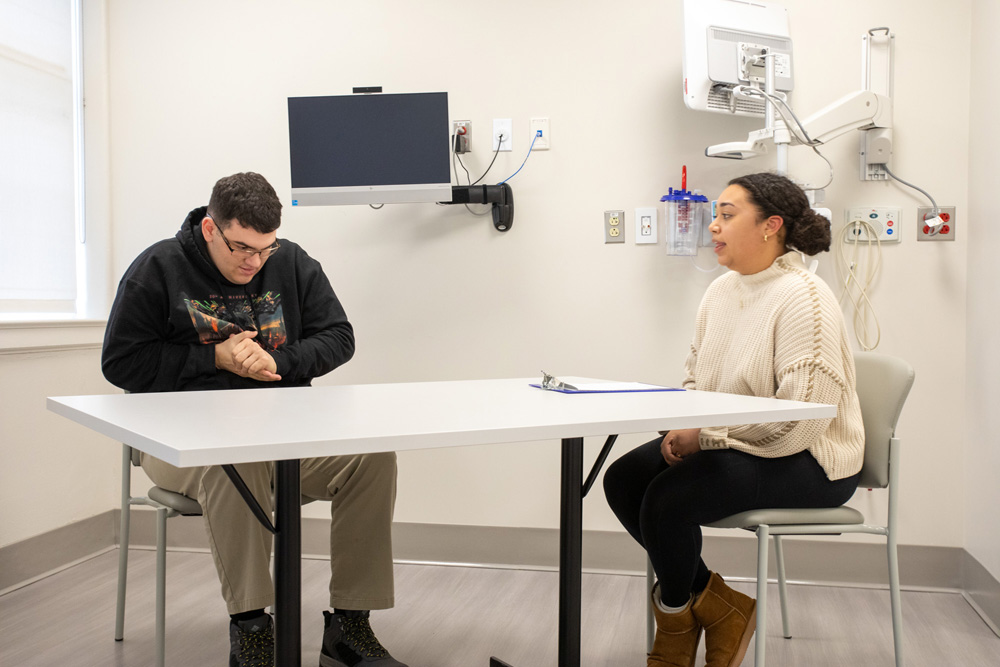
Student Austin Corporale serves as a standardized patient in a clinical simulation for social work major Mikayla Quey.
An unusual partnership at Eastern Connecticut State University is bringing together theatre and social work students in a novel simulation experience that prepares both groups for their future careers. The collaboration creates a safe but realistic environment where students can test their skills, make mistakes, and build confidence before working with actual clients.
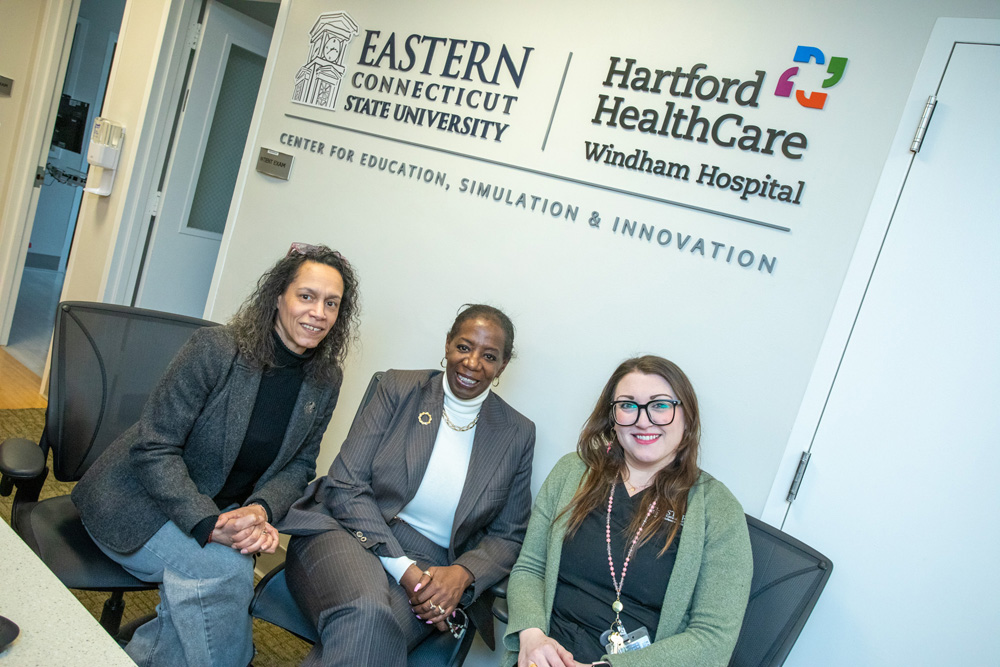
Hosted in Eastern’s nursing simulation lab at Windham Hospital — formally named the Eastern/Hartford HealthCare Center for Education, Simulation, and Innovation (CESI) — the collaboration gives social work students a chance to practice their clinical skills in a low-risk environment simultaneously as theatre students hone their skills in acting and improvisation.
The theatre students serve as “standardized patients” (SPs) — trained actors portraying specific patient cases — who enact their role, unscripted, based on a patient description. Meanwhile, the social work students must build rapport with the patient in order to understand and best support them. The result is an authentic clinical exchange that tests both students' skills.
The simulation
One such patient the theatre students played for the social work trainees was Eric, a germophobic college student with debilitating anxiety who withdrew from school following the Covid-19 pandemic.
Five theatre students taking independent study with Professor Alycia Bright-Holland played the role, among other patients in different scenarios, for roughly 40 social work students training under Professor Eunice Matthews-Armstead.
During the simulation, a patient and social worker pair off for eight-minute clinical sessions, observed by social work classmates in a separate room who are watching a live recording. Following the session, the patient gives in-character feedback, telling the social worker what made them feel heard or dismissed.
“It’s about getting into the head of someone else,” said junior Lucas Poole, who’s majoring in communication, film, and theatre. “It's very different from theatrical acting because you're not doing it for an audience. ... It’s just for the social worker and the observers, but they’re not an audience — it’s not meant to be entertaining.”
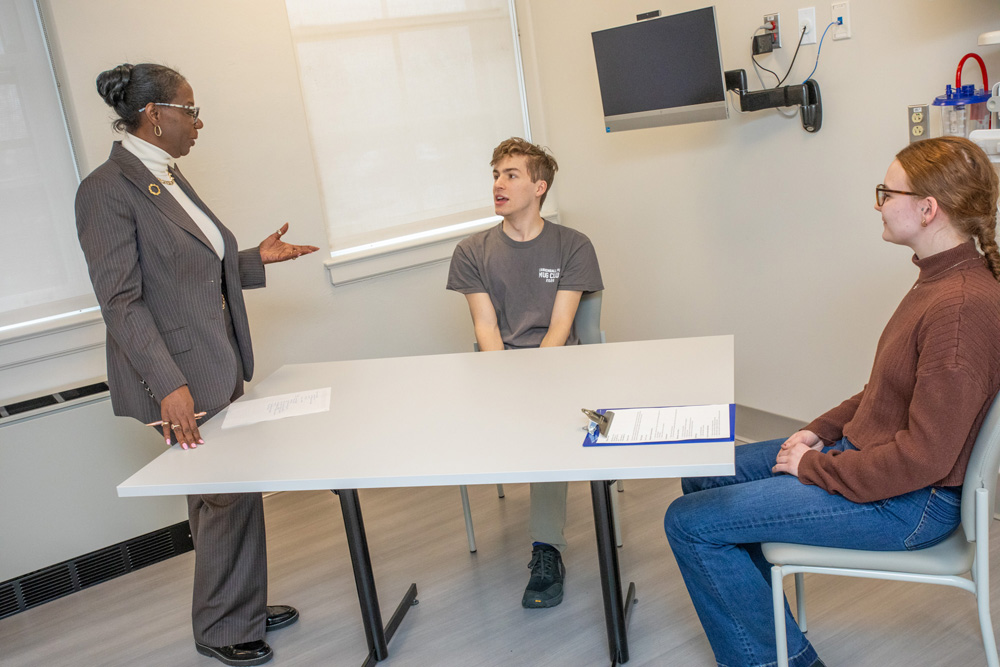
Social work Professor Eunice Matthews-Armstead provides feedback following a simulation with acting Lucas Poole and social work student Brigid Sheades.
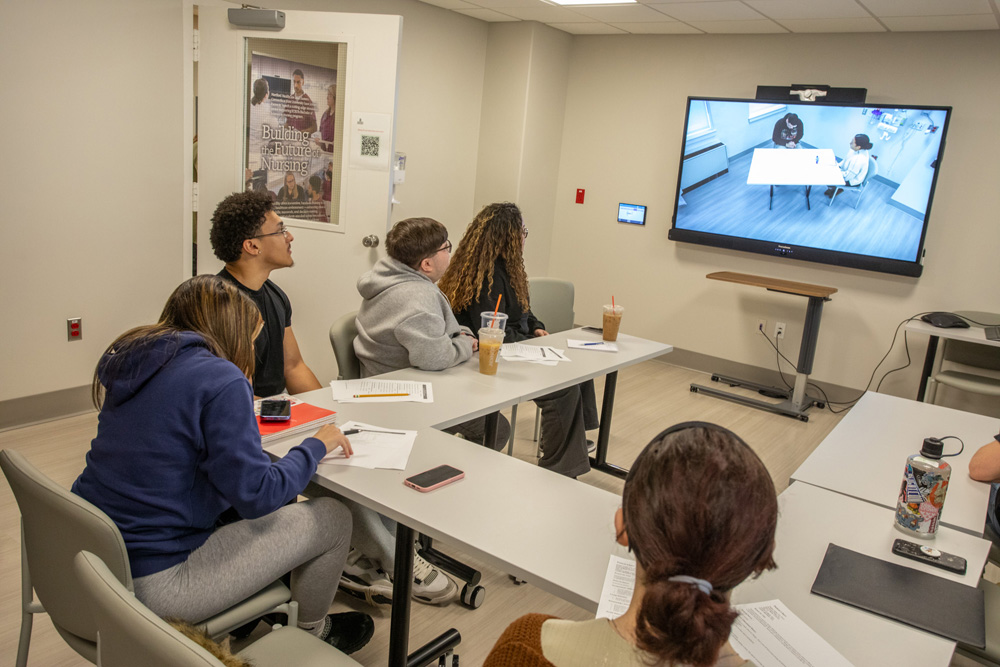
Social work students observe a live recording of their classmate's clinical simulation.
The use of standardized patients is crucial to the simulation, versus traditional roleplaying by peer social work students, who may unintentionally cater to the social work trainee.
Standardized patients help create a more realistic environment by fostering authentic patient interactions that require clinical reasoning and patient-centered problem solving, according to Matthews-Armstead. “This strengthens their professional competence and confidence.”
The social workers take turns as the theatre students replay their role session after session, each time doing it differently based on the interactions with the social work student.
“For theatre and performing arts students, these simulations provide applied acting opportunities that refine improvisation, emotional authenticity, and character consistency,” said Bright-Holland.
Prior to each session, the social work students prepare for their clients as they would in the real world: with a patient intake form providing a brief description and background.
“We get to look at that for a couple minutes and then we just jump right into it,” said junior social work major Brigid Sheades. “That's how it's going to be when you are in a clinical practice.”
While the sessions feel real, the fact that they're a simulation removes some of the pressure. “We can mess up, we can make a mistake,” added Sheades. “We can accidentally crack a smile or say the wrong thing, and we're not putting someone's mental health at risk.”
As for the social workers’ objective, senior Mikayla Quey said, “We want to build a connection, build trust, and get the client to talk as much as they can so we can get an understanding of how can we can best help them.”
Over the course of the semester, the simulation follows a three-phase rotation mirroring the “helping relationship," which includes engagement, assessment/goal-setting, and intervention/evaluation. A best practice for the social work field, this model is meant to build rapport by empowering clients through trust and empathy.
Interpersonal Training
For theatre major Austin Corporale, the simulation benefits extend beyond career preparation.
“Not only do we get to help the social work students practice their skills, but it also helps us grow as actors,” he said. “And in our everyday lives ... we can see how these interactions play out and learn from them.”
That interpersonal dynamic is one of the most valuable parts of the collaboration. “College students today are coming in less interpersonally and emotionally equipped than, say, 15 years ago,” said Matthews-Armsted, pointing to the proliferation of social media and digital communication.
“These interpersonal, social, and emotional challenges can affect future practitioners’ ability to build rapport, interpret nonverbal cues, and establish and sustain empathetic connections in clinical or collaborative settings.”
Simulation Coordinator Lauren Lary of the Department of Health Sciences and Nursing agrees that communication skills are at a deficit in other clinical fields as well, including health care.
“Lack of communication is the number one cause of medical errors,” she said, adding that the problem is exacerbated by the fast pace and high caseloads of clinical settings. “You have very little time to communicate and engage with your patient now.”
A Growing Opportunity
Because of this interdisciplinary need for more interpersonal training, Lary noted that the nursing program plans to offer simulations with standardized patients in the coming 2026-27 academic year. This may result in a collaboration involving all three disciplines; for example, a homeless patient (played by a theatre student) with both medical and social needs, requring the nursing and social work students to work togehter.
The increasing opportunity for standardized patients (SPs) on campus is reflective of the wider economy, said Bright-Holland. "Many of our students find gainful employment as SPs, or at least gig employment, between auditions and staying active in (traditional) theatre." Bright-Holland said they are exploring grant funding to pay alumni to serve as standardized patients.
The demand for professional SPs is growing, according to Lary, as more and more medical schools and simulation labs look to enhance their trainings. For now, Eastern’s program is unique among undergraduate programs:
"We are the first undergraduate, interdisciplinary simulation lab in the area,” said Matthews-Armsted. “The only other simulations are at the graduate level."