- Apply
- Visit
- Request Info
- Give



Written by Michael Rouleau
Published on March 06, 2026
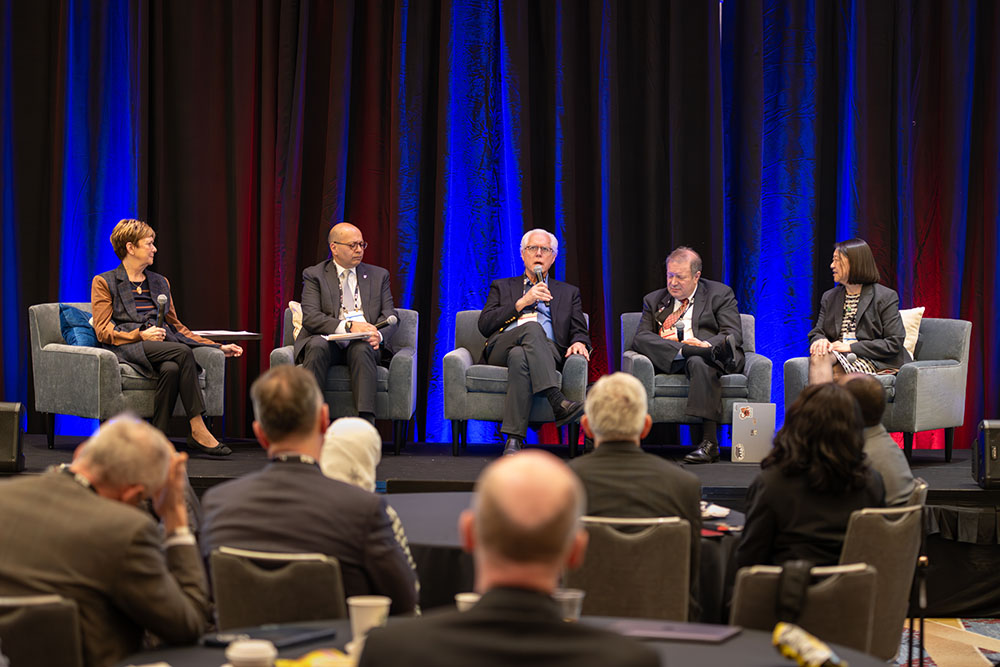
During several trips to Washington, D.C. this semester, President Karim Ismaili has worked to advocate for Eastern at a time when higher education faces historic challenges. By strengthening the University’s connections with national organizations and federal lawmakers, his efforts make Eastern a constructive voice in imperative conversations about the future of higher education.
As the sector faces financial pressures, shifting enrollments, and political uncertainty, Ismaili said, “This is a time when Eastern needs to be connected with our peer institutions. By standing with the larger ecosystem of universities … that's where we can make collective change.”
First on Ismaili’s advocacy tour in the nation’s capital was the American Association of Colleges and Universities (AAC&U) Annual Meeting, from Jan. 21-23. A member of the AAC&U board of directors, Ismaili co-presented with Miriam Feldblum, president and CEO of the Presidents’ Alliance on Higher Education and Immigration, of which Eastern is also a member.
During the board of directors meeting, the two discussed campus realities and national trends facing international, undocumented, and immigrant students, much of which is centered on the fear of detainment and deportation by immigration officials.
“The common goal (among all participating institutions) is to make sure that our students feel secure, protected, and able to move through their academic programs with as minimal disruption as possible,” said Ismaili. “Regardless of immigration status, all students are valued members of our campus community and deserve the opportunity to pursue their education without fear.”
The following day, Ismaili spoke during the AAC&U President's Trust Symposium on a panel titled “Moral Courage and Tough Decisions in Complex Times.”
When deciding to speak out on current events, Ismaili said, “You need to be mindful that (being a college president) is not a political platform. … It’s an opportunity to demonstrate leadership and remind the campus of our values as an institution.”
Later that week, Ismaili attended the first-ever legislative breakfast for the Council of Public Liberal Arts Colleges (COPLAC) on Capitol Hill. A member of the COPLAC executive committee, Ismaili, explained that COPLAC is hyper-focused on communicating the value of the public liberal arts. Eastern is Connecticut’s designated public liberal arts university and one of only 27 COPLAC institutions in North America.
“The legislative breakfast was an opportunity for us to come together at the center of government in the United States, and really talk about what we do, how we do it, and to detail the positive social and economic impact of our institutions.”
The meeting featured remarks by Minnesota Sen. Amy Klobuchar and Oregon Rep. Andrea Salinas, among others, who shared their thoughts about the value of the liberal arts.
The event also premiered the COPLAC advocacy video, which highlights the importance of the public liberal arts through the lens of alumni. In the video, Eastern is represented by Kevin Booker Jr. ’00, who is a college professor and community activist.
“Another highlight for me,” said Ismaili, “was the powerful testimony delivered by alumna Grace Carlos ’23, who spoke eloquently on the influence of Eastern’s accessible liberal arts education on her budding career on Capitol Hill.” Carlos is currently a scheduler for California Rep. Jimmy Gomez.
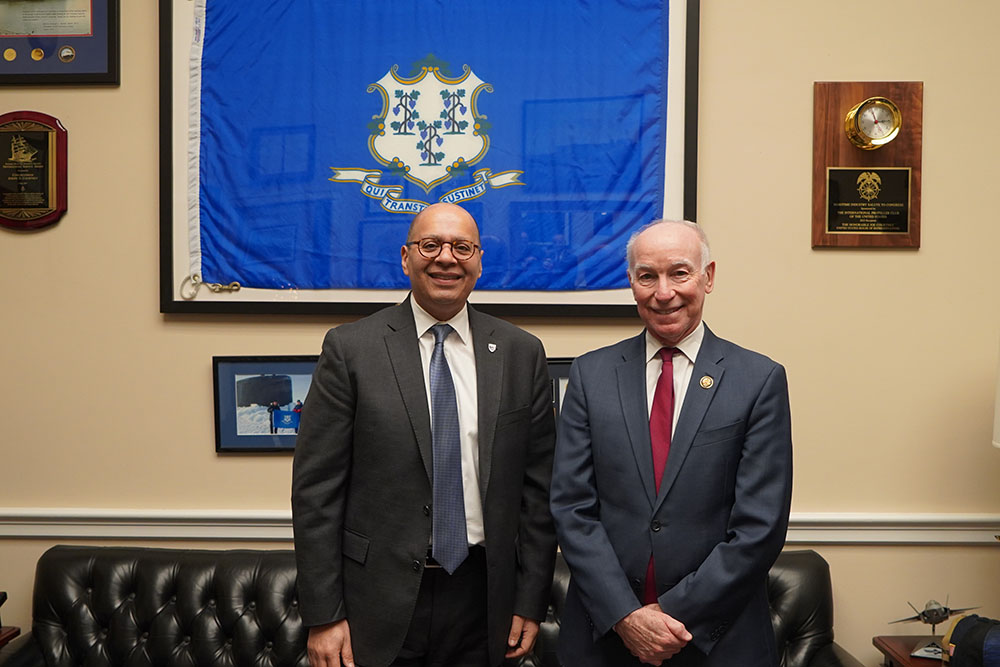
Later that day, Ismaili met with Connecticut Congressman Joe Courtney. “We talked about opportunities for Eastern to be more engaged with local business, industry, nonprofits, and tribal organizations. ... We talked about federal issues that the congressman is involved with, like Pell Grants and financial aid, research funding, and AI.”
President Ismaili returned to Washington, D.C. in February for the Campus Compact Policy & Impact Summit at George Washington University.
Campus Compact is the largest higher-ed nonprofit dedicated to civic and community engagement. Eastern was invited by Campus Compact board member Mary Grant, president of the Massachusetts College of Art and Design and Eastern’s 2025 honorary degree recipient.
“I was able to share all of the great work we're doing in the community through the Center for Community Engagement (CCE),” said Ismaili, emphasizing Eastern's strong tradition of service learning and community involvement.
“We have a public purpose that is not only focused on education and the development of our students,” he said, “but also on contributing to the public good through our community partnerships and by being engaged in the democratic process.”
While in D.C. on this trip, Ismaili met with United States Sen. Richard Blumenthal and the staff of Sen. Chris Murphy. “We talked about the importance of college presidents leading on current issues, from human rights to academic freedom,” said Ismaili. Considering the turbulent political climate, he added, “There is worry about the growing sentiment that Americans no longer see four-year college degrees as worth the cost.”
On the value of these interactions with government officials, Ismaili said: “They give me an opportunity to talk about our mission and our significance for Connecticut and beyond.”
Ismaili has accepted an invitation to take part in the American Association of State Colleges and Universities’ (AASCU) “On the Hill” event in late March. The goal is “to make the voices of regional public universities heard in the halls of Congress” and to advocate for funding.
“We are a part of a larger ecosystem of universities,” said Ismaili of Eastern’s involvement with organizations like AASCU, AAC&U, COPLAC, Presidents’ Alliance, and Campus Compact.
“These are sustaining networks for everyone involved. … It is strategic for Eastern to be engaged; they help people understand who we are and our value.”
Ismaili acknowledged the scrutiny facing higher education today. “Whether we like it or not, higher education has changed. We can't think about going back ... we must take agency and construct our own futures in this new environment," he said.
"There is concern over whether higher education has value. Are we insular? Are we not focused enough on what society needs?”
To these questions, Ismaili says the value of higher education — and the liberal arts in particular — is in the development of the whole person. “We impart in our students exactly the skills and habits of mind that they need to thrive and to be contributing members of society.”
Ismaili says the job of higher education is greater than career preparation and social mobility. “Our alums are doing incredible things in and outside of their work, and we want to continue that trajectory,” he said. “The way we do that is by not only attending to the instrumental purpose of getting students into a career path, but also by contributing to the public good.”
To the challenges and opportunities that lie ahead, Ismaili said, “Eastern is incredibly well-placed for this next phase. ... We don’t need to justify ourselves; we just need to emphasize and build upon what we already do incredibly well.”