
- Apply
- Visit
- Request Info
- Give



Written by Savannah Striano '25
Published on March 17, 2026
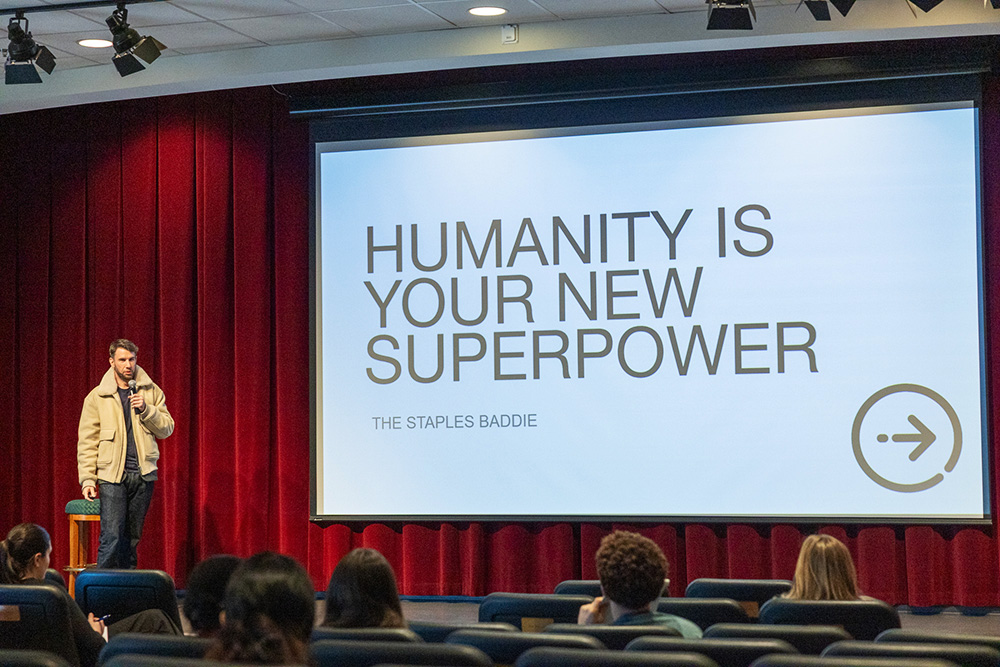
Mason Interactive Senior Creative Director Michael Mellia discusses the importance of human originality in advertising.
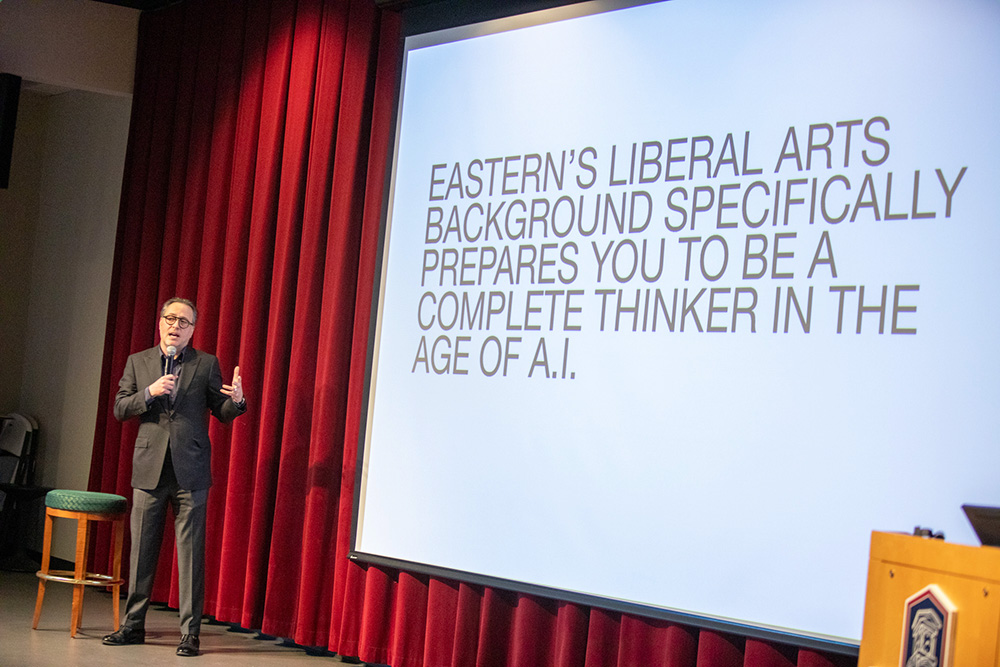
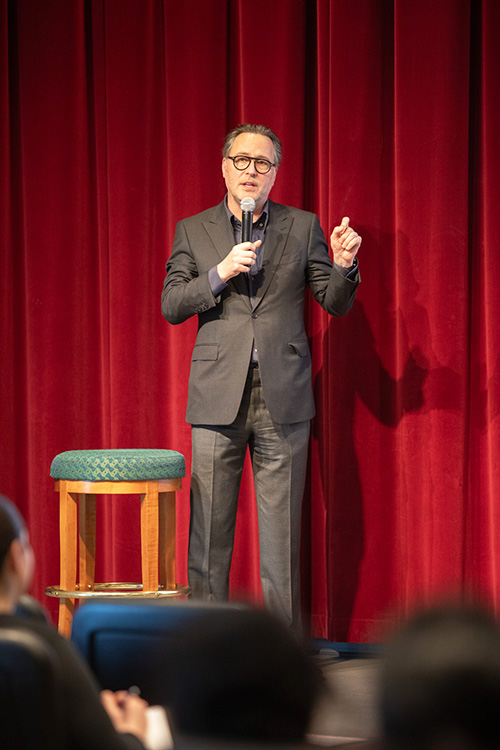
Mason Interactive CEO Brook Shepard emphasizes the importance of a liberal arts degree in an AI-infused marketing industry.
As artificial intelligence increasingly permeates the workforce and daily life, marketing professionals who recently visited campus argue that the emerging technology cannot replace human creativity.
On March 4, students heard from Mason Interactive CEO Brook Shepard and Michael Mellia, the firm's senior creative director, in a special presentation in the Student Center Theatre. Shepard and Mellia discussed how AI is reshaping advertising while increasing the importance of human storytelling and liberal arts thinking.
During this presentation, titled “How to Go Viral,” they touched on many topics, such as the evolving role of artificial intelligence in marketing, the advantages of a liberal arts degree, and the importance of human creativity in an increasingly automated digital landscape.
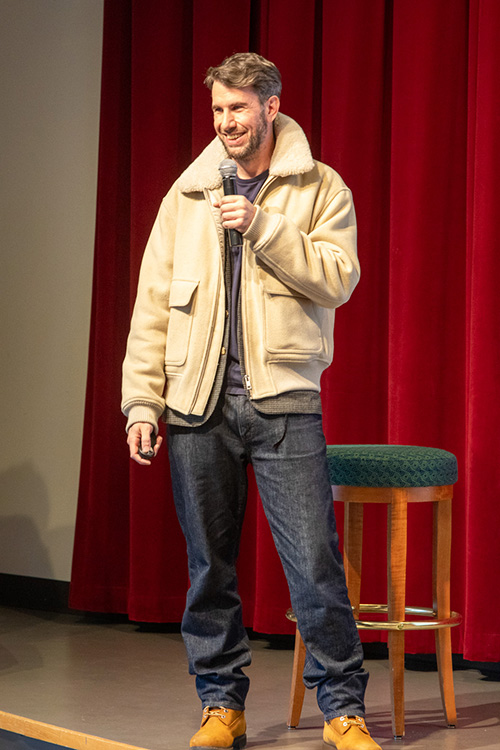
Mason Interactive is an award-winning advertising agency based in Brooklyn, NY. Founded in 2008, Mason Interactive has grown its portfolio to include both fashion brands and higher education institutions, including Eastern.
Ryan Quigley, Eastern’s director of university communications and marketing, highlighted this connection between industries in his opening remarks. “Fashion marketing moves quickly and constantly adapts to cultural and digital trends,” he said. “That connection positions Mason to help institutions like Eastern stay current in a rapidly evolving media landscape.”
The Power of a Liberal Arts Degree
Shepard and Mellia explained that while AI can perform many technical tasks, it cannot replace the broader critical thinking skills possessed by humans, particularly those with a liberal arts education. These skills are necessary for careers that often do not take a linear path, according to the two speakers.
“An Eastern liberal arts background specifically prepares you to be a complete thinker,” said Mellia. He explained that nonlinear or “zigzag” careers that move between roles such as research, product development, and sales are becoming more common in AI-driven industries. According to Mellia, these types of careers thrive because they require adaptability, skill diversification, and resilience.
As technology continues to evolve, Shepard and Mellia argued that these qualities give liberal arts graduates a distinct advantage in navigating a constantly changing workforce. “The most valuable employees are the best communicators, not the best button pushers,” added Shepard.
AI in the World of Commercials
Additionally, AI is changing the production process within the advertising industry. Mellia explained that in the past, producing commercials often required large teams, expensive equipment, and budgets that could reach millions of dollars.
Today, AI tools make high-quality marketing content easier and more accessible to create. Programs that assist with animation, editing, and visual effects allow creative teams to complete tasks that once took hours or even days in much less time.
“You can now start making your own campaigns easier than before,” said Mellia. Because of this, companies such as IBM are restructuring and increasing junior positions to focus on “higher value work,” according to Mellia, “like complex problem solving, client interactions, or even AI oversight rather than just routine coding, administrative tasks, or specific skills.”
Despite these technological advancements, Mellia emphasized that AI is primarily a tool rather than a replacement for human creativity. He shared examples of campaigns his agency worked on in which AI was used to enhance small details, such as adding subtle movement to images or improving visual effects. The overall concept, narrative, and artistic vision were developed by the creative team.
‘Humanity is your superpower’
In a world increasingly filled with AI-generated content, an authentic human personality may become the most valuable asset in marketing. Mellia described this concept as “humanity being your new superpower.”
The speakers highlighted that as more brands experiment with AI to produce polished advertisements and social media posts, audiences are beginning to gravitate toward content that feels genuine, relatable, and unscripted. Rather than responding to highly produced campaigns, many users are more engaged with content that feels like it comes from real people.
One example Shepard and Mellia highlighted was a viral TikTok personality known as the “Staples Baddie.” This creator gained attention by casually filming themselves at work and demonstrating different services that the office supply store Staples offers, such as printing posters, mugs, and clothing. The videos were humorous, informal, and filled with internet slang, which helped them resonate with younger audiences.
Mellia described modern-day social media as “interest media,” describing a relationship of mutual interest between creator and consumer. “You share some kind of interest, and in the comment section, it becomes an entire world,” he said. This type of relationship, highlighted by the example of the “Staples Baddie,” reflects the need for original, human-driven marketing and advertising content in a world saturated by AI.