
- Apply
- Visit
- Request Info
- Give



Written by Noel Teter '24
Published on March 17, 2026
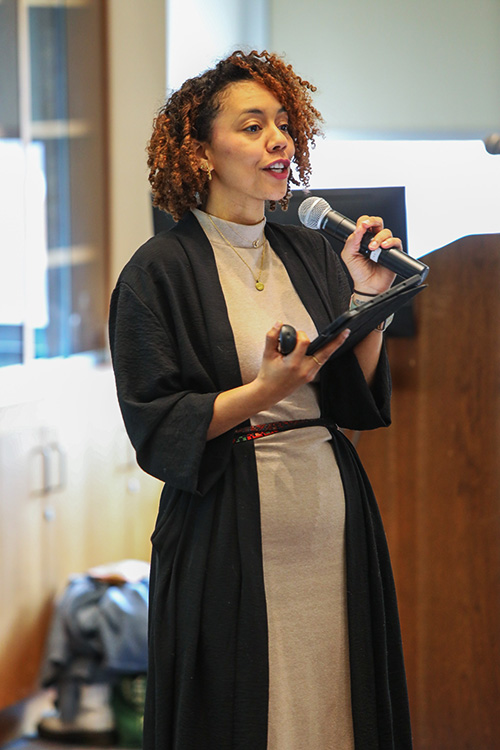
Eastern English Lecturer Bulaong Ramiz, a former identity center professional in higher education settings, has become a passionate advocate against improper practices in the offices she once served. On Feb. 19, she led an on-campus discussion encouraging attendees to speak up when higher education institutions fall short of their promises to protect marginalized populations.
The discussion followed the theme of a chapter Ramiz recently authored in a book titled “Shaking the Table: Survival and Healing Amongst Identity Center Practitioners,” published in November 2025.
The book chapter, “‘It Is Better to Speak:’ Public Testimony as Survival, Resistance, and Healing,” detailed her experience in identity centers, where she witnessed staff leaders refusing to advance the values they claimed to stand for.
A living example of intersectionality, Ramiz was born and raised in Hartford by her paternal grandmother, whose mother fled Georgia during the Great Migration. Due to her status as a Black and Puerto Rican Muslim woman and a member of the LGBTQIA+ community, she knew early in life that she would face inequities in education and employment.
“My father instilled in me that I would have to work twice as hard,” she said, reflecting on attending a Catholic school as a firstborn Muslim. Ramiz persevered to earn an undergraduate degree at Wesleyan University, as well as graduate and doctoral degrees from Central Connecticut State University and the University of Kansas.
As a higher education professional, Ramiz held several roles in identity centers, where she came to learn that those in leadership positions “failed to actualize” the values their offices were founded on.
She continued: “We like to talk about colleges as ‘safe bubbles,’ but … these spaces are microcosms of the larger world … furthering systems of oppression that my offices were positioned to eradicate.”
Drawing heavily on Audre Lorde’s poem “A Litany for Survival” in her discussion and book chapter, Ramiz reflected on her decision to engage in “public testimony” about the injustices done by these offices, which she says often encourage silence.
She detailed a student activities director, who was a white man, instructing her to “be apolitical” following the fatal 2012 shooting of Trayvon Martin. She was “silenced” at a time that called for discourse: “My role in this center was mostly performative,” she said.
Years later, after the murder of George Floyd in 2020, Ramiz was working at a different institution, which offered the “false promise” of a scholarship in Floyd’s name and later dismantled its diversity, equity, and inclusion (DEI) department.
Ramiz described herself as “the canary in a coal mine” when turning to social media, especially “Black Twitter.” Ramiz said, “If I did not speak it and name it, I’d feel alone in it.”
Ramiz finds peace in her decisions to stand up for what she believes in. “Status quo still runs the show,” she said. “There are always consequences, (but) I sleep really well at night.”