
- Apply
- Visit
- Request Info
- Give



Written by Noel Teter '24
Published on March 17, 2026
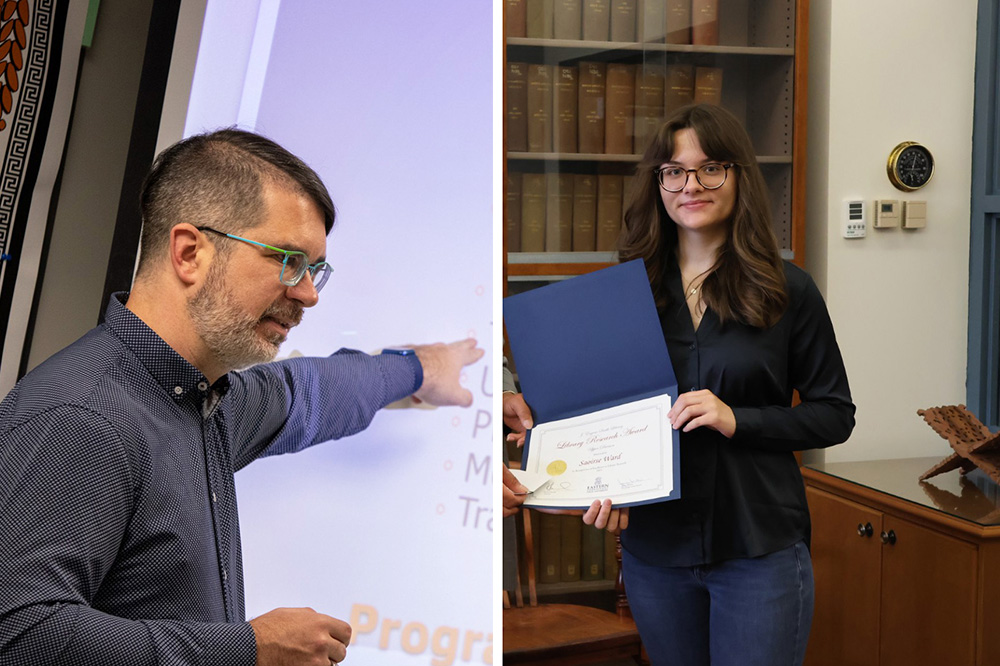
A recent graduate from Eastern’s Department of Psychological Science and her faculty mentor have published research examining popular opinions about depression and the enduring influence of the “chemical imbalance theory” in the Psi Chi Journal of Psychological Research this March.
Saoirse Ward ’25 and psychological science Professor James Diller published “Biogenetic Endorsements of Depression: The Enduring Influence of the ‘Chemical Imbalance Theory,’” the culmination of an entire academic year of work in fall 2024 and spring 2025.
As an undergraduate, Ward was a member of the Psi Chi International Honor Society in Psychology, which publishes the Psi Chi Journal. She also earned one of the University’s prestigious Library Research Awards in spring 2025 for her work on the project.
The article was published as one of the journal’s first-ever “Online First” articles due to a high volume of submissions and will later be published in a quarterly issue. Ward is credited as first author of the article.
“At first, I didn’t think it was possible for me as an undergraduate to publish a paper as a first author,” she said. “However, Dr. Diller believed in my ability to do it, even when I wasn’t so sure myself. Having that kind of support … showed me that I could contribute to the field in a meaningful way.”
Diller reciprocated Ward’s praise: “I’m very proud of the work that Saoirse did on this project. Her conscientiousness and organizational skills made her easy to work with.”
Ward was inspired to study the chemical imbalance theory, which posits that depression is caused by abnormalities in brain chemicals, after a conversation with Diller regarding the theory: “It made me wonder; if we supposedly have medications that can correct this chemical imbalance, why aren’t we seeing depression rates go down?”
Diller added, “Saoirse and I talked about issues related to mental health treatment often early in her time at Eastern.” As part of these conversations, Diller introduced Ward to the book “Anatomy of an Epidemic” by Robert Whitaker, which inspired her in part to start the project.
Ward also observed that much of the everyday literature about depression that people consume has a medically rooted perspective. “That framing can shift attention away from the challenges people face in our environment and instead place most of the focus on our biology,” she said.
“That curiosity ultimately led me to explore how the chemical imbalance idea became so widely accepted.”
An issue Ward encountered among those believing in the theory is that it causes patients to believe their condition is permanently rooted in their biology. “That sense of permanence can make them more pessimistic about recovery because it feels innate and less likely to improve,” she said.
Ward does not hope to dismiss biogenetic explanations of depression; rather, she hopes to highlight the complex factors causing mental health conditions. “One of the main goals of my research is to help people see that depression isn’t explained by a one-size-fits-all model,” she said.
Ward continued: “It’s a complex issue with multiple contributing factors, which means there can also be many ways to address it. Because of that, access to information really matters.”
This fall, Ward will begin graduate studies at Southern Connecticut State University. She then plans to apply to Ph.D. programs and pursue a career as a professor.