- Apply
- Visit
- Request Info
- Give



Written by Noel Teter '24
Published on February 26, 2026
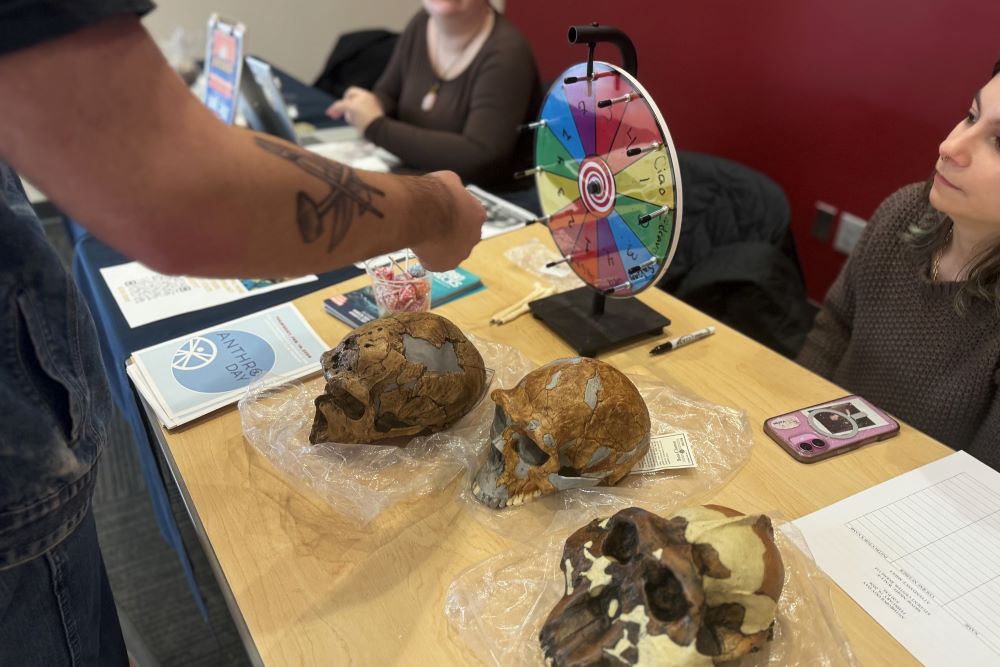
Anthropology Club Vice President Danielle Durao (right) and President Elaina Meccariello host a bake sale at the tabling session at Anthropology Day.
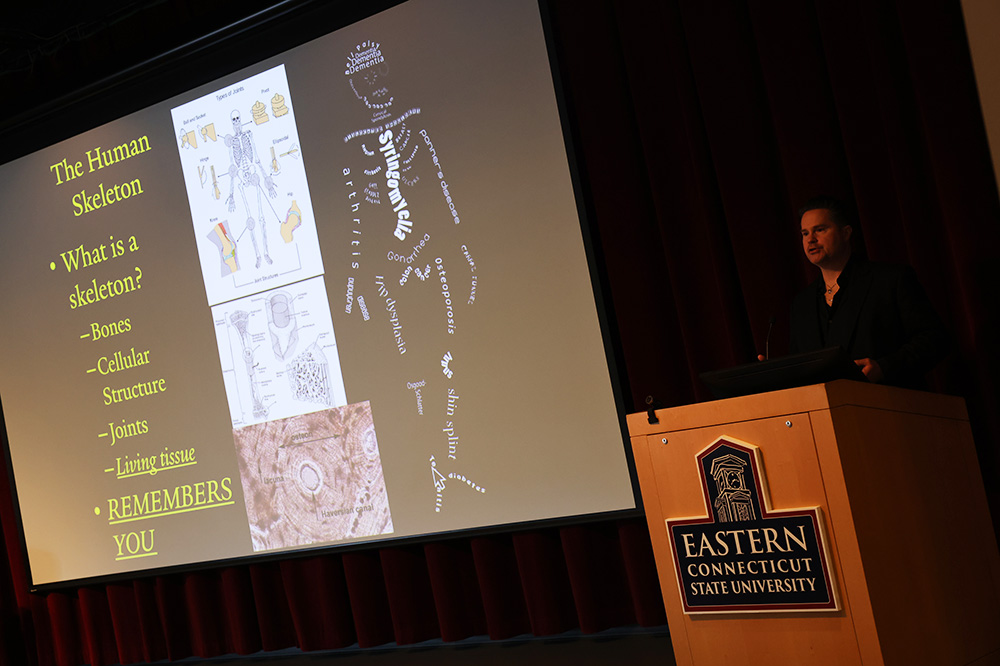
Gary Aronsen, research associate at the Yale University Department of Anthropology, gives a guest lecture at Anthropology Day.
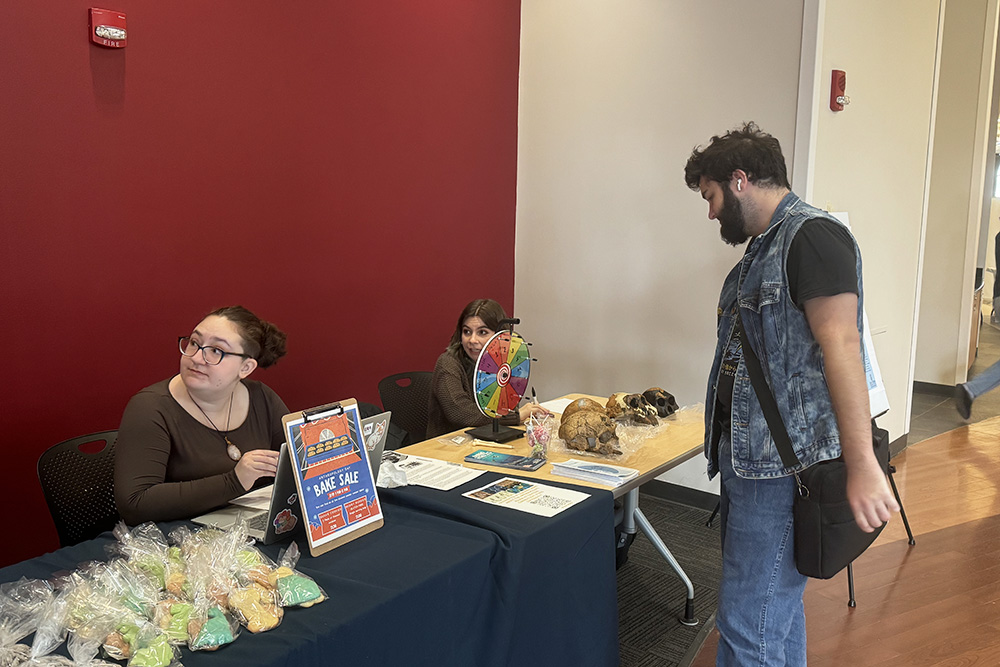
Anthropology Club President Elaina Meccariello (left) and Vice President Danielle Durao host a bake sale at the tabling session at Anthropology Day.
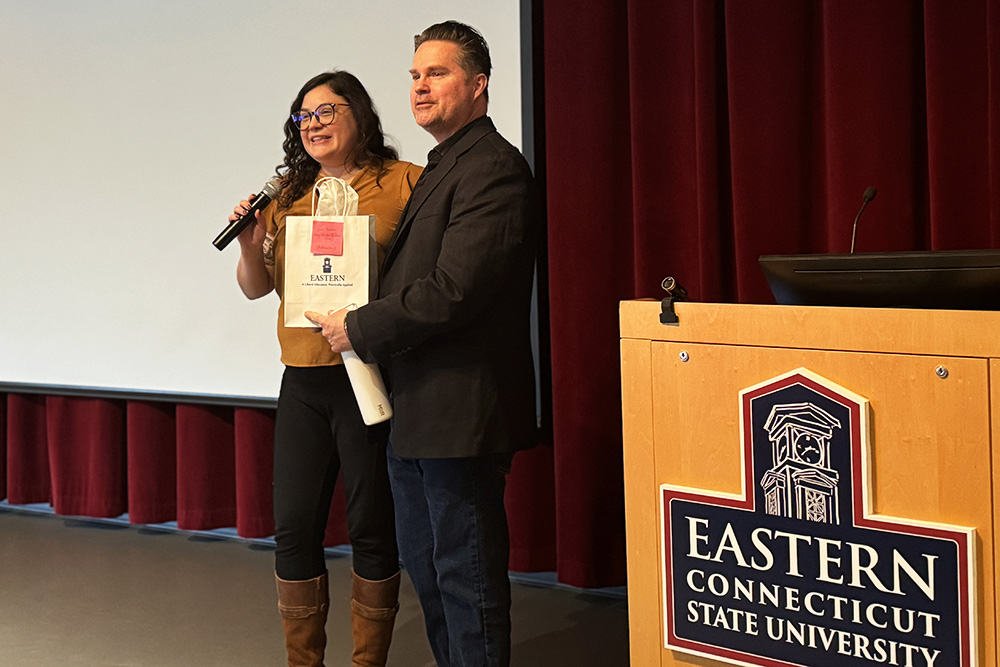
Anthropology Professor Amanda Leiss (left) and Yale University's Gary Aronsen participate in a discussion at Anthropology Day.
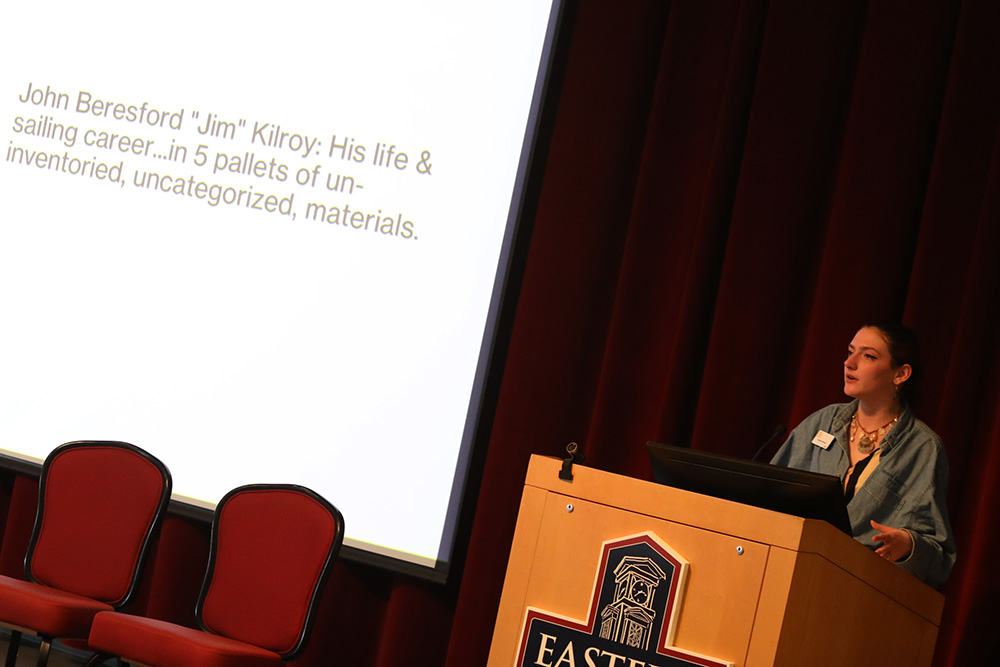
Makenzie Metivier '25 discusses her time at Eastern and in the field at Anthropology Day.
Eastern’s Department of Sociology, Anthropology, Criminology, and Social Work held an all-day celebration in recognition of “Anthropology Day” on Feb. 19 in the Student Center. The day’s events featured a presentation by a recent graduate from Eastern’s anthropology program, as well as a discussion with a guest faculty member and a tabling session.
Anthropology Professor Ricardo Pérez coordinated the event and delivered opening acknowledgments. “This is the fifth consecutive year Eastern has coordinated Anthropology Day,” he said.
Pérez was eager to help the campus community “further knowledge about humanity” while focusing on global issues currently facing the world, such as public health challenges and climate change. He also expressed hope that his department and the anthropology program would grow as a result of the day’s visibility.
Dean of Arts and Sciences Emily Todd spoke next, praising Eastern’s anthropology program. “I look forward to Anthropology Day every year. I appreciate the richness and diversity of the program,” she said. “It is a discipline that is tied to our liberal arts mission.”
She continued: “Anthropological methods are useful for answering the ‘why’ questions (facing humanity). … That’s what a liberal arts education does — it helps (students) explore the world from different perspectives.”
Metivier ’25: “Fill the white space”
Makenzie Metivier ’25 returned to campus to share her experiences as an anthropology student and, more recently, as a professional in the field, serving as collections assistant at the Mystic Seaport Museum.
Anthropology Club President Elaina Meccariello moderated the discussion. “People are always asking me what I’m going to do with my degree, so I wanted to bring in someone who graduated from Eastern and is established in the field,” she said.
Metivier, a “lifelong lover of history and advocacy,” was heavily involved as a student. “I joined everything I could where there were opportunities to shadow,” she said. Metivier served on the Dean’s Student Council under Todd.
Metivier advised students, in both an educational and a professional setting, to “fill the white space,” or to address gaps in their respective situations and work to alleviate them.
Much of Metivier’s work involves digitizing archival documents and artifacts to make them accessible to modern audiences. Recently, she adapted issues of the “Log of Mystic Seaport” and “Coriolis,” journals dealing with the Museum and maritime studies, to be available digitally.
Metivier’s repertoire at Mystic Seaport has also grown to include “ethnographic collection research and repatriation,” or “fixing records that are scant or incorrect” in archival documents. She has also become a published writer through her work and served as main acquisitions head at the museum.
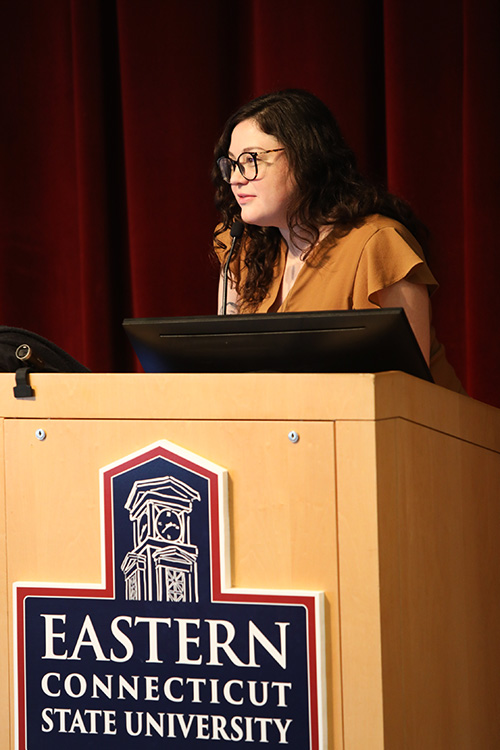
Anthropology Professor Amanda Leiss moderates an open class session at Anthropology Day.
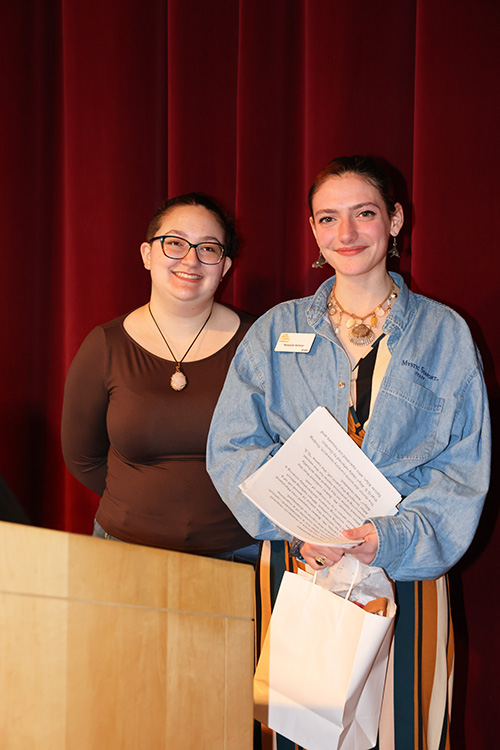
Elaina Meccariello (left) and Makenzie Metivier '25 conduct a discussion on Metivier's achievements in the field.
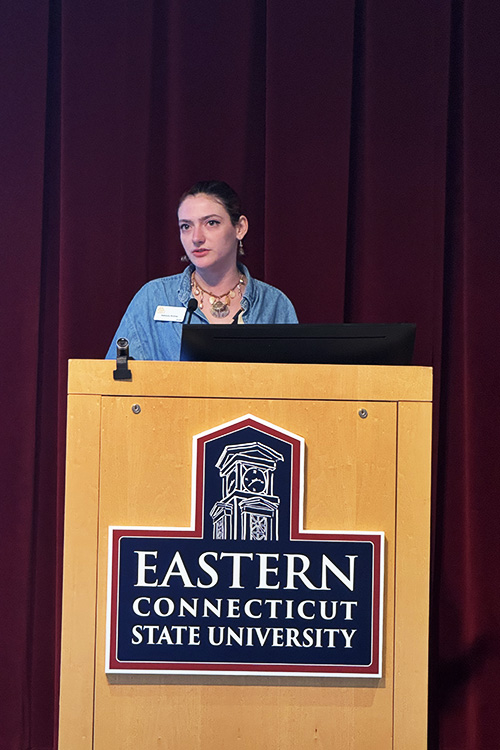
Makenzie Metivier '25 discusses her current role as collections assistant at the Mystic Seaport Museum.
Yale’s Aronsen discusses ups and downs of field
Anthropology Professor Amanda Leiss led an open class session at 11 a.m., including students from her class “ANT 245: Bioarchaeology in Connecticut,” along with all others in attendance. “Bioarchaeology” is a field dealing primarily with the human skeleton and how its structure is influenced by factors such as “diet, health, social structures, and migration patterns,” said Leiss.
Leiss served as moderator during the session; Gary Aronsen, research associate at the Yale University Department of Anthropology, visited campus to speak at the session. Aronsen began with a self-effacing but inspiring remark on the often-isolating nature of anthropology as a discipline and the scientific methods used to study it.
“We spend our time in tiny rooms, staring at the most fragmented information to figure out what’s going on,” he said. “Science is not better or worse than any other discipline, but its structure is inherently testable and repeatable.”
Aronsen continued: “All of us share a series of life history stages … bones and teeth can reflect this.”
‘Wall-E’ sparks environmental discussions
Following light refreshments and an afternoon tabling session by the Anthropology Club in the Student Center, the day’s events concluded with a screening of scenes from the 2008 Disney film “Wall-E” at 5 p.m. in Student Center 115.
The scenes led to a discussion on current economic and environmental concerns, moderated by Anthropology Club Vice President Danielle Durao.