- Apply
- Visit
- Request Info
- Give



Written by Noel Teter '24
Published on January 29, 2026
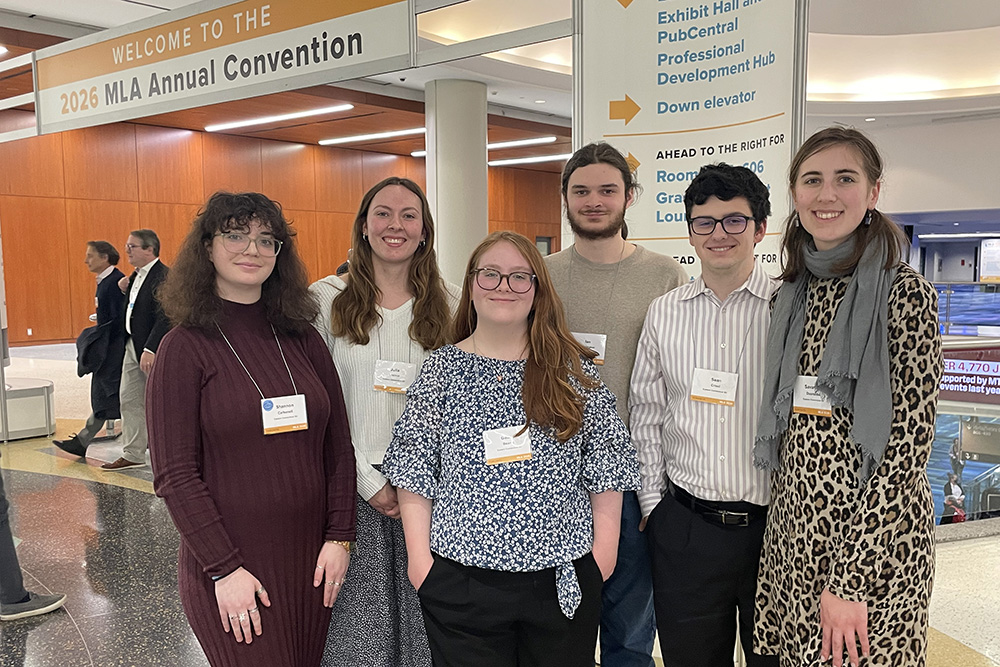
Six English majors at Eastern Connecticut State University made history on Jan. 9, presenting their research at the Modern Language Association (MLA) Annual Convention’s inaugural undergraduate research poster session in Toronto, Canada. Eastern’s group was the largest representation by any institution at the session.
The MLA consists of more than 20,000 members in 100 countries and provides programs supporting educators of English and other languages. Speaking to the annual convention's inaugural undergraduate research session, MLA Executive Director Paula Krebs said:
"Undergraduate research is vital to the future of languages and literature, and it gives students essential opportunities to develop transferable skills, build their intellectual identities, and make learning meaningful. I was so excited to meet the team of students from Eastern, to find out more about their research, and to get their feedback about ways we could further engage undergrads. They are an inspiring bunch!"
“I am incredibly proud of our Eastern English majors for presenting their research at the MLA convention's first-ever undergraduate research poster session,” said Emily Todd, dean of arts and sciences and trip supervisor. “The students not only presented their own projects but also filled their convention schedules with sessions relevant to their research and future goals.”
Faculty mentor and English Professor Allison Speicher spoke to the seriousness of the students' research and the conference's impact on their identy as scholars: "Being able to write a strong paper or creative work is one skill; being able to translate that work into an informative poster and explain it face-to-face to leading scholars is quite another, and I'm exceptionally proud that our students were bold enough to (literally) stand by their work."
Presenting students from Eastern included Gabriella Beams, Shannon Carbonell, Sean Crisci, Savannah Duursema, Ian Harrington, and Julia Trainor.
Duursema, a member of Eastern’s Honors Program, used her project, “‘I Can Read All By Myself, I Can Read Without Your Help!’: Analysis of Contemporary Early Reader Books,” to complete the program’s thesis requirement. She worked with Speicher for three semesters on the project.
“We chose quality early reader books, analyzed them through a cultural studies lens, came up with four major assumptions presented toward children, and put it all together into a paper,” said Duursema.
Duursema and her Eastern peers understood the magnitude of being the largest group at the convention’s inaugural undergraduate research session: “It was a huge deal, and we felt it, as whenever anyone mentioned the undergrad session, they mentioned Eastern.
“I didn't realize the significance until I was surrounded by professionals and realized that Eastern gave me the opportunity to stand alongside them as their equals for the weekend.”
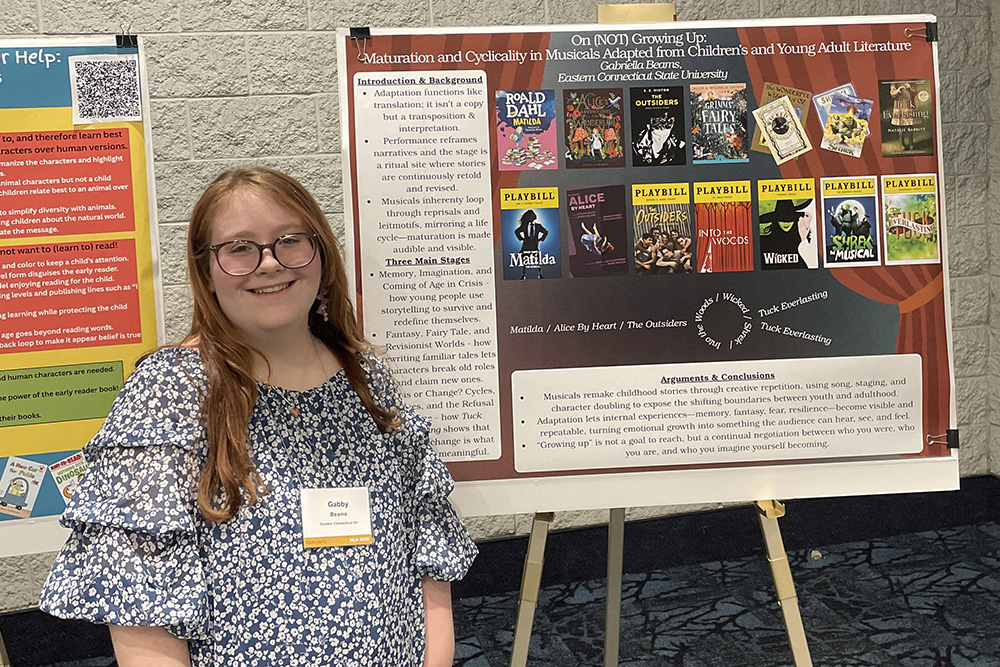
Gabriella Beams
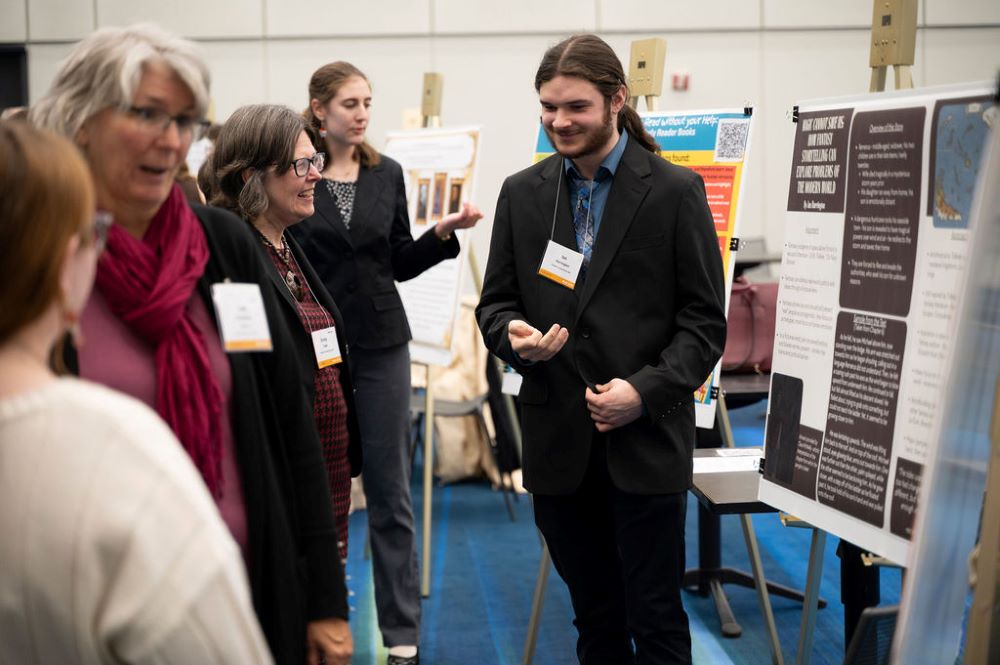
Ian Harrington (right) presents to Dean of Arts and Sciences Emily Todd. (photographed by Oceane Auclair)
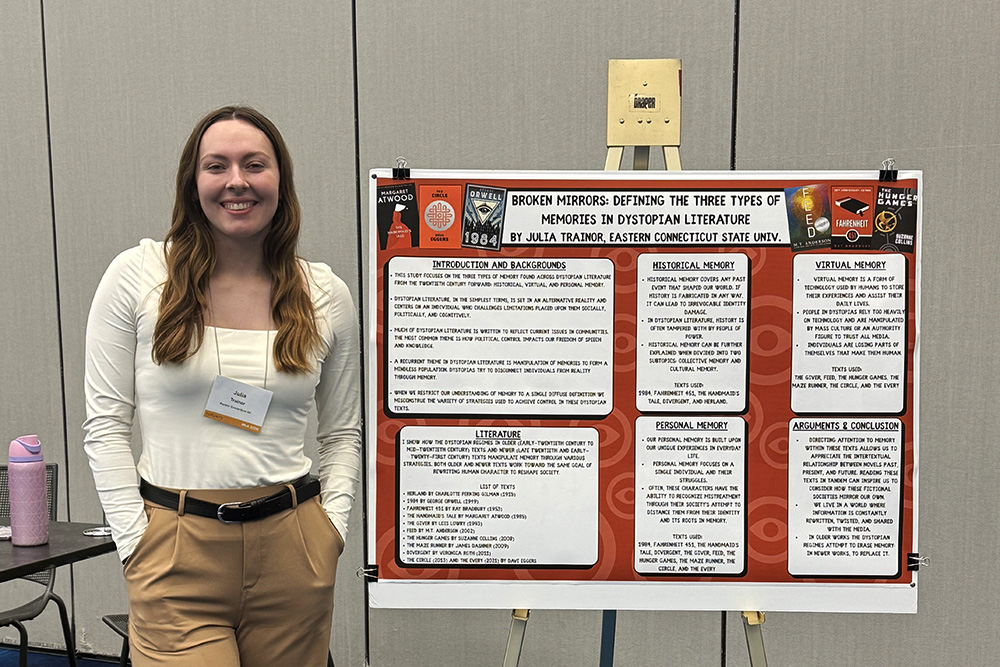
Julia Trainor
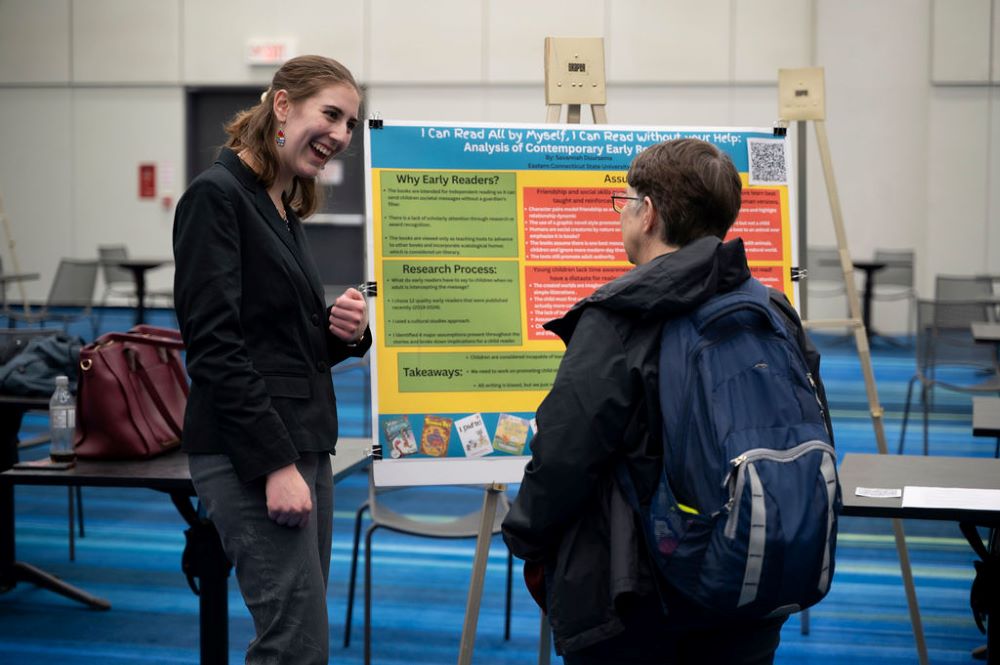
Savannah Duursema (left, lphotographed by Oceane Auclair)
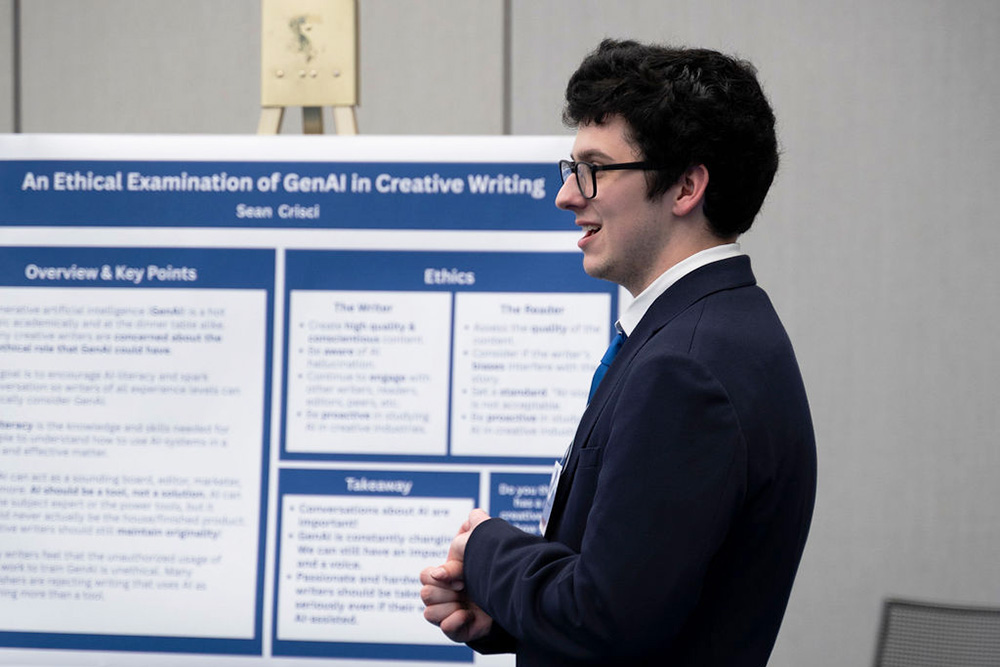
Sean Crisci (photographed by Oceane Auclair)
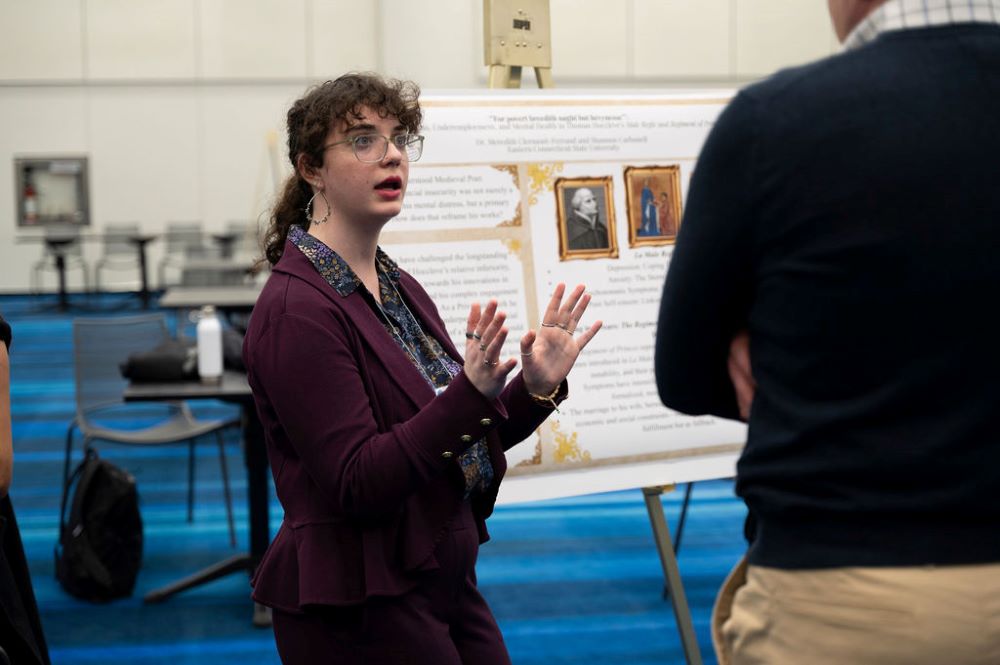
Shannon Carbonell (photographed by Oceane Auclair)
Beams’s project, titled “On (NOT) Growing Up: Maturation and Cyclicality in Musicals Adapted from Children’s and Young Adult Literature,” analyzes these musicals’ commentary on maturation (growing up) as a repeatable process. In other words, Beams was curious as to whether maturation is depicted through common themes across these works.
She started the project after reading S.E. Hinton’s 1967 novel “The Outsiders,” having already watched the musical inspired by the novel. “My knowledge of the musical affected how I was reading the original text. This gave me the idea to look at other texts and see ... if there had been an overarching message or theme across the works,” she said.
Beams felt a “sense of responsibility” to lead by example as one of the MLA convention’s first-ever undergraduate presenters. “Representing Eastern as one of the inaugural participants was both affirming and grounding,” she said. “How we presented helped set the tone for other universities to develop their own undergraduate research programs.”
Carbonell co-created her project, “‘For povert breedith naght but hevynesse:’ Benefice Loss, Underemployment, and Mental Health in Thomas Hoccleve’s ‘Male Regle’ and ‘The Regiment of Princes,” alongside English Professor Meredith Clermont-Ferrand, who had already started the project and needed a research assistant to improve its academic quality. Hoccleve’s works are written in Middle English, hence the unconventional spelling in the project title.
“We were able to edit and draft a paper that was accepted for publication, and I ended up presenting at MLA to showcase the variety of undergraduate research that we offer at Eastern,” she said.
Attending the conference inspired Carbonell toward future career prospects. “Thanks to attending MLA and feeling the welcoming environment, I am debating getting a Ph.D. in English or medieval studies,” she said. “I hope one day to be a panelist at MLA; that would be a dream come true.”
Harrington also presented his honors thesis, titled “Magic Cannot Save Us: How Fantasy Storytelling Can Explore Problems of the Modern World.” He created his own story, “set in a fictional world that mirrors our own but still retains the fictional and fantastical aspects of a fantasy world.”
Harrington continued: “I used this setting to address the impacts of climate change and sea level rise, a topic I find lacking in fantasy literature.”
Harrington was pleasantly surprised to find like-minded peers at the conference: “Speculative fiction (science fiction, fantasy, etc.) receives more academic focus and attention than I had realized beforehand. ... It was inspiring to see the genres I love be given serious academic attention.”
Trainor conceived of her project, “Broken Mirrors: Defining the Three Types of Memories in Dystopian Literature,” during an independent study with Speicher. She combined her interest in the dystopian genre with her psychology minor to incorporate memory into her argument.
Trainor’s research was enriched by her attendance at the conference: “During these presentations, I found different sources I could use to support my thesis and different ways to continue my own research,” she said.