
- Apply
- Visit
- Request Info
- Give



Written by Kyle Berson '26
Published on January 22, 2026

Eastern biology Professors Barbara Murdoch and Matthew Graham have made a discovery that challenges long-held assumptions about one of nature’s most feared substances. The two professors co-authored a study that identifies microbial communities living in scorpion venom, a substance previously believed to be sterile.
The study, “Microbiota Discovered in Scorpion Venom,” was published in the research journal “PLOS One” this January 2026. Co-authored with University of Dubuque biology Professor Adam Kleinschmit and Western Connecticut State University Professor Carlos E. Santibáñez-López, the study is the first assessment of microbial diversity conducted in scorpion venom secretions, according to Murdoch and Graham.
“Our study refutes the idea that scorpion venom is a sterile environment lacking bacteria,” wrote Murdoch. “It corroborates the discovery of microorganisms in the venom of other organisms, like spiders and snakes.”
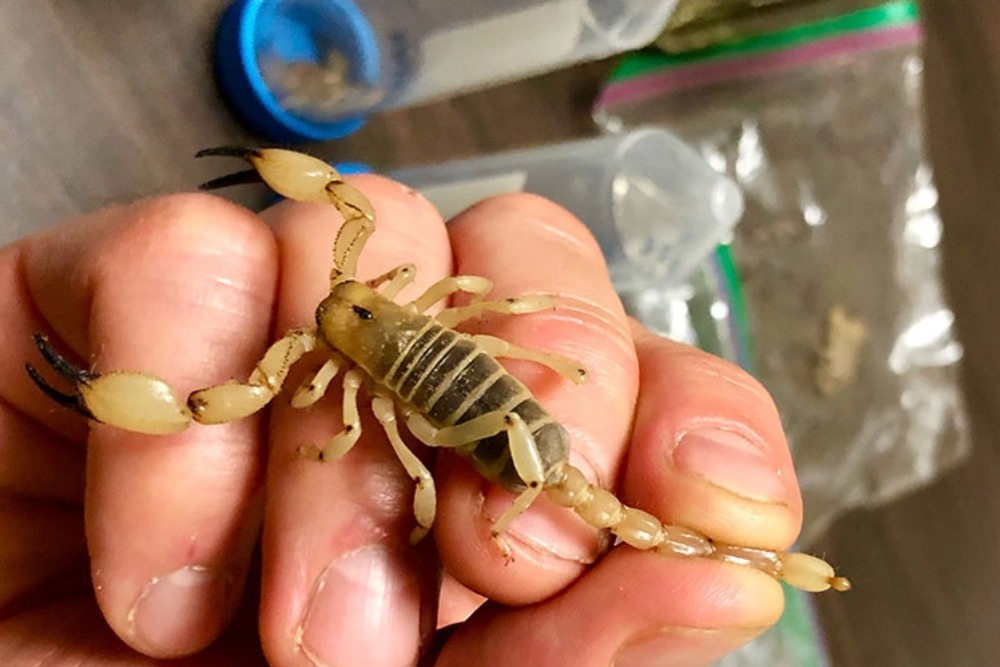
According to the study’s abstract, the researchers used DNA sequencing to identify microbial communities within the venom and analyzed microbiome diversity between two species: Paruoctonus becki (Beck’s Desert scorpion) and Anuroctonus phaiodactylus (California swollen-stinger scorpion), as well as between geographically distant populations and individual scorpions.
‘Not just a weapon’
The researchers found that not only did the venom contain bacterial communities, but these microbiomes contained a certain degree of diversity between species and individuals.
For example, Murdoch noted that venom samples from populations in Nevada and California contained similar core bacteria, but distinctly different microbiomes.
“What fascinates me most is the realization that every scorpion, of the nearly 3,000 species worldwide, carries a tiny globe of life in its tail,” Graham wrote. “[These findings] completely change how we think about scorpion venom. It’s not a sterile substance, but a living, dynamic system shaped by ecology, geography, and evolutionary processes.”
The discovery raises new questions about other venomous animals. While the discovery of bacteria in scorpion venom doesn’t prove their existence in other animals, the researchers note that it prompts a demand to investigate further.
Implications for human health
Although the researchers were intrigued by the mere existence of bacteria in the venom, they also recognized possible applications for healthcare and medicine.
“Scorpion stings pose a significant global health concern, as infections often complicate these cases,” Murdoch wrote.
Because venom is a harsh environment where few bacteria can survive, she noted that further research into the bacteria that do exist could offer clues to aid the creation of new compounds for antibiotics.
“Understanding the microbial communities in the venom could prevent infection and help inform successful treatment,” Murdoch wrote. “We speculate that our study may open an exciting new avenue for bioprospecting the antimicrobial compounds that can be created by venom bacteria and thus the discovery of novel compounds to treat antibiotic infection and antibiotic resistance.”

A long-standing relationship
Including “Microbiota Discovered in Scorpion Venom,” Murdoch and Graham have published five scholarly works together over the last five years.
“We each bring different skillsets that, when combined, have led to these studies,” Murdoch noted. “It’s invigorating to have such an amazing colleague to collaborate with.”
Murdoch and Graham have been awarded multiple grants to fund their various research initiatives, including awards from the National Science Foundation, NASA, and the American Association of University Professors.