- Apply
- Visit
- Request Info
- Give



Written by Elisabeth Craig ’26
Published on September 15, 2025
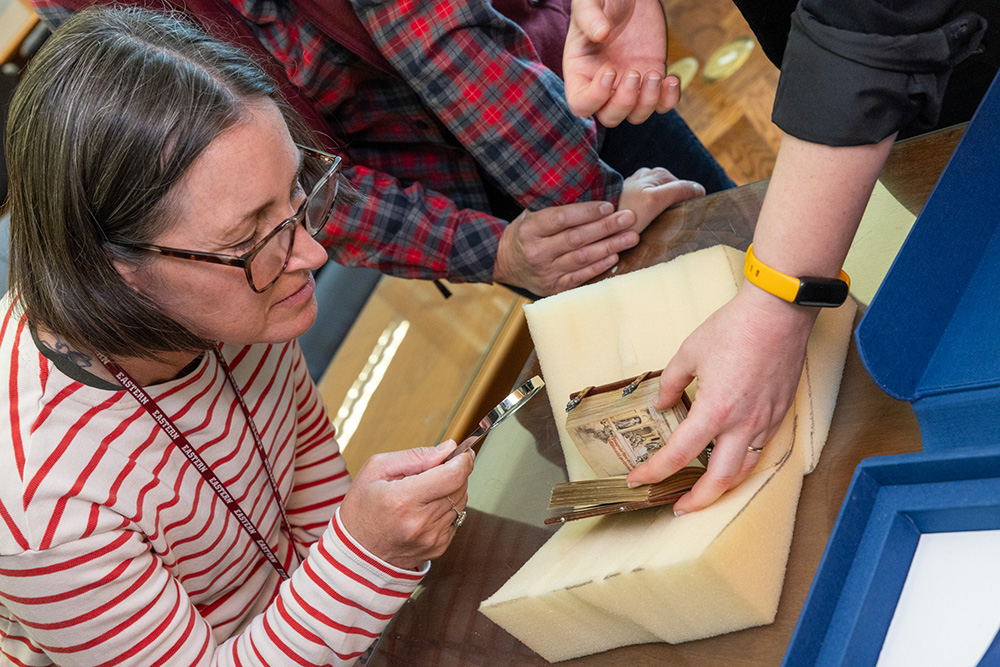
Theatre Professor Kristen Morgan examines the medieval book of prayers facsimile during an event in the library's archives.
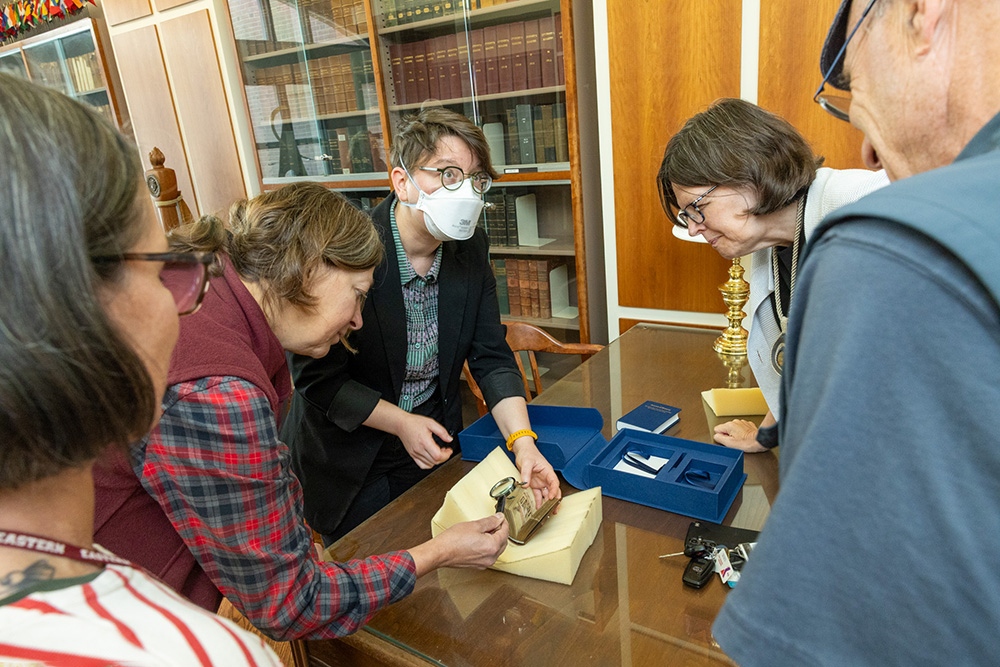
Eastern community members examine medieval artifacts during an event in the library's archives.
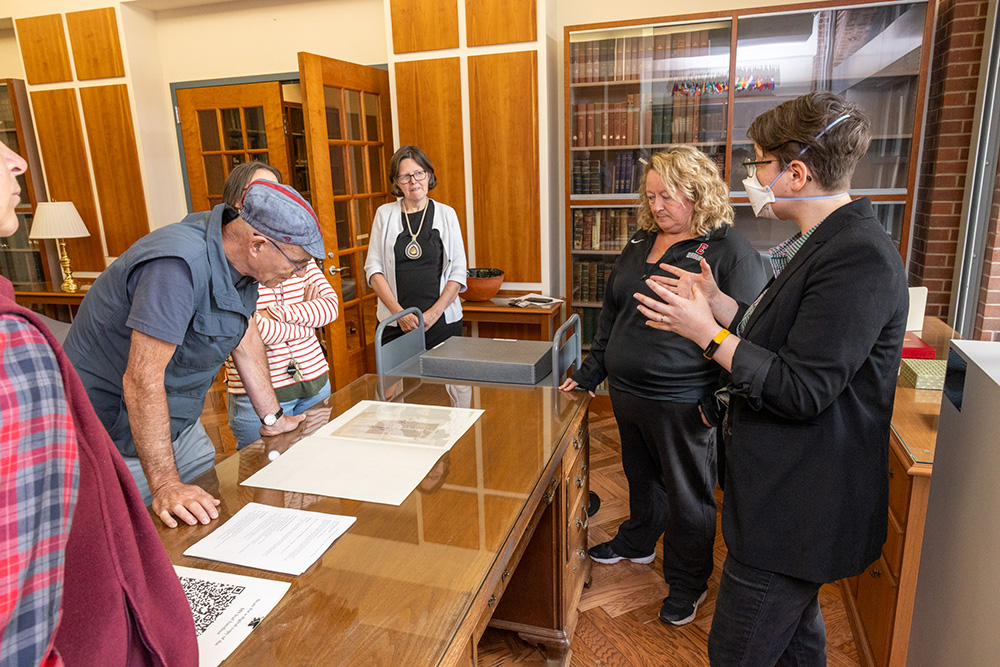
Professor Maeve Doyle (right) and Archivist Tara Hurt (second from right) discuss the University's new medieval acquisitions.
A curation effort by a team of faculty members at Eastern Connecticut State University recently brought two medieval artifacts to the University Archives and Special Collections. Located on the fourth floor of the J. Eugene Smith Library, the archive now houses a leaflet from a 13th-century Bible and an exact copy of a 14th-century prayer book.
After receiving a donation of the Bible leaflet from Student Development Specialist Michael Smith, art history Professor Maeve Doyle verified the artifact as part of a Biblical manuscript.
“This is, as far as I know, the oldest object in any of our campus collections, so this is an exciting addition,” said Doyle. “We also know the provenance of this leaf: it was cut out from its book by a 20th-century art dealer who did a lot of cutting pages out of books and selling them.”
Doyle continued: “Since we don’t want to further separate or lose the pieces of the manuscript, receiving it as a gift from Smith means we’re not participating in the continued breaking up of a jigsaw puzzle.”
Art Gallery Director Julia Wintner was the primary curator of the leaflet. According to her, the ultimate goal of procuring the artifacts was for art and art history students to have hands-on experience with the roots of their profession.
"Seeing a single hand-copied book page whose painted initials, gilded accents, and careful lettering reveal the mastery of an unknown artisan scribe up close will be exciting to students,” she said. “They’ll notice the texture of parchment, the raised tooling of gold, the rhythm of the script, and marginal details that rarely reproduce in photographs.”
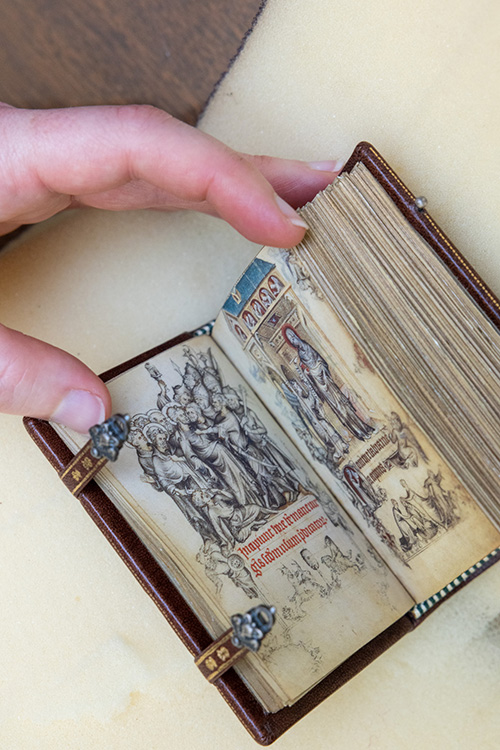
A facsimile of a medieval book of hours, once used by French Queen Jeanne d’Evreux
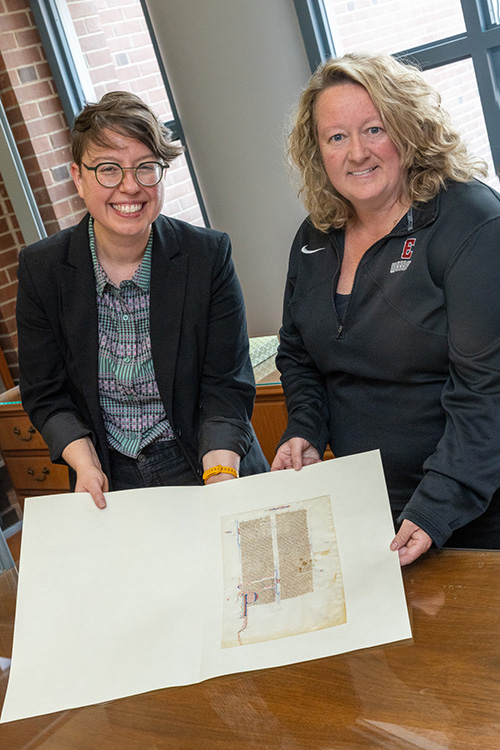
Art history Professor Maeve Doyle (left) and University Archivist Tara Hurt (right)
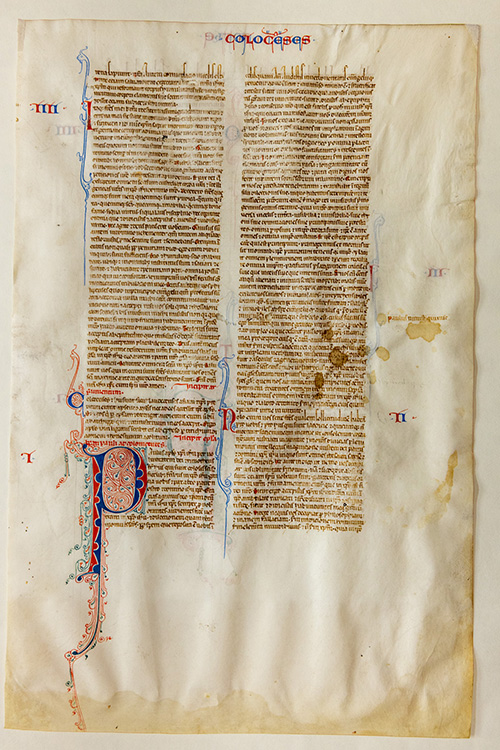
An 800-year-old parchment leaflet taken from a Bible
Wintner continued: “The leaf will be integrated into art history courses for close examination and discussion and will serve as a touchstone for conversations about medieval workshop practices, authorship, and the enduring life of books as objects.”
Doyle traced the prayer book’s origin as an exact copy -- also known as a "facsimile" -- of 14th-century French Queen Jeanne d’Evreux's "book of hours," a book which medieval Christians used as a manual for their daily prayers. While the original currently resides in the Metropolitan Museum of Art, the University managed to procure a facsimile that was published in 2006. Doyle has tailored their medieval art course so that their class can view these art essentials from that era.
“I redesigned the class to have a greater emphasis on manuscript history. ... We’re going to connect manuscripts into the larger narratives of art history,” said Doyle. “When I bring my class to the archives later this semester, they’ll be able to compare the sizes, see what a real manuscript looks like, and feel what it feels like.”
Interim Vice President for Academic Affairs Ben Pauley coordinated the University's purchasing of the book for the archives. He counted the need to collect relics for the humanities departments at Eastern as equally important to supplying materials for tech-heavy departments.
“There were some funds available at the end of the fiscal year, and the facsimile (exact copy) Dr. Doyle had identified turned out to be something we were able to acquire with those funds,” said Pauley. “This was an acquisition that we were able to make in much the same way that we were able to acquire some pieces of advanced equipment for chemistry labs and stage hardware for the theatre.”
University Archivist Tara Hurt explained the importance of properly storing the delicate parchment paper while also making it accessible for students to marvel at and research.
“To preserve items and make them accessible, you want to do that in a very positive way and have them in places where you have the resources to do that,” said Hurt. “We keep the humidity and temperature very precise when storing the leaflet, and we also use low-resolution scanners so we can put it in the digital archives.”