- Apply
- Visit
- Request Info
- Give



Written by Darlene Orozco '28
Published on October 29, 2025
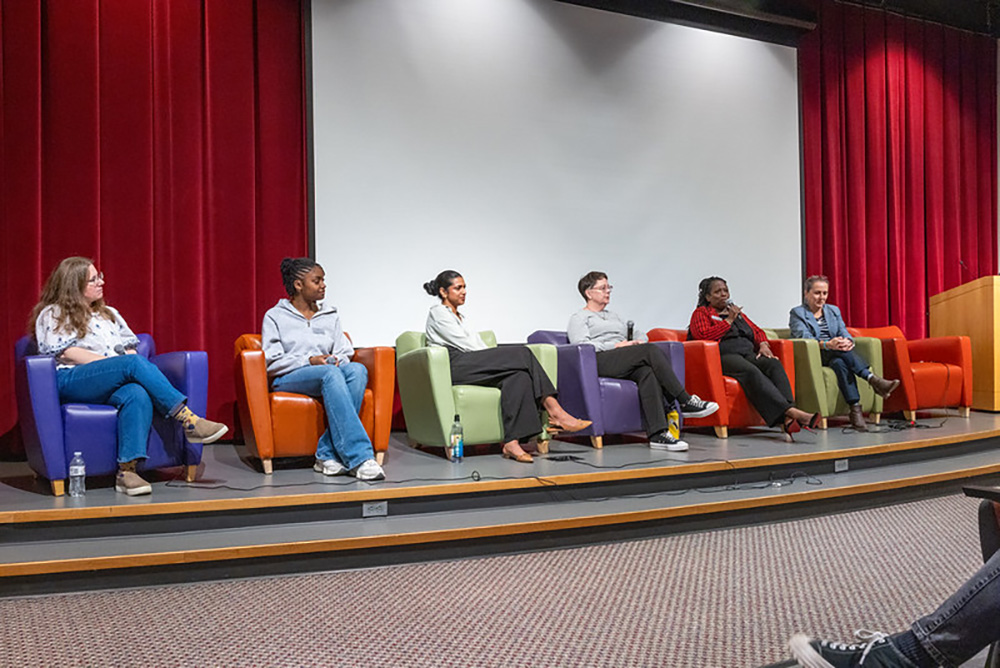
Eastern continued its “Becoming a Woman” series with an original documentary exploring what it means to be a woman. Featuring Eastern students, faculty, staff, and alumni, "Voices of Women at Eastern” premiered in the Student Center Theatre on Oct. 23, followed by a panel discussion amplifying more female voices.
The event was part of a larger project spearheaded by French Professor Michèle Bacholle featuring art, film, and literary activities inspired by Nobel Laureate Annie Ernaux. Regarded as one of France's most important 20th-century authors, Ernaux's body of work examines and uncovers the lives, decisions, and experiences of ordinary women.
Produced by film Professor Brian Day, the documentary featured women of Eastern sharing their thoughts about womanhood through self-recorded testimonials. Day stitched together their diverse perspectives into the 30-minute-long film.
“This production and the event that Dr. Bacholle put together are important for us to gain insight into different ideas about identity,” said Day. “Exploring what one's gender means to them is a difficult question that allows for a lot of introspection, and a project like this allows for everyone to grow and learn."
Motherhood was addressed several times by the women throughout the documentary. Among them, music Professor Okon Hwang shared how becoming a mother shaped her womanhood. “Being pregnant gave me a sense of power,” she said. “Not the power that comes from control, but the ability to create, satisfy, and nurture life.
“Becoming a mother changed everything,” said Hwang. “It changed how I approach my work, how I relate to others, and it gave my personal life a deeper sense of meaning.”
She continued, “Becoming a woman is not a fixed idea, but a journey that carries you into places you never expected to go but somehow always belonged.”
Others weighed in on the topic as well. "Accepting my womanhood meant confronting contradiction, breaking expectations, and choosing my own path,” said Director of Opportunity Programs Christina Irizarry. “My family taught me that being a woman meant being selfless and nurturing, and cultural traditions reinforced these ideas.”
When growing up, Irizarry was met with mixed messages: “... pride in being proud, strong and bold, but stereotypes about being too loud, too emotional, and fiery.”
That’s when she realized that “becoming a woman isn’t about fitting a single role.”
Other women in the documentary had similar ideas. “Womanhood is not as narrow as cultural norms,” said Lisa Centola, university assistant for the Department of World Languages and Cultures. “Womanhood is about sisterhood and pushing back against standards and norms.”
Sisterhood, or friendship and support amongst women, was also a recurring topic. Emily Todd, dean of the School of Arts and Sciences, shared that “it is clear to me that my female friends have been central to my journey to womanhood.
“All the time we spent together and our conversations all those decades ago matter because we were all searching for meaning; we shared our hopes and ambitions, but also our vulnerabilities and uncertainties,” said Todd.
The documentary served as a discussion starter for a panel, where the participants explored the complexities of womanhood, such as strengths, weaknesses, stereotypes, struggles, and expectations.
Among the panelists was sociology Professor Cara Bergstrom-Lynch, who was “pleased to see the definition of womanhood has expanded.”
Some of the struggles that panelists discussed were navigating male-dominated fields. Eastern alumna Shaheera Khan ‘21 shared her experience as a federal contract investigator with CACI , an information technology company that serves the U.S. government in defense and homeland security.
“Being in a white, male-dominated field is a challenge,” she said. “People question me even though I have the right qualifications.”
“I may not look like your average investigator, but I bring a different perspective with my femininity and cultural background,” Khan continued.
The power of choice was a big part of the conversation as well. Panelist and Dean of Students Kemesha Wilmot shared her experience as the oldest daughter in her Jamaican family. “There is pressure to be the second mother,” she said. “From a very young age, there were expectations to care and sacrifice for others.”
Wilmot saw her mother’s sacrifice and dedicated her life to education, working in higher education for more than 16 years at Eastern. “I knew when I had the opportunity to get an education, I had to do it for the women in my family who never had the chance,” said Wilmot.
Wilmot realized that she defined her womanhood when she was able to make a choice. “I can choose motherhood or not and still be a woman. I can choose my career and still be a woman.”