
- Apply
- Visit
- Request Info
- Give



Written by Noel Teter '24
Published on October 13, 2025
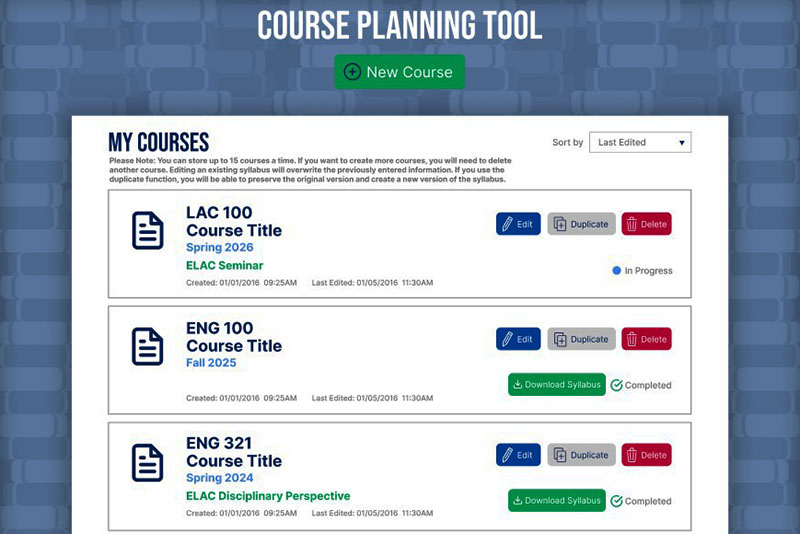
Through an initiative funded by the Davis Educational Foundation, three students at Eastern Connecticut State University are currently developing a digital course planning tool to help faculty members create personalized syllabi for courses.
The course planning tool takes the form of a web application where faculty members can answer a series of questions about their goals for a specific course.
The app then automatically produces a “personalized, editable syllabus,” according to Julia DeLapp, director of Eastern’s Center for Teaching, Learning, and Assessment (CTLA), project coordinator for the faculty development initiative. DeLapp hopes to launch the tool in spring 2026.
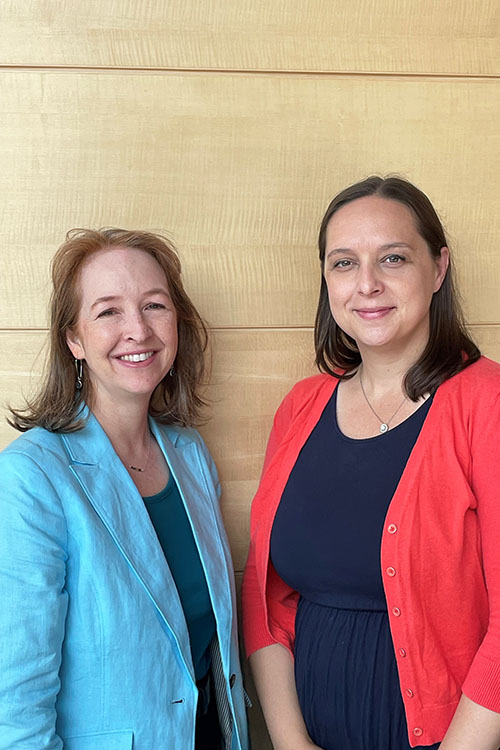
“What this is trying to do is take the theory and what we know works in the field in terms of pedagogical practices and bake them into course planning,” said political science Professor Courtney Broscious, director of the grant project, who developed the concept of the tool.
“This tool … is going to help you work through the process of integrating what we know about innovative pedagogy into your syllabus.”
So, what do we know about innovative pedagogy? According to Broscious, effective course planning comes down to faculty members articulating specific learning objectives: “The clearer and more explicit you can be about what the goals are for students in your course, the more successful students are and the more gains you see in skills across the semester.”
Solving puzzles
Senior computer science major Sencere Rabel handles the “back-end” portion of the software, meaning “the core functionality of the web app,” he said. His work determines how the software interacts with traditional syllabus documents to automatically produce syllabi.
Rabel also develops the security aspects of the app, including rate limits, which help to prevent overloading the software.
Junior art and English major Jessica Day is in a graphic design role, creating mock-ups of the application using Figma, a platform to create prototypes for products. “I'm also working in Adobe Illustrator to create background images, icons, and the usual graphic design layout stuff,” she said.
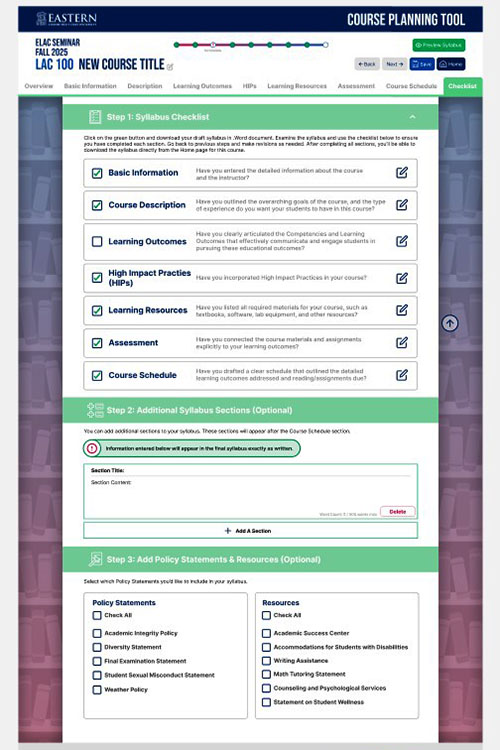
Having spent “hours looking at the mock-ups,” Day described the appearance and functionality of the app: “You have your login screen, then a homepage where it tells you the classes you're working on. … Then it takes you through a seven- or eight-page system where it says the steps you're going to go through. It'll give you a page for each basic step of the process where you can input information based on prompts.
“At the end, you have a little checklist… and it'll generate a syllabus for you.”
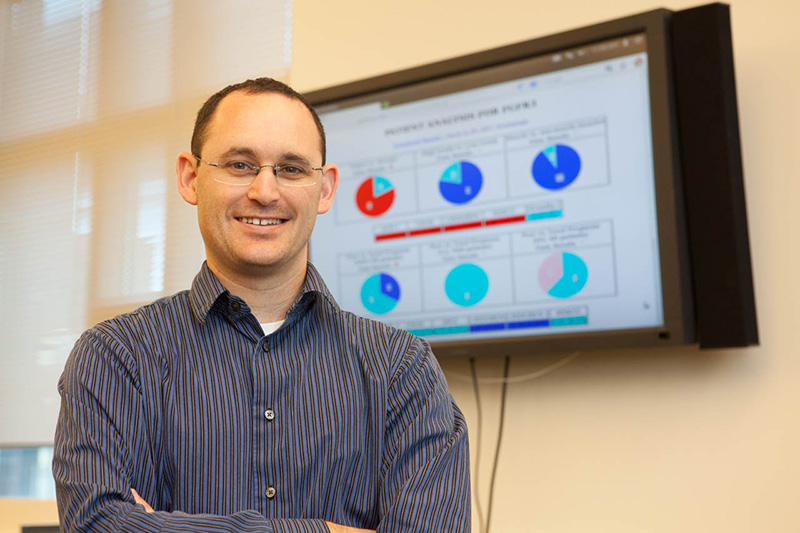
Senior computer science major Chris Windrow is primarily in charge of the front-end framework of the app. “The front end is what a user sees when they go to the website,” said computer science Professor and Department Chair Garrett Dancik, who oversees the students’ work and plays a key role in the software’s development.
Windrow added that she uses the programming language TypeScript to implement Rabel and Day’s developments in an attractive way for the app user.
Each student has encountered challenges and opportunities while developing the tool, learning about themselves in the process. Beginning as a student employee for Dancik over the summer, Rabel relished the challenge of getting paid for “eight hours a day to solve puzzles and problems.”
Rabel continued: “It confirmed for me that I like computer science as a gig, which is very comforting. … It was challenging, and that's what I like, even though it's a challenge. It's like the sense of fulfillment you get after you solve a hard puzzle.”
Day’s greatest difficulty has been designing a tool for faculty members as a student. “I don't know the process of how college professors make their course syllabi or design their courses,” she said.
“It’s not a process I have to go through, so I have to understand it a bit better than you usually would as a student.”
Day learned to trust herself with her own schedule: “On a personal level, I've learned I have more confidence in my time management abilities now because I had a feeling it was going to be more of a challenge for me than it ended up being.”
Windrow also went through growing pains with time management, which taught her to manage her expectations of herself. “There is such a thing as enough,” she said. “I have a lot of self-doubt and all, but I still make it work in the end.”
Assisting in “intentional” course planning
When developing the grant project and course planning tool, Broscious and DeLapp realized their potential to assist faculty members in meaningful, efficient course development.
“As we were transitioning to the ELAC (Eastern Liberal Arts Core) curriculum, we recognized an opportunity to support faculty in evidence-based course planning and design, as well as explicit and transparent course planning and design,” said Broscious.
In line with the grant project’s goals of innovation in teaching practices and helping faculty members on an individualized basis, the course planning tool will be innovative in that it will not offer an “all-in-one” package for course preparation, according to Broscious.
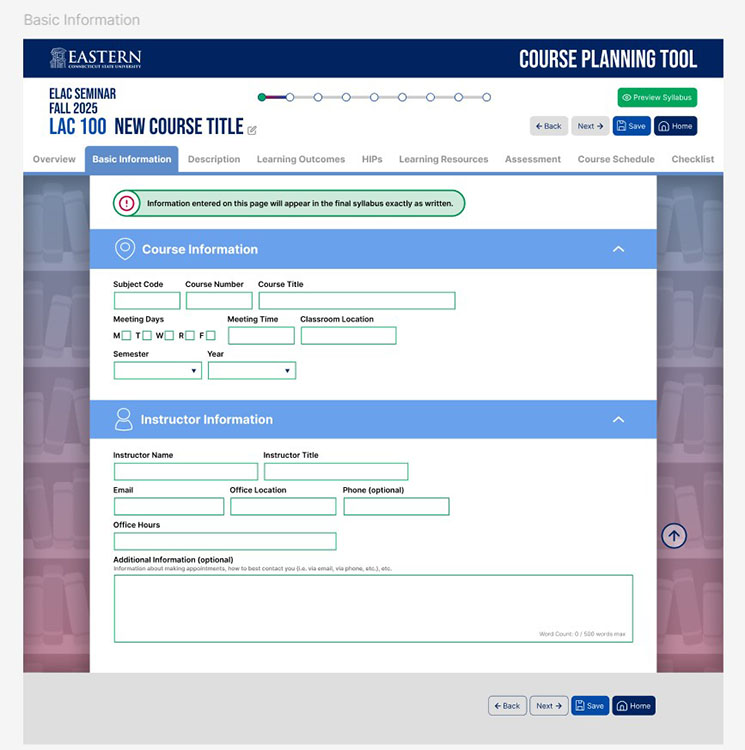
Dancik added that app users can use courses they have previously taught as templates for similar courses they plan to teach. “You may want to make some changes to your syllabus, so you can start by duplicating that previous course and making changes that way, and then you can create a new course,” he said.
Dancik continued: “Once you create a new course, you put in the basic course information, and then it'll walk you through a few different steps of course development. The goal for this is to help faculty develop courses in a way that is very intentional.”
This faculty development initiative began with a $281,120 grant from the Davis Educational Foundation, established by Stanton and Elisabeth Davis after Mr. Davis’s retirement as chairman of Shaw’s Supermarkets, Inc. The foundation sent a payment of $112,201 in April 2024 and made the second and final payment of $168,919 in April 2025.
Among other projects covered by the grant initiative is the CTLA's Teaching Scholars Program, which supports 10 faculty members to engage in scholarship of teaching and learning projects during the grant's two-year period.