
- Apply
- Visit
- Request Info
- Give



Written by Michael Rouleau '11
Published on November 20, 2025
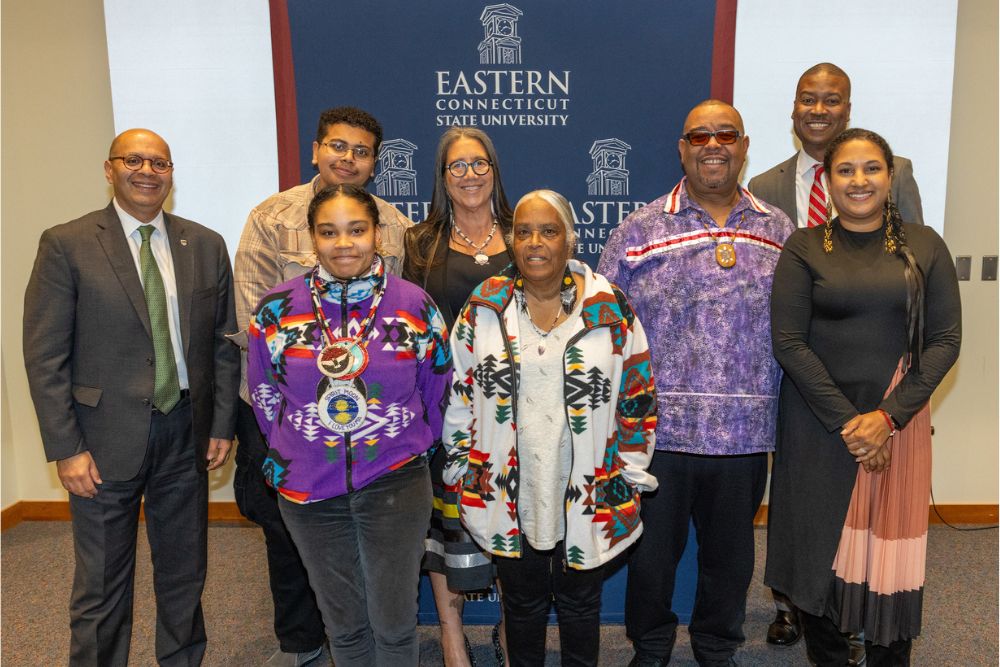
President Karim Ismaili (left) and VP for Equity and Diversity LaMar Coleman (top right) with tribal representatives, including (left to right, back row) Sebastian Spencer '26 (Cherokee, Blackfoot, Penobscot), Beth Regan '79 (Mohegan), and Michael Thomas (Mashantucket Pequot). Front row: Natasha Gambrell '15 (Eastern Pequot), Valerie Gambrell '77 (Eastern Pequot), Cassandra Sherman Keola (Golden Hill Paugussett).
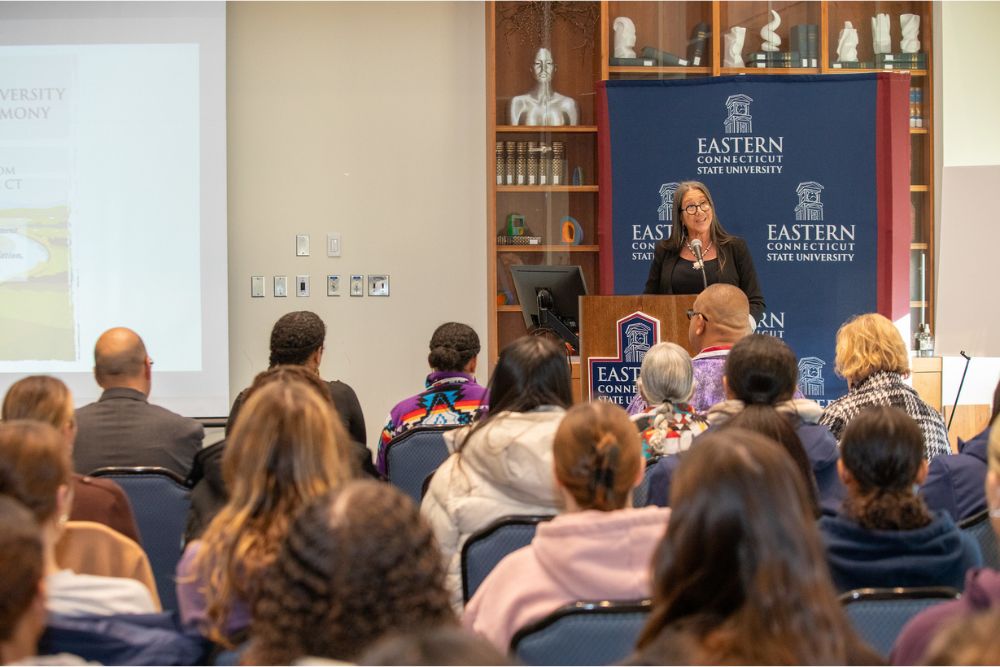
Keynote speaker Beth Regan '79, Mohegan Tribal Council of the Elders
Eastern Connecticut State University made a meaningful gesture this Native American Heritage Month by holding its first land acknowledgement ceremony on Nov. 19. The ceremony featured representatives from four local tribal nations in recognition of the tribal ancestral lands on which the University stands.
Additionally, the ceremony unveiled Eastern's official land acknowledgement statement. The statement reads:
We respectfully acknowledge that the land on which Eastern Connecticut State University stands, and the broader land now known as the State of Connecticut, is the ancestral territory of the Eastern Pequot Tribal Nation, Golden Hill Paugussett Tribe, Mashantucket Pequot Tribal Nation, Mohegan Tribe, Nipmuc Tribe, and Schaghticoke Tribe, who have stewarded this land throughout the generations with great care. We honor their resilience, cultural heritage, and enduring presence. As Connecticut's public liberal arts university, we are committed to fostering greater awareness of Indigenous histories and contemporary experiences, and to building relationships grounded in respect, reciprocity, and responsibility.
During his opening remarks, President Karim Ismaili explained that the University Senate formally adopted the statement on Nov. 18, which will be read at the beginning of major campus events, starting with the spring 2026 University Meeting. Moving forward, he promised continued engagement with the region's native tribes.
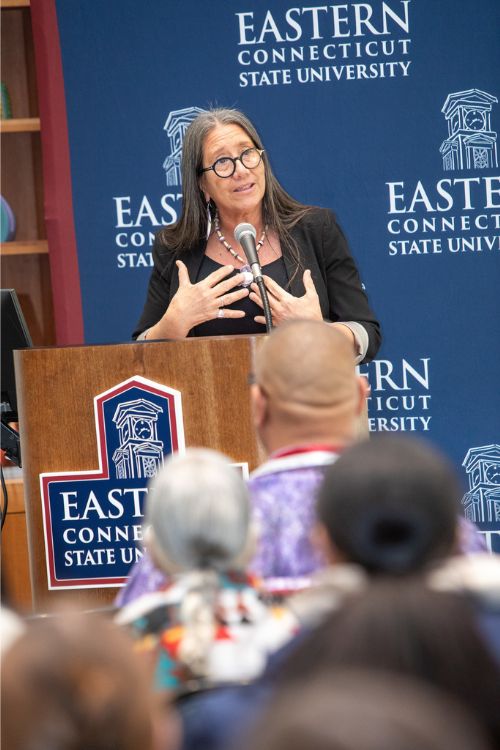
"A land acknowledgement helps us understand the deep and enduring relationships Indigenous nations maintain with their homelands," said Ismaili. "It brings attention to histories that have too often been overlooked and invites us to reflect on the commitments we should uphold as a university - grounded in learning, respect, and inclusion."
Keynote speaker Beth Regan '77, chairwoman and justice of the Mohegan Tribal Council of Elders and an Eastern alumna, spoke with great reverence for her ancestors and those of all Native American "relatives."
"Our ancestors carry our stories, our knowledge, and our responsibilities across generations, so we may continue to flourish. ... Honoring our ancestors is not simply looking back; it is remembering who we are."
Of the land on which her people have lived for hundreds of generations, she said, "The land is a gift ... we are connected to the land. We are the land. We cannot be separated. This is why dispossession and removal were so traumatic for our people."
Regan appreciates the visibility in November that comes with Native American Heritage Month, but challenged the audience to be considerate of Native American history and cultures year-round.
"Our histories are deeper than a single month. We live this daily, but November reminds us to listen, to honor, and to understand the full truth of the first peoples of this land."
A proud of alumna of Eastern, Regan is pleased about the University's land acknowledgement statement. "Today is a new beginning - a new relationship with this university and with these tribes."
The ceremony featured additional remarks from speakers representing different Connecticut tribes. Among them was Alumna Natasha Gambrell '15 of the Eastern Pequot Tribal Nation, whose federal recognition was controversially revoked in the early 2000s.
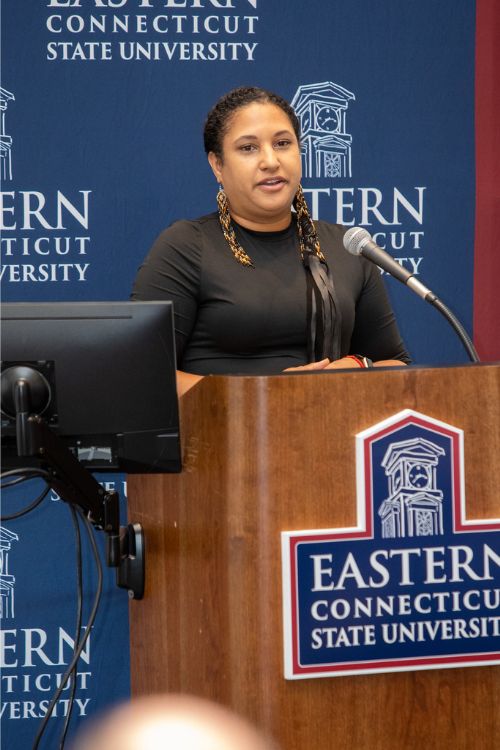
Cassandra Sherman Keola, Golden Hill Paugussett Tribe
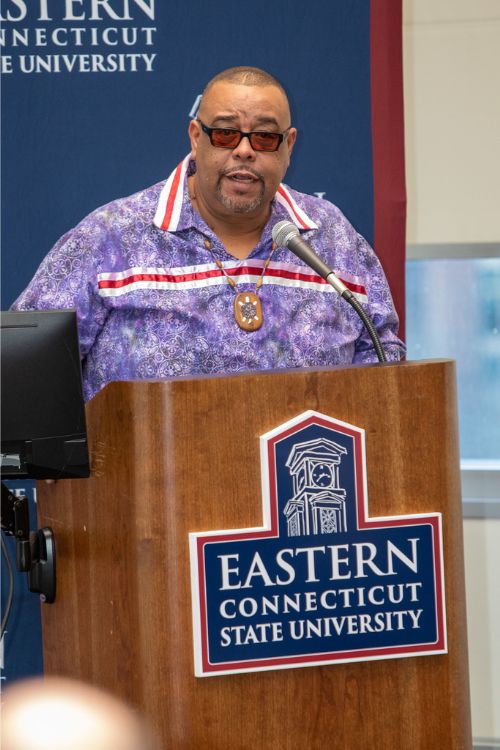
Michael Thomas, Mashantucket Pequot Tribal Nation
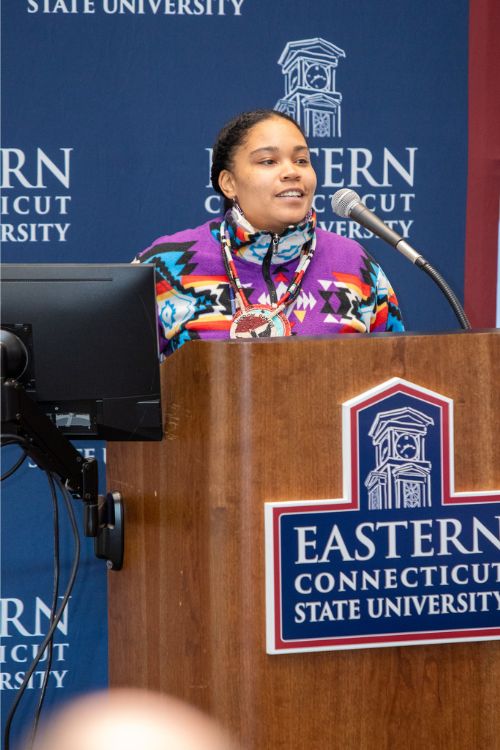
Natasha Gambrell '15, Eastern Pequot Tribal Nation
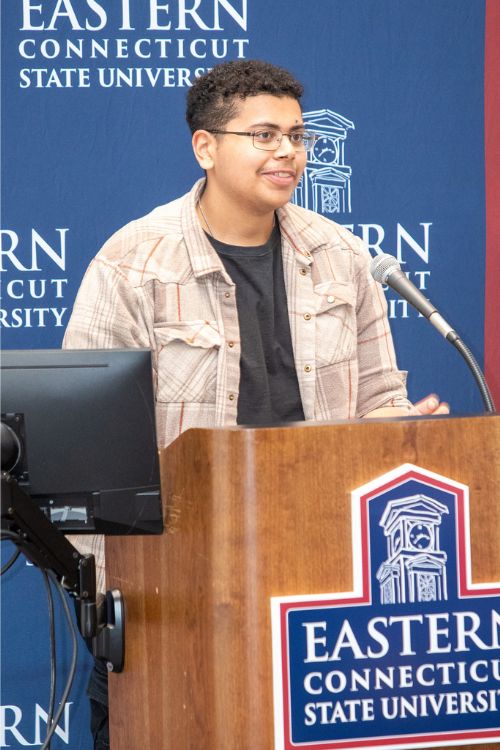
Sebastian Spencer, Eastern student of Cherokee, Blackfoot, and Penobscot tribal affiliation and reader of the statement
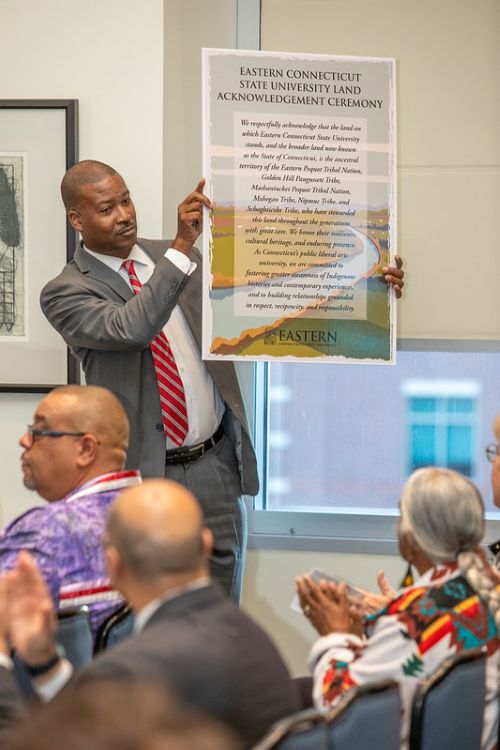
Vice President for Equity and Diversity LaMar Coleman holds the statement.
Due to this lack of recognition, she says her people are often left "voiceless" and "forgotten." "It's great to have the visibility here today," she said. "I'm thankful that Eastern is moving in the right direction."
Michael Thomas, cultural resources director of the Mashantucket Pequot Tribal Nation, spoke of Native people's ongoing battle for recognition in the United States.
"To assume that the only real Indians are the ones acknowledged by the colonizer is foolish," he said. "Our relatives are our relatives - state-recognized, federally recognized, or unrecognized. ... Our histories, our efforts, are intertwined."
According to Thomas, who is of mixed indigenous ancestry, many Native peoples do not identify with the notion of a family tree. "What we have are more like rhododendron bushes - branches crossing too many times to call it a tree."
Cassandra Sherman Keola of the Golden Hill Paugusset Tribe challenged the crowd to truly become acquainted with the land, and with the native people who continue to inhabit it.
"When you walk outside, remember that the land carries the stories of those who came before. ... Indigenous people are everywhere, but often invisible. Seek us out, acknowledge us, and listen."
Download a printable version of Eastern's land acknowledgement statement.