
- Apply
- Visit
- Request Info
- Give



Written by Darlene Orozco B. '28
Published on November 19, 2025
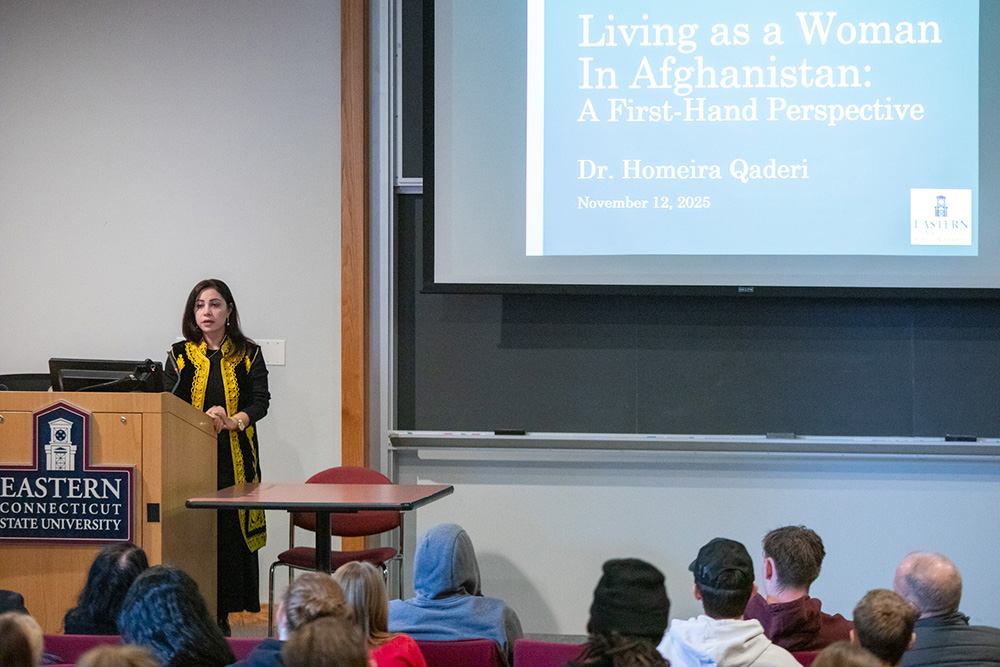
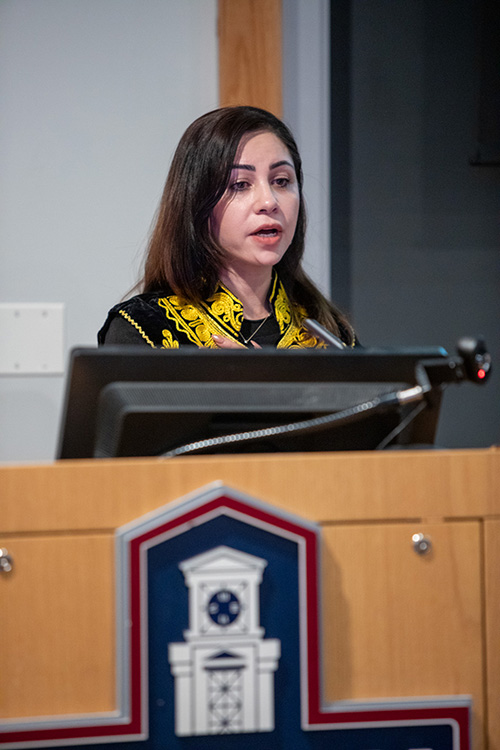
The Women’s and Gender Studies program at Eastern hosted a conversation with award-winning Afghan writer and women’s rights advocate Homeira Qaderi on Nov. 12 at Webb Hall. Qaderi discussed resilience, loss, and the realities of being a woman under Taliban rule and shared how storytelling allowed her to show resistance against her oppressors.
“I believe it is critically important to create spaces in higher education in which we listen to and learn from women's/girls' rights activist-scholars such as Dr. Qaderi," said sociology professor and event moderator Cara Bergstrom-Lynch. “I was deeply moved by Dr. Qaderi's brilliant storytelling and her message to students about courageously challenging Taliban rule despite great risks and personal costs.”
Qaderi’s bravery is shown through her storytelling, as she has published several books and is currently working on another one titled “Tell Me Everything,” a novel inspired by real stories from Afghan women.
Qaderi emphasized the importance of education, especially for women. She hopes to see the “progress of the fight for human rights.”
Born during the Soviet-Afghan War and raised during the Afghanistan Civil War, Qaderi later experienced the United States’ occupation of Afghanistan. “I have never known a day of peace,” Qaderi said. “The only thing that has helped me survive during war was hope.”
Qaderi found refuge in her father’s library, which was filled with Russian novels, and in the stories her mom told her to distract her from the conflict going on outside. “I started to see people through a different lens,” she said. “Listening to my mother’s stories and reading my father’s books helped me make my own dreams.”
When the Taliban took control of Afghanistan in 1996, Qaderi’s books had to be “wrapped in plastic and hidden underground.” Motivated by her passion for education and literature and forced by the exclusion of women from educational spaces, Qaderi started the “Golden Needle Sewing Class” in a house in Herat, a city in Afghanistan.
This class had nothing to do with sewing and everything to do with Afghan girls secretly using their pens and notebooks to “survive their depression” as they narrated their stories of perseverance.
“I published my first story at 15 years old,” said Qaderi, “and when the Taliban saw it was under a woman's name, they threatened my family with lashings.”
Qaderi continued writing and teaching her peers through the Taliban rule until 2001, when the situation for women in Afghanistan improved slightly. Qaderi went on to get her Ph.D. in Persian literature from Jawaharlal Nehru University in India and was awarded the Malalai Medal — Afghanistan’s highest civilian honor — for exceptional bravery and dedication to women’s rights. She taught at Gharjistan University in Kabul and worked as a senior advisor to both the minister of education and the minister of labor, social affairs, martyrs, and the disabled.
Relocation to the U.S.
Qaderi also spoke about her experience in an arranged marriage, from which she was able to get a divorce. Due to this, her son was taken from her at only 19 months old. After an uphill battle, she won custody of her son and fled with him to the U.S. in 2021, when the Taliban took control of Afghanistan again.
While in the U.S., Qaderi has dedicated her time to advocating for women’s rights and telling the story of Afghan women who are “completely excluded from society.” Qaderi told the audience about the challenges women in Afghanistan face, such as being “banned from secondary and higher education, from most forms of employment, and heavily restricted in public life.”
Qaderi’s eyes teared up as she remembered her loved friends, some from the “sewing class,” who decided to self-immolate “to save themselves from their miserable lives.”