
- Apply
- Visit
- Request Info
- Give



Written by Elisabeth Craig '26
Published on November 10, 2025
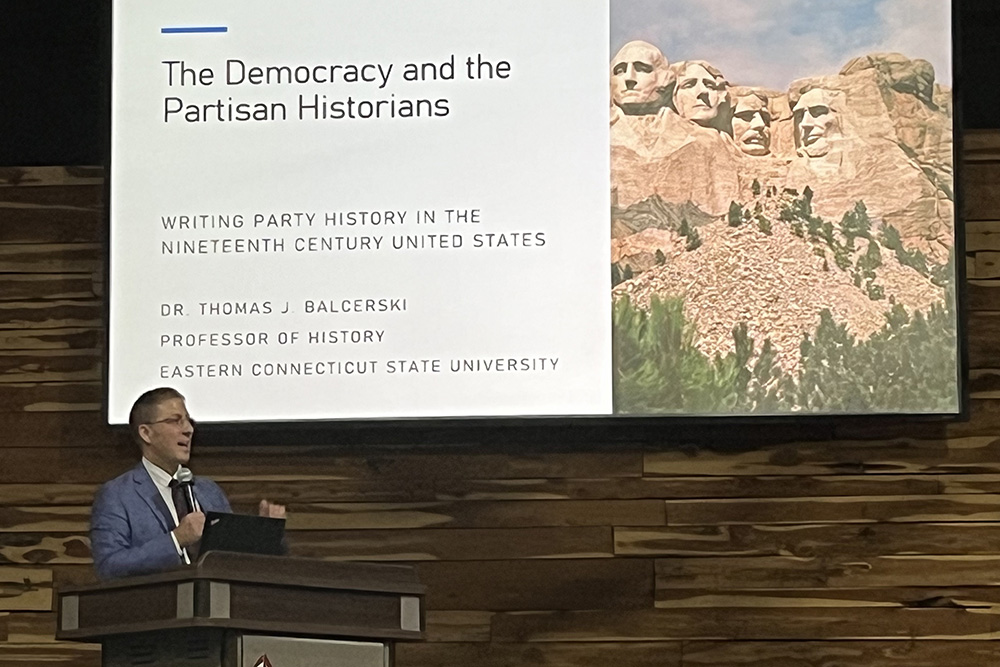
Professor Thomas Balcerski presenting at Cumberland University

Balcerski poses with a portrait of Martin Van Buren, eighth president of the United States.
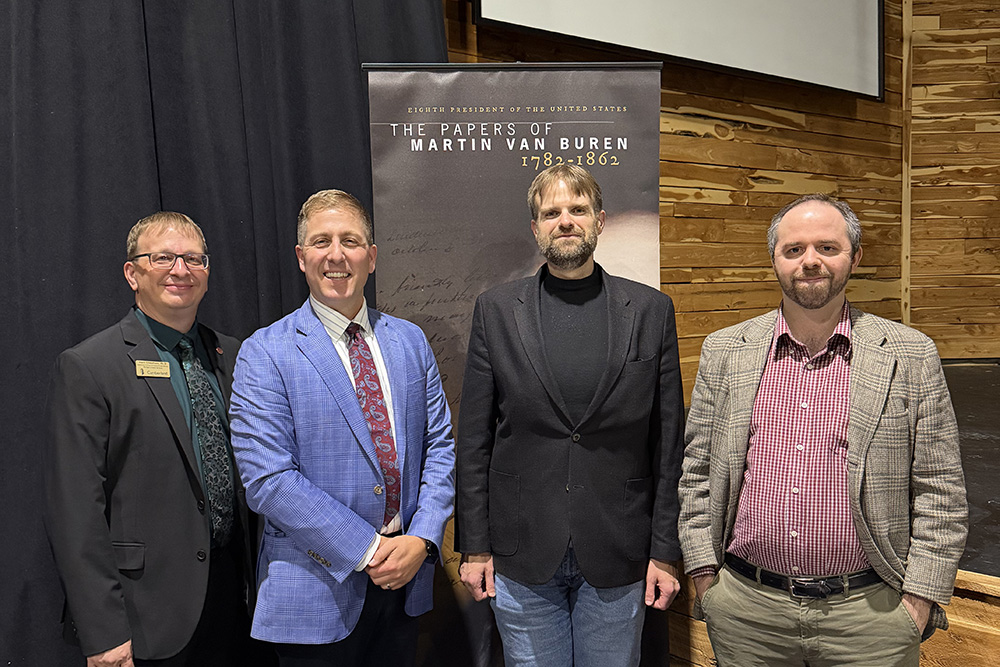
Balcerski with Cumberland's resident scholars
History Professor Thomas Balcerski presented a guest lecture on partisan history at a conference hosted by Cumberland University in Lebanon, TN, on Oct 28. Balcerski discussed the "Papers of Martin Van Buren" and how they correlate to the history of the Democratic Party.
The "Papers of Martin Van Buren" are a collection of hundreds of documents sent or written by the eighth U.S. president, Martin Van Buren. They are housed at Cumberland and supported by institutions such as the National Endowment for the Humanities, the National Archives, and the Library of Congress.
“Van Buren’s descendant Cynthia gave a bequest upon her death to endow this lecture series to encourage scholars to visit Cumberland University,” said Balcerski. “Through my archival work, I’ve been called the ‘shadow editor’ of the 'Papers of Martin Van Buren.'”
In his lecture, Balcerski referenced some of the voices of partisan history, namely New England native Nahum Capen. Balcerski also expanded upon the political differences and schisms amongst the Democrats in the antebellum period.
“My argument is that history is a partisan tool of parties, and partisan historians are the individuals who write that history,” said Balcerski. “Parties tell us about organization. They tell us about strategy, leadership — big-picture things that matter to both American politics and American history.”
He continued: “Nahum Capen was one of the first to write a history of the Democratic Party that was widely read. It became what we would call propaganda, but historians at the time would call it education.”
Antebellum politics in New England — particularly Connecticut — reflected these schisms, according to Balcerski: “These differing policies speak to Connecticut’s political devolution in the 1850s, especially on views concerning slavery, which many democrats at the time were proponents of.”
Balcerski emphasized that partisan historians shaped public understanding of the evolution of the two-party system. He explained that through his numerous hours of research that he “became a partisan historian without realizing it.”
He continued: “When you pull that lever, when you fill in that line for a Democrat, you're voting for its history — good or bad.”
Balcerski’s presentation also served as a teaser for his current passion project, a book detailing the entire history of the Democratic Party that he hopes to publish by the 2028 election season.
“I'm writing about thousands of elected officials, more than 20 presidents who called themselves Democrats over 225 years of American history,” he said. “This book will explore some of the most difficult and partisan issues we've ever faced.”