- Apply
- Visit
- Request Info
- Give



Written by Kyle Berson '26
Published on December 16, 2025
Where does a biology degree at Connecticut’s public liberal arts university get you? For Liz Charnysh ’17 and Kristine Zlotnick ’23, an Eastern education helped launch careers in research and academia, from sequencing the human genome to studying electrical currents in the brain.
Liz Charnysh ’17
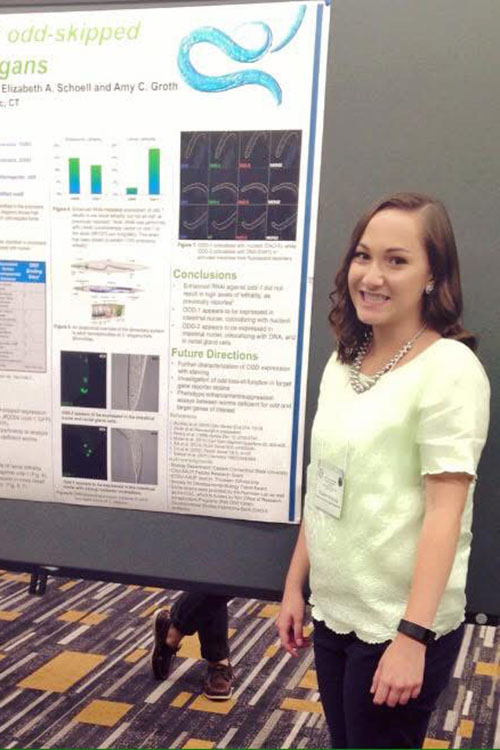
Charnysh is a certified genetic counselor at the Jackson Laboratory for Genomic Medicine in Farmington. Performing clinical genome analysis, writing patient test reports, and serving as project manager for various genomic sequencing initiatives, Charnysh started her college journey with the intent to become a dentist, but an introductory course in genetics quickly changed her path.
During her sophomore year, biology Professor Amy Groth inspired Charnysh to change her course of study. “I was distraught by the possibility of changing the direction that I was going,” she said, reflecting on her undergraduate experience.
“Looking back, that was the best way to go about it. I became really interested in genetics, and I let that guide me instead of my original plan.”
Outside the classroom, Charnysh added that she learned valuable leadership, networking, and project management skills while engaging in several extracurricular activities. Serving as a student orientation counselor, Leap into Leadership member, and becoming involved in various student organizations, Charnysh gained a unique skillset that she uses daily in her career.
After graduating from Eastern in 2017, Charnysh earned a master’s degree in human genetics at Sarah Lawrence College in 2019 and her certification in genetic counseling (CGC) in the same year. She began her professional career as a genetic counselor at Yale New Haven Health, focusing on hereditary cancer risk assessments and genetic testing for individuals with personal or family history of cancer.
Her work in this role helped individuals learn about genetic testing options for hereditary cancer and make informed decisions about their personal and family health.
Later, Charnysh accepted a role as a clinical research project manager at Jackson Laboratory. Funded by a National Human Genome Research Institute grant, her role explored the implications of employer-sponsored genetic testing through workplace wellness programs. The years-long grant recently concluded and is helping lay the groundwork for further study in the emerging subject.
“Usually when we think of genetic testing, we don’t think about employment,” said Charnysh. “Some unique ethical and legal questions arise with that.”
Currently, Charnysh works as a clinical genome scientist in Jackson Laboratory’s Advanced Precision Medicine Laboratory. As the only lab in the country that offers classification testing of central nervous system tumors, Charnysh provides analysis in her day-to-day work. When tumor tissue samples are sent to the lab, Charnysh and her team conduct genetic tests to help clinicians make diagnoses.
The tests Charnysh and her team conduct “can help put puzzle pieces together to help [healthcare providers] make a diagnosis,” she said.
In addition to her professional role, Charnysh has maintained a long-standing relationship with the Jackson Laboratory. In 2015 and 2017, she was a fellow in the lab’s summer student program, where she discovered a love for the organization. “If there was ever a chance to be a counselor at Jackson, I’d love to be there,” she said.
Kristine Zlotnick ‘23

Zlotnick was able to apply her skills directly after graduation as a lab technician in the University of Connecticut’s Department of Physiology and Neurobiology (PNB).
Originally studying biology at Florida State University, Zlotnick transferred to Eastern to complete her biology degree in her home state. “Although Eastern is a smaller university, it doesn’t lack academic rigor or passion for student success,” she said.
Zlotnick valued Eastern’s more personalized approach to higher education. “I was able to get to know my professors individually,” she said. “While their classes were challenging, the department supported my growth both academically and professionally.”
Zlotnick’s fascination with neuroscience began during an independent study with biology Professor Kurt Lucin, exploring how microgravity affects immune cells in the brain. Zlotnick later earned the opportunity to present her findings at the Northeast Undergraduate Research Organization for Neuroscience (NEURON) conference at Quinnipiac University.
Alongside a challenging and rewarding curriculum, Zlotnick appreciated the flexible structure of Eastern’s biology labs. “They were often designed to encourage individual curiosity and promote the fun of science while still maintaining important core concepts,” she said.
She enjoyed getting to design her own experiments with former biology Professor Derek Laux and wilderness outings with biology Professor Kristen Epp. “They really fostered my interest in asking scientific questions,” she said.
“From molecular techniques at the bench to teaching strategies that I now pass on to my own anatomy and physiology students, I use the skills I learned from classes and faculty at Eastern every day,” Zlotnick continued.
“Their encouragement played a major role in my decision to pursue neuroscience in graduate school, and I truly would not be where I am today without their mentorship and support.”
After graduation, Zlotnick was hired as a lab technician at Menuz Laboratory at UConn’s Storrs campus, studying molecular and cellular behaviors in insects. The lab uses techniques such as genetic manipulation, electrophysiology, RNA sequencing, and CRISPR genome editing to make discoveries in neuron physiology.
During the fall 2025 semester, Zlotnick began a Ph.D. program in physiology and neurobiology at UConn, where she is developing skills for further use in Menuz Lab. Zlotnick also began teaching part-time at UConn, passing on her lab knowledge and expertise to undergraduate students.