


If you’re already working in accounting, you’ve probably run the math in your head more than once. A master’s degree costs money and time you don’t have a lot of extra of. The good news is you don’t have to guess: there’s real wage data, real program data, and a straightforward way to weigh them against each other.
This guide walks through what a Master of Science in Accounting (MSA) costs in time and money, what current salary data says about accountants and auditors, and how Eastern Connecticut State University’s online MSA fits the equation. See the full M.S. in Accounting program page
The Real Question Behind “Is It Worth It”
“Worth it” isn’t one number. It’s really three questions: what the degree costs, what it opens up, and how fast you recover the investment. Most people asking already have a bachelor’s in accounting and are deciding whether the next step is a master’s, the CPA exam, or both.
The honest answer is that a master’s in accounting isn’t a guarantee of a raise or a title bump. It’s a credential that removes specific barriers, mainly the CPA licensure requirement, while positioning you for roles that tend to sit higher on the pay scale.
What a Master’s in Accounting Actually Costs You
Cost isn’t just tuition. It’s tuition plus the months you spend studying instead of doing something else with that time, which is often the bigger factor for working adults.
Eastern’s online MSA is built to minimize both. The program does not require the GMAT or GRE for admission, removing a testing hurdle that can add months to an application timeline. It runs on seven-week terms with three start dates a year, and is designed so a full-time, continuously enrolled student can finish in 12 months. A shorter timeline changes the ROI math directly: less time away from full earning potential means a faster path back to a higher level, not a slower one. Check admissions requirements
M.S. in Accounting Online
Elevate your expertise with Eastern’s online M.S. in Accounting: a gateway to mastering advanced accounting principles and enhancing your career prospects. Explore the program to shape your future in the accounting profession.
The CPA Connection: Why This Degree Matters More Than It Looks
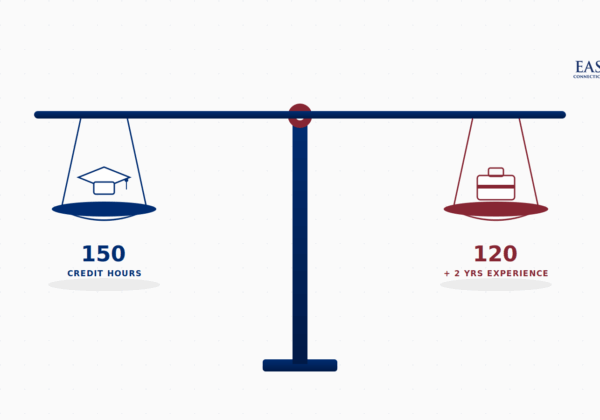
For a lot of accountants, the real driver behind a master’s degree isn’t the letters after their name. It’s the 150 semester hours most states require to sit for the CPA exam, since a typical bachelor’s degree only gets you to about 120.
Eastern’s MSA is built to fulfill that 150-hour requirement, so the degree and the CPA pathway move together instead of requiring a separate patchwork of extra coursework. If CPA licensure is part of your plan, this is often the single biggest reason the math tips toward “worth it.”
What the Salary Data Actually Shows
Here’s where real numbers matter more than marketing language. The U.S. Bureau of Labor Statistics reports a median annual wage of $83,680 for accountants and auditors as of May 2025, with employment projected to grow 5% from 2025 to 2035 and about 115,300 annual openings projected over the decade BLS Occupational Outlook Handbook, Accountants and Auditors.
That figure covers the occupation broadly, not master’s holders specifically, so it’s a baseline, not a promise. A master’s degree and CPA license tend to position accountants for roles at the higher end of that range, like senior auditor, accounting manager, or corporate controller, rather than guaranteeing a specific number.
Eastern’s own program materials cite similar wage data for the field, including sector breakdowns of roughly $83,250 for finance and insurance and $79,410 for accounting, tax, and bookkeeping services firms specifically Eastern Connecticut State University, “M.S. in Accounting Program Page“. The two data sets line up closely, which is a good sign the range is realistic.
Eastern’s MSA: The Numbers Behind the ROI Case
Beyond salary data, a few program-specific facts matter for weighing the investment itself. Eastern’s MSA is a 30-credit-hour, 100% online program, and U.S. News & World Report has ranked Eastern among the top 25 best public institutions in the North U.S. News & World Report, “Best Regional Universities North Rankings“, a distinction the program points to as part of its “Best Value in the North” positioning.
Graduates of accounting master’s programs commonly move toward roles like accounting manager, senior auditor, corporate controller, financial accountant, and senior financial analyst, according to Eastern’s program page. None are automatic outcomes of the degree itself, but they’re the kind of roles the coursework and CPA eligibility are built to support. Explore the curriculum
Weighing the Investment: A Simple ROI Framework
You don’t need a spreadsheet to think through this clearly. Three questions get you most of the way there.
- Do you need the 150-hour requirement fulfilled? If you’re short of 150 credit hours and CPA licensure is part of your plan, this alone often justifies the degree.
- How much time can you realistically commit? A 12-month, no-GMAT program is a lighter lift than a two-year part-time degree, and that difference compounds when you’re already working full-time.
- What roles are you trying to reach? If your target roles typically expect a master’s or CPA license in your market, the ROI case is stronger. If your target role requires neither, the case is weaker.
Who a Master’s in Accounting Makes the Most Sense For
This degree tends to make the clearest financial sense for working accountants who are short of the 150-hour CPA requirement, want a credential-driven promotion path (senior auditor, controller, accounting manager), and can commit to a focused, sub-12-month program rather than a longer one. Request info and talk to a representative
It makes less sense if your goal is broader business leadership outside of accounting itself, since that’s usually a better fit for an MBA. If you’re weighing that comparison directly, it’s worth reading up on how an MSA and an MBA differ in focus and career direction before deciding.
The Bottom Line
A master’s in accounting isn’t automatically worth it for everyone, and no reputable program should tell you otherwise. It tends to be worth it when you need the 150-hour CPA requirement fulfilled, you’re aiming at credential-driven roles like controller or senior auditor, and you can find a program that respects your time instead of stretching it out.
Eastern’s online MSA was built around that math: no GMAT or GRE, a sub-12-month accelerated path, and a curriculum designed to fulfill the CPA’s 150-hour rule. The BLS data gives you the field-wide baseline, and Eastern’s own reported outcomes give you a sense of where the degree tends to lead from there.
The path to your future starts at Eastern. Request info about the M.S. in Accounting program
FAQ
Is a master’s in accounting worth the cost?
It depends on your goals. If you need the 150-hour CPA requirement fulfilled or are targeting credential-driven roles like controller or senior auditor, the investment tends to pay off faster, especially in a program with no GMAT/GRE requirement and a sub-12-month timeline like Eastern’s MSA.
What is the average salary for someone with a master’s in accounting?
The U.S. Bureau of Labor Statistics reports a median annual wage of $83,680 for accountants and auditors as of May 2025. A master’s degree and CPA license tend to position graduates toward the higher end of that range, though the BLS figure covers the occupation broadly rather than master’s holders specifically.
Does a master’s in accounting help you pass the CPA exam?
A master’s in accounting doesn’t take the exam for you, but it commonly fulfills the 150 semester hours most states require to sit for the CPA. Eastern’s MSA is built to satisfy that requirement.
How long does it take to complete a master’s in accounting?
It varies by program, but Eastern’s MSA is designed to be completed in under 12 months for full-time, continuously enrolled students, running on seven-week terms with three start dates a year.
Do I need the GMAT or GRE to apply for a master’s in accounting?
Not at Eastern. Eastern’s M.S. in Accounting does not require the GMAT or GRE for admission.