


You want the Master of Science in Accounting. You know it would help your CPA timeline and your career. The part that’s holding you back isn’t motivation, it’s the invoice.
Here’s the good news: a lot of employers already have a mechanism for this, they just haven’t been asked recently. This guide covers how tuition reimbursement typically works, what the IRS allows tax-free, and how to build a business case your manager can say yes to, using Eastern Connecticut State University’s online MSA as the reference point. See the full M.S. in Accounting program page
Why This Benefit Exists
Employers offer tuition assistance because it’s often cheaper than losing you and hiring your replacement. For accounting specifically, the incentive is even stronger: a staff accountant working toward CPA licensure and a graduate credential is a known, in-progress investment, and supporting it is one of the simpler ways a finance leader can improve retention on their own team.
How Employer Tuition Reimbursement Typically Works
Programs vary by company, but most share a similar shape:
- Reimbursement, not up-front payment. You typically pay first and get repaid after finishing the course with a passing grade.
- Annual caps. Most plans cap the benefit per year, commonly in the $2,000 to $5,250 range, though this varies by company.
- Relevance requirements. Coursework generally needs to relate to your current or foreseeable role. An MSA tied to your accounting job qualifies easily.
- Service commitments. Some employers ask you to stay a set period after finishing, or repay the assistance if you leave early.
Ask HR for your plan document before building your ask around assumptions.
The IRS Section 127 Rules, in Plain English
This is worth understanding before you talk to your employer. Under Section 127 of the tax code, an employer can provide up to $5,250 per employee per year in educational assistance excluded from your taxable income, meaning it isn’t added to your W-2 wages IRS, “IRS updates frequently asked questions about section 127 educational assistance programs”. This applies to a written, qualifying employer plan and can cover graduate coursework, and recent IRS guidance confirms the cap stays in place with cost-of-living adjustments starting after 2026.
Assistance beyond that cap is generally treated as taxable wages, so if a year’s tuition runs higher, expect the excess to show up as income. This is general tax information, not individualized advice. Confirm your situation with HR and a qualified tax advisor before you count on a particular outcome.

M.S. in Accounting Online
Elevate your expertise with Eastern’s online M.S. in Accounting: a gateway to mastering advanced accounting principles and enhancing your career prospects. Explore the program to shape your future in the accounting profession.
How Common Is This Benefit, Really?
Tuition assistance isn’t a rare perk reserved for large corporations. It’s a mainstream benefit across company sizes and industries, with employers historically reporting some form of tuition assistance for a meaningful share of their workforce InStride, “Must-Know Tuition Reimbursement Statistics for 2025”. You’re not requesting something unusual, you’re asking to use a benefit category that already exists in a lot of standard packages.
Building the Business Case: What to Actually Say
Framing matters. Don’t lead with “I want to go back to school.” Lead with what the degree does for the work you already do.
| Angle | What to say |
|---|---|
| CPA-track ROI | “This fulfills the 150-hour requirement for CPA licensure, positioning me for CPA-eligible work the firm needs.” |
| Retention value | “I want to grow here, not somewhere else. Tuition support is a low-cost way to keep me invested in this team.” |
| Low time cost | “Eastern’s MSA runs on 7-week terms and can be completed in 12 months, so this isn’t a multi-year disruption.” |
| Low risk | “There’s no GMAT or GRE required, so there’s no extra testing timeline before I can start.” |
| Tax efficiency | “Assistance up to $5,250 a year is excluded from my taxable wages under IRS rules, which keeps the cost efficient for both of us.” |
Sources: program details from Eastern’s M.S. in Accounting program page; IRS Section 127 rules from the IRS newsroom update cited above.
What Makes Eastern’s MSA an Easier Ask
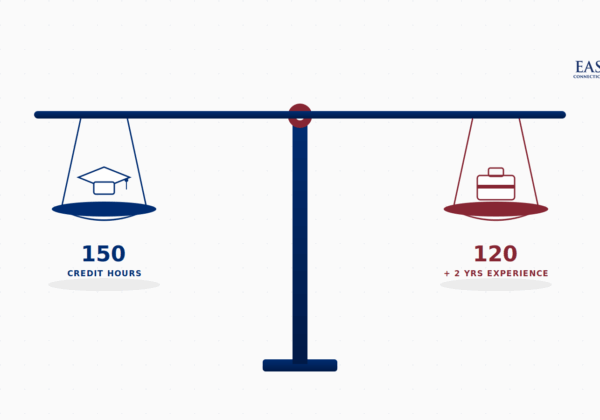
Part of a strong business case is picking a program that’s genuinely easy to say yes to. Eastern’s online MSA runs across 30 credit hours with no GMAT or GRE, on 7-week terms with three start dates a year, completed in under two years at a standard pace or accelerated to under 12 months full-time. Explore the curriculum and format. That testing-free, shorter runway is a lower-risk ask, and it fulfills the 150-hour requirement most states need for CPA licensure. Check admissions requirements.
Bottom Line
Employer tuition reimbursement is a real, common benefit, and accounting is one of the easiest cases to make for it. The IRS allows up to $5,250 a year tax-free under Section 127, and a program like Eastern’s MSA keeps the time and testing barriers low enough that saying yes is reasonable. Bring the numbers, not just the ask, and confirm plan and tax specifics with HR and a tax advisor first.
The path to your future starts at Eastern. Request info and talk to a representative
FAQ
Do employers really pay for a master’s in accounting?
Many do, through tuition reimbursement or assistance programs, though amounts and rules vary by company. Ask your HR department rather than assuming your employer doesn’t offer it.
How much can my employer give me tax-free for tuition?
Under IRS Section 127, an employer can provide up to $5,250 per employee per year in educational assistance excluded from your taxable income, under a qualifying written program. Amounts above that limit are generally treated as taxable wages.
Does tuition reimbursement apply to graduate degrees like an MSA?
Yes, Section 127 programs can cover graduate coursework, not just undergraduate study. Confirm with your employer whether their specific plan extends to graduate programs.
What if my program costs more than the tax-free limit?
Any assistance above the annual exclusion is typically added to your taxable wages