


If you’re already working in accounting and thinking about a graduate degree, you’ve probably landed on the same two options everyone else does: a Master of Science in Accounting (MSA) or an MBA. Both show up in the same searches, both get called “the smart next step” by somebody, and both can genuinely help your career. That doesn’t mean they help it in the same way.
The honest answer is that the right choice depends on the kind of promotion you’re actually chasing, not just which degree sounds more impressive. This guide breaks down the real differences in cost, time, CPA eligibility, and career outcomes, using Eastern Connecticut State University’s online MSA as the reference point. See the full M.S. in Accounting program page.
The Real Difference: Depth vs. Breadth
An MBA in Accounting blends accounting with broader business training: management, marketing, operations, and strategic decision-making. It’s designed to prepare graduates for senior leadership roles and a wider range of career paths, including consulting, corporate strategy, or general management, not just accounting-specific ones.
An MSA goes the other direction. It’s a specialized, technical degree focused on advanced accounting topics like auditing, taxation, financial reporting, and increasingly, data analytics. It’s built for people who want to go deeper into accounting itself, not broader into general business, and it aligns directly with the CPA and forensic accounting career tracks.
Neither is “better.” They’re built for different kinds of promotions.
What an MBA Actually Prepares You For
If your goal is to eventually move out of pure accounting and into a broader leadership role, like a CFO track, general management, or consulting, an MBA’s breadth is the point. You’ll study functions well beyond accounting, and that range is exactly what positions you for cross-functional leadership later.
The tradeoff is time and specialization. An MBA typically takes one to two years depending on enrollment status, and because the curriculum is broad by design, it spends less time on the technical accounting depth that licensure and specialized accounting roles require.
M.S. in Accounting Online
Elevate your expertise with Eastern’s online M.S. in Accounting: a gateway to mastering advanced accounting principles and enhancing your career prospects. Explore the program to shape your future in the accounting profession.
What Eastern’s MSA Actually Prepares You For
If your goal is deeper accounting expertise, whether that’s the CPA license, a controller-track role, or a specialized path like forensic accounting, the MSA is the more direct route. Eastern’s program is built around exactly that: advanced functional accounting knowledge, taxation, auditing, international reporting standards, and data analytics and visualization skills that are increasingly expected of accountants. Explore the curriculum.
It’s also built to remove some of the friction that makes people hesitate. Eastern’s MSA doesn’t require the GMAT or GRE, runs on 7-week terms with three start dates a year, and is designed to be completed in 12 months full-time. Check admissions requirements.
Cost, Time, and CPA Eligibility: Side-by-Side
| MSA (Typical) | MBA in Accounting (Typical) | |
|---|---|---|
| Primary focus | Deep technical accounting | Broad business and leadership |
| Program length | About 1 year full-time (Eastern: 12 months) | 1-2 years depending on enrollment |
| Admissions test | Eastern: no GMAT or GRE | Often required, though waivers are common |
Sources: program length and outcome comparisons drawn from the University of San Francisco, “MSA vs. MBA: Key Differences” and Eastern Connecticut State University’s program page.
Career Outcomes: Which Degree Gets You Promoted Faster?
This is where the “depth vs. breadth” distinction actually plays out in a paycheck.
For accountants aiming at technical, credential-driven promotions, senior auditor, corporate controller, accounting manager, or a CPA-required role, the MSA is usually the faster and more direct path, because it’s built around exactly those competencies and licensure requirements. Eastern’s program page cites these as common outcomes for its graduates, alongside senior financial analyst roles.
For accountants whose goal is a broader leadership seat that happens to sit above accounting, not just within it, the MBA’s cross-functional training tends to matter more than additional technical depth.
For context on the field overall, the Bureau of Labor Statistics reports a median annual wage of $83,680 for accountants and auditors as of May 2025, with employment projected to grow 5% from 2025 to 2035 and about 115,300 annual openings projected over the decade (BLS Occupational Outlook Handbook, Accountants and Auditors). As with any projection, actual outcomes vary by role, region, and experience. An MSA can position you for these paths, but it isn’t a guarantee of a specific title or salary.
How to Know Which One Fits You
Ask yourself these three questions:
- Am I trying to go deeper into accounting, or broader into general business? Deeper points toward the MSA. Broader points toward the MBA.
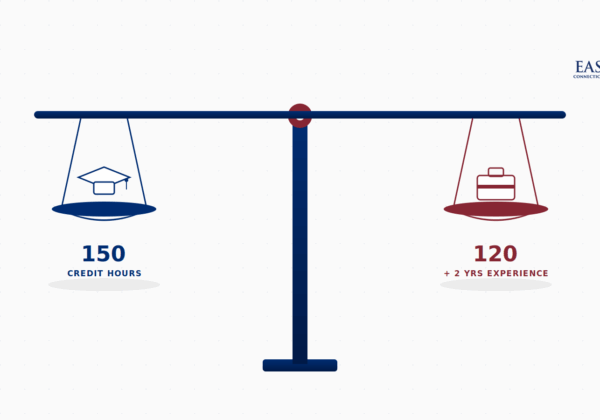
- Do I need to fulfill the 150-hour CPA requirement? If yes, confirm the program you’re considering actually satisfies it. Eastern’s MSA is built to.
- How much time and cost can I commit right now? A 12-month, no-GMAT program is a meaningfully different commitment than a two-year MBA, and that difference matters if you’re working full-time.
Can You Do Both?
Plenty of accountants do, just not usually at the same time. It’s common to complete an MSA earlier in your career to build technical depth and CPA eligibility quickly, then pursue an MBA later once you’re ready to move into broader leadership. Going in that order tends to make more financial sense too, since the MSA is typically the faster, lower-cost credential to start with.
There’s no wrong answer here. The two degrees solve different problems, and needing both eventually isn’t a sign you chose incorrectly the first time.
The Bottom Line
An MSA and an MBA aren’t really competing for the same promotion. One goes deep into accounting expertise and licensure. The other goes broad into general business leadership. The right one depends on which direction your next few promotions are actually headed.
The path to your future starts at Eastern. If deeper accounting expertise, CPA eligibility, and a faster, more affordable timeline sound like the right next step, Eastern’s online MSA is worth a closer look. Request info and talk to an advisor.
FAQ
Is an MSA Better Than an MBA for Accountants?
Neither is universally better. An MSA is built for deeper, technical accounting expertise and CPA licensure, while an MBA offers broader business training aimed at general leadership roles. The right choice depends on your career direction.
Does Eastern’s M.S. in Accounting Help Fulfill the 150-Hour CPA Education Requirement?
Yes. Eastern states that its M.S. in Accounting helps students meet the 150-hour educational requirement for CPA licensure. CPA eligibility requirements vary by state, so students should confirm requirements with the applicable state board of accountancy.
Do I Need the GMAT or GRE to Apply?
No. Eastern’s MSA does not require the GMAT or GRE for admission.
How Long Does the Program Take to Complete?
Eastern’s MSA runs on 7-week terms with three start dates a year and is designed to be completed in under 12 months of full-time study.
What Jobs Can an MSA Lead To?
Common outcomes include accounting manager, senior auditor, corporate controller, and senior financial analyst roles.