- Apply
- Visit
- Request Info
- Give

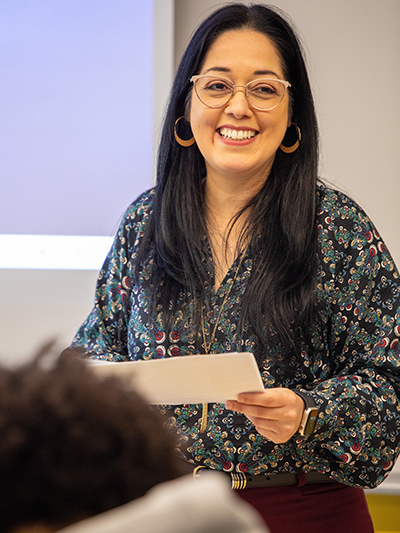
“I was born and raised in Puerto Rico, and my academic and professional journey has always been connected by an interest in communication, language and people, as well as a desire to help others and create space for voices that are too often overlooked. I began my studies in Public Communication at the University of Puerto Rico, Río Piedras, and later earned a master’s degree in Rehabilitation Counseling. My growing interest in how people communicate, learn and navigate different linguistic and cultural environments eventually led me to pursue a Ph.D. in Language Sciences at Indiana University Bloomington.
My teaching career has allowed me to work with students in a variety of academic environments. I taught at Indiana University for five years while completing my doctorate, followed by three years at Amherst College, a decade at Mount Holyoke College, and a year at Anna Maria College. My experience within liberal arts environments has been particularly meaningful because it has allowed me to draw from my own interdisciplinary background and bring different perspectives into the classroom. Rather than seeing communication, counseling, linguistics, language, and culture as separate areas, I see them as interconnected ways of understanding people and their experiences.
When the opportunity at Eastern emerged, I was thrilled about joining a public university. I am a product of public education myself, as I completed all of my degrees within that educational system. I have experienced firsthand how access to a high-quality education can transform a person’s path and create possibilities that might otherwise seem out of reach. After many years working at private institutions, joining Eastern felt like a chance to give back to the system that played such an important role in my own journey. Eastern’s liberal arts mission also resonated with me because it values the kind of interdisciplinary thinking that has shaped both my academic path and my approach as an educator. I saw Eastern as a place where my experiences could come together while I continued growing as an educator and scholar and helping students discover their own possibilities.”
“This semester, I am teaching Introductory Spanish I, Spanish In & Through Social Media, and Hispanic Screen Cultures. Although these courses are very different, they share a common goal: helping students understand language and culture as something living, dynamic, and connected to the world around them.
Across all three courses, I hope students develop greater confidence, curiosity and a willingness to engage with perspectives beyond their own. I want them to see language learning as more than mastering vocabulary and grammar, and cultural learning as more than acquiring facts. Whether they are communicating in Spanish, examining social media, or interpreting film, I hope they learn to think critically, make meaningful connections, and better understand the people and cultures around them.”
“My research focuses broadly on language learning and teaching, with interests in second language acquisition, the syntax-semantics interface, Spanish heritage speakers, Spanish for specific purposes, and inclusive language pedagogy. More recently, I have been exploring the role of artificial intelligence in language education. I am particularly interested in how AI can support students as language learners while encouraging them to remain active, critical and independent participants in the learning process. Rather than focusing only on what technology can do for students, I am interested in how we can help students question it, evaluate its limitations and use it responsibly. Much of my research grows directly from the classroom, where my students and their experiences continually inspire new questions about how we teach and learn languages.”
I hope [students] learn to think critically, make meaningful connections, and better understand the people and cultures around them.
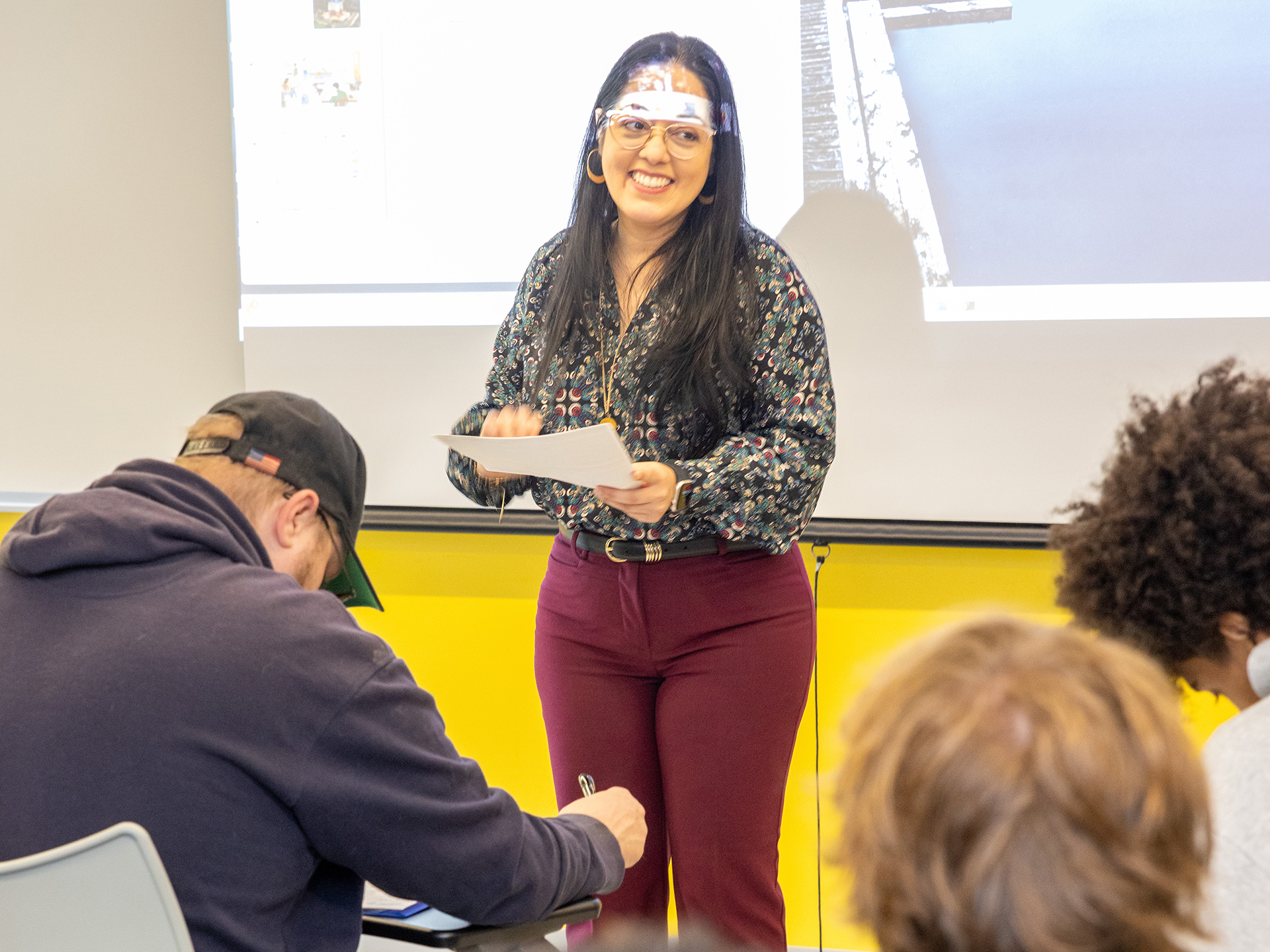
“My first impression of Eastern has been how welcoming and collegial the community is. I have especially appreciated the effort that faculty and staff put into helping new faculty feel supported and become part of the community. From learning how to navigate campus resources to simply knowing whom to turn to with a question, I have felt that people genuinely want one another to succeed.
I have been equally impressed by my students. They bring a wide range of life experiences and perspectives into the classroom, and I value the curiosity, effort, and respect they show toward one another and the learning process. Their willingness to participate and learn from each other has already enriched our classroom conversations. There is a strong sense of community at Eastern, and that has made my transition a very positive experience.”
“My teaching philosophy is grounded in creating an inclusive, dynamic and student-centered learning environment where every student feels that they have a place and a voice. I believe students learn best when they are active participants, so I design opportunities for them to collaborate, ask questions, take risks and connect what they are learning to their own experiences and interests. I also believe that mistakes are an essential part of the process. I want my classroom to be a space where students feel challenged, supported and comfortable being curious.”
“Enjoy the process and take advantage of as many opportunities to learn as you can. Learn from your professors, colleagues, and people outside your own field. Explore different disciplines, consider a minor or double major, and do not be afraid to follow interests that may seem unrelated at first. Those connections can often lead you in unexpected and rewarding directions. If you have the opportunity, study abroad, even for a semester. Experiencing another language and culture firsthand can change not only how you see the world, but also how you understand yourself and the possibilities available to you.”
“Do not be afraid of having doubts or feeling unprepared. We are eternal learners in life, and graduation is not the end of that process. Your education will give you a strong foundation, but be ready to go beyond what you already know, adapt to new situations, and continue learning from the people and experiences you encounter. Most importantly, look for work that gives you a sense of purpose and satisfaction that cannot be measured solely by salary, title, or prestige. A fulfilling career should not only support the life you want to live, but also give meaning to the work you do.”