


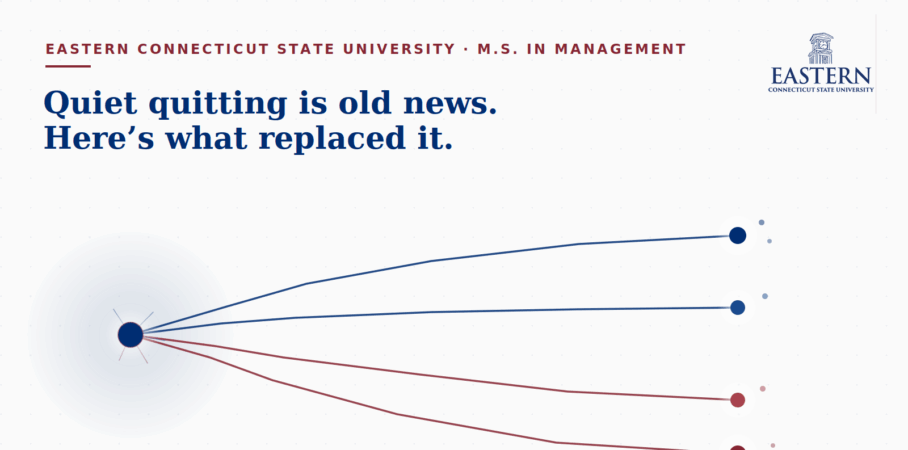
Quiet quitting hasn’t disappeared. It’s splintered into three more specific, more urgent problems, and most managers still aren’t trained to catch any of them before they cost a good employee. That’s precisely the gap Eastern Connecticut State University’s online M.S. in Management is built to close. If you’re a manager who thought “quiet quitting” was last year’s HR buzzword to shrug off, the data says otherwise: workplace disengagement didn’t get better, it evolved into forms that are harder to spot and more expensive to ignore.
Is Quiet Quitting Still Happening in 2026?
Yes — more than ever, and it’s no longer a fringe behavior. According to Gallup’s State of the Global Workplace: 2026 report, global employee engagement fell to 20% in 2025, its lowest level since 2020, costing the world economy an estimated $10 trillion in lost productivity. Gallup’s research found that at least 50% of U.S. workers can now be classified as quiet quitters — meeting their job requirements without going beyond them. What’s changed isn’t the behavior itself. It’s what’s driving it, and what it’s turning into.
What Is “Quiet Cracking,” and How Is It Different From Quiet Quitting?
Quiet cracking describes the slow erosion of an employee’s morale and performance over time, rather than a deliberate decision to do the bare minimum. The term describes a slow slide into unhappiness that quietly drags down performance over time. Where quiet quitting was a boundary an employee chose to set, quiet cracking is what happens when someone doesn’t even have the energy left to set one — they’re not withdrawing on purpose, they’re wearing down.
What Is “Quiet Burnout,” and Why Is It Considered More Serious Than Quiet Quitting?
Quiet burnout is the internalized, hidden version of traditional burnout — chronic workplace stress that never reaches the point of a visible breakdown or resignation but never gets resolved either. Unlike quiet quitting, which many workers experienced as a form of self-protection, quiet burnout is internalized and hidden, emerging as boundaries employees tried to set are repeatedly tested, eroded, or simply aren’t enough to contain the pressure. Two forces are commonly cited as driving it in 2026: AI tools raising productivity expectations without corresponding increases in staffing or pay, and continued return-to-office friction layered on top of already-stretched teams.
What Is “Revenge Quitting,” and How Does It Differ From Quiet Quitting?
Revenge quitting is the opposite move — instead of withdrawing quietly while staying, employees leave abruptly and visibly, often after concerns went unaddressed for too long. Revenge quitting involves leaving a job specifically out of resentment, broken trust, or accumulated frustration — an active, often dramatic departure that signals to employers and colleagues that something went fundamentally wrong. Where quiet quitting was passive and prolonged, revenge quitting is the release valve after that patience runs out.
In short: quiet quitting was a symptom. Quiet cracking, quiet burnout, and revenge quitting are what happens next if the underlying cause — disengagement, unsustainable workload, unaddressed concerns — never gets addressed.

M.S. in Management Online
Unlock your leadership potential and advance your career options with our M.S. in Management program. Explore how we blend theory with practical insights to prepare you for tomorrow’s challenges.
Is Quiet Firing Still a Problem in 2026?
Yes, and it’s reportedly become more common, not less. Recent workplace studies indicate that 67% of employees have experienced some form of quiet firing, with 41% of managers admitting to using these tactics to manage underperforming team members. Quiet firing — gradually reducing an employee’s responsibilities, visibility, or feedback to push a resignation rather than managing performance directly — sits on the employer side of the same disengagement cycle driving quiet cracking and revenge quitting on the employee side.
Why Do These Workplace Trends Keep Relabeling the Same Root Problem?
Because the underlying issue — employees feeling disconnected from their work, and managers lacking the skills or systems to address it directly — hasn’t been solved, just renamed as it resurfaces in new forms. Each cycle (quiet quitting → quiet firing → quiet cracking/quiet burnout → revenge quitting) is a different visible symptom of the same gap: organizations that manage performance and retention reactively instead of structurally.
What Can Managers Actually Do About This Cycle?
The organizations breaking the cycle tend to treat retention and engagement as a structural management discipline, not a series of one-off HR interventions. That means:
- Building real feedback loops — regular, specific, two-way feedback rather than annual reviews, so disengagement (quiet cracking) surfaces before it becomes a resignation
- Designing sustainable workloads deliberately — explicitly accounting for AI-driven productivity gains in staffing and compensation decisions, rather than treating “AI efficiency” as free capacity
- Training managers in talent management and succession planning, not just task delegation, so performance and retention conversations happen proactively, not as damage control
- Addressing concerns when they’re raised, not after they’ve compounded into the kind of resentment that drives revenge quitting
Is This the Kind of Problem an M.S. in Management Prepares You to Solve?
Yes. This cycle sits squarely inside the talent management and organizational design skills a management-focused graduate program is built to teach. Eastern Connecticut State University’s online M.S. in Management includes a dedicated Talent Management course covering best practices in talent selection, performance management, succession planning, and the retention-focused skills directly relevant to interrupting this exact cycle. Program faculty include Dana Dowdell, an HR practitioner and educator who has worked in the human resources field since 2011 and holds SHRM-CP certification, bringing practitioner-level retention and talent expertise directly into the classroom, not just academic theory.
Frequently Asked Questions
Did quiet quitting go away in 2026?
No. Engagement levels have continued to decline, and quiet quitting behavior, doing only what a job description requires, now describes roughly half of U.S. workers, according to Gallup’s 2026 workplace report.
What replaced quiet quitting as the main workplace trend in 2026?
No single term replaced it. Instead, three related trends emerged: quiet cracking (a slow morale/performance decline), quiet burnout (internalized, hidden chronic stress), and revenge quitting (an abrupt, visible departure after prolonged frustration).
What’s the difference between quiet quitting and quiet cracking?
Quiet quitting is a deliberate choice to stop going beyond baseline job requirements. Quiet cracking is an unintentional erosion of morale and performance over time, often without the employee consciously choosing to disengage.
Is quiet firing the same as quiet quitting?
No. Quiet quitting is initiated by employees; quiet firing is initiated by managers who reduce an employee’s responsibilities or visibility to encourage a voluntary resignation rather than managing them out directly.
Can management training address these workplace trends?
Yes. Structured training in talent management, feedback systems, and organizational design, the kind covered in a graduate management program, is specifically aimed at addressing the root causes behind this entire disengagement cycle, rather than reacting to each new labeled trend as it appears.
Break the Cycle Instead of Renaming It
Quiet quitting, quiet firing, quiet cracking, quiet burnout, revenge quitting, the labels keep changing because the underlying management gap hasn’t closed. Eastern’s online M.S. in Management, including its dedicated Talent Management coursework, is built to give current and future managers the structural tools to address disengagement before it becomes next year’s viral term.